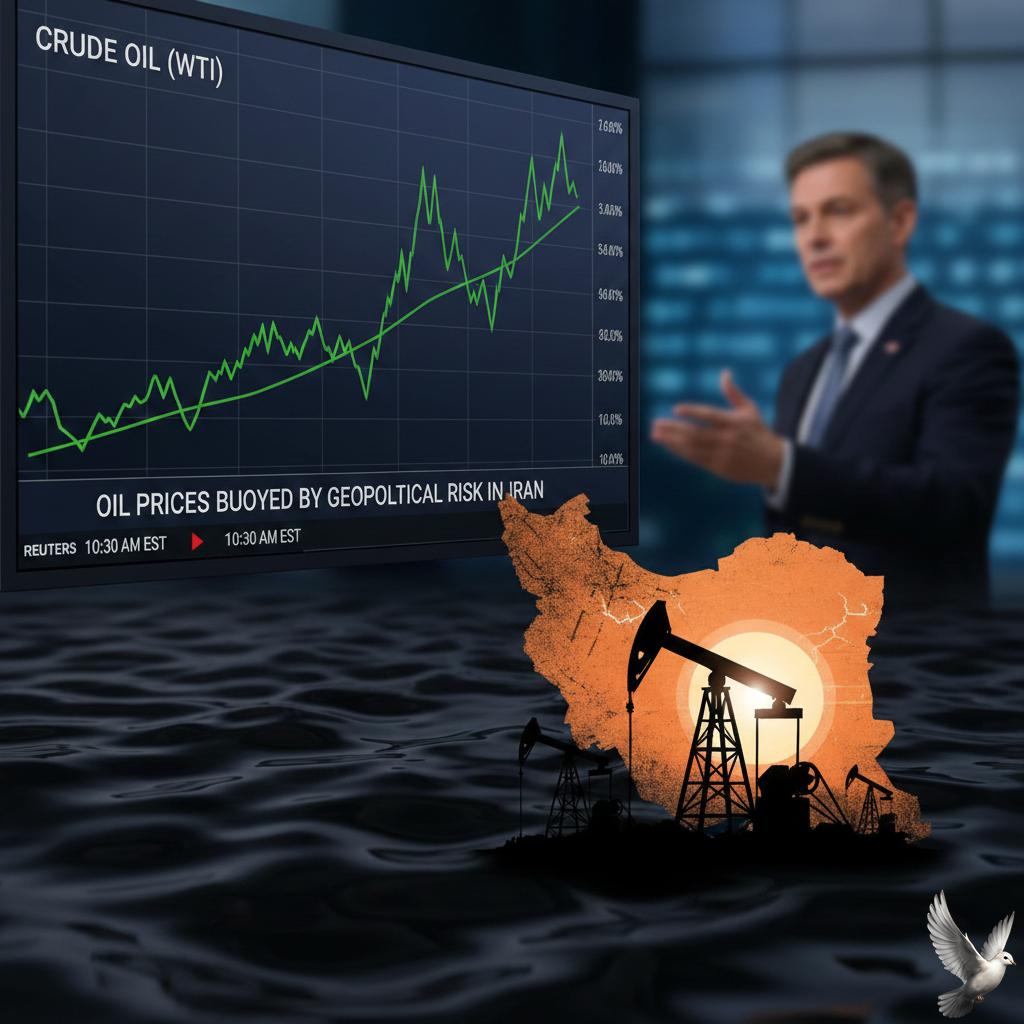
Oil Prices Buoyed by Geopolitical Risk in Iran
**CRUDE RALLY EXTENDS AS IRAN TENSIONS ECLIPSE SUPPLY CONCERNS**
Global oil prices surged, extending a strong upward trend into the new week. The market is overwhelmingly focused on escalating geopolitical risk in the Middle East, a factor that is currently overshadowing structural supply concerns.
Both major benchmarks recorded substantial gains on Friday, capping a **fifth consecutive week** of rising prices. Brent crude futures moved sharply, settling near **$65.88** per barrel. West Texas Intermediate (WTI) followed suit, pushing back above the **$61** mark, last trading around **$60.90** per barrel.
The immediate catalyst for the upward pressure is the rapid escalation of rhetoric and military positioning between the United States and Iran. Geopolitical risk premiums increased sharply after the US deployed a naval carrier strike group toward the region.
This military presence was coupled with renewed political pressure from US President Donald Trump, who revived threats directed at Tehran and announced new sanctions targeting Iranian oil transport vessels.
Iran remains a critical supply factor, ranking as OPEC’s **fourth-largest producer**. Analysts estimate any sustained disruption to Iran’s output of approximately **3.3 million barrels per day** could trigger an immediate and significant price spike. The crucial **Strait of Hormuz**—through which roughly **20%** of global petroleum liquids transit—remains the market’s core chokepoint vulnerability.
Adding to the supply-side stress are fresh, severe disruptions in Eurasian production. While initial reports suggested that Kazakhstan's main export pipeline was resuming operations, new supply shocks from the region are keeping the market tight.
Ongoing outages in Kazakhstan, including a recent fire at the crucial Tengiz oilfield, have severely constrained output. The country’s production is estimated to average only **1 to 1.1 million barrels per day** this month, significantly below its typical rate of **1.8 million barrels per day**.
This production loss, estimated at up to **900,000 barrels per day**, reinforces supply anxieties, effectively nullifying any positive market sentiment from isolated pipeline repair progress.
Looking beyond immediate headlines, the market structure still presents a fundamental headwind to sustained high prices. Despite the geopolitical noise, the overall supply picture is one of looming surplus.
The International Energy Agency (IEA) continues to project a substantial global **supply surplus** for the year ahead, expecting global stockpiles to swell by **3.7 million barrels per day**.
This structural overhang is supported by record output from North America. US crude production forecasts have been revised upward, expected to reach a record **13.59 million barrels per day**. The US Energy Information Administration (EIA) recently reported a build in national crude inventories of **3.6 million barrels**, exceeding consensus expectations.
However, two secondary factors are currently providing additional buoyancy. The US Dollar recently recorded its weakest performance in seven months. A depreciating dollar makes dollar-denominated crude cheaper for international buyers, boosting physical demand.
Secondly, a severe winter storm across the United States is spiking demand for refined products. This cold snap is driving up prices for heating oil and diesel, supporting the entire petroleum complex.
In summary, the oil market remains a battleground where high-stakes geopolitical tension is consistently overpowering bearish structural signals like record US supply and the looming global inventory surplus. Prices will continue to trade on headline risk as long as the US-Iran situation remains unresolved.