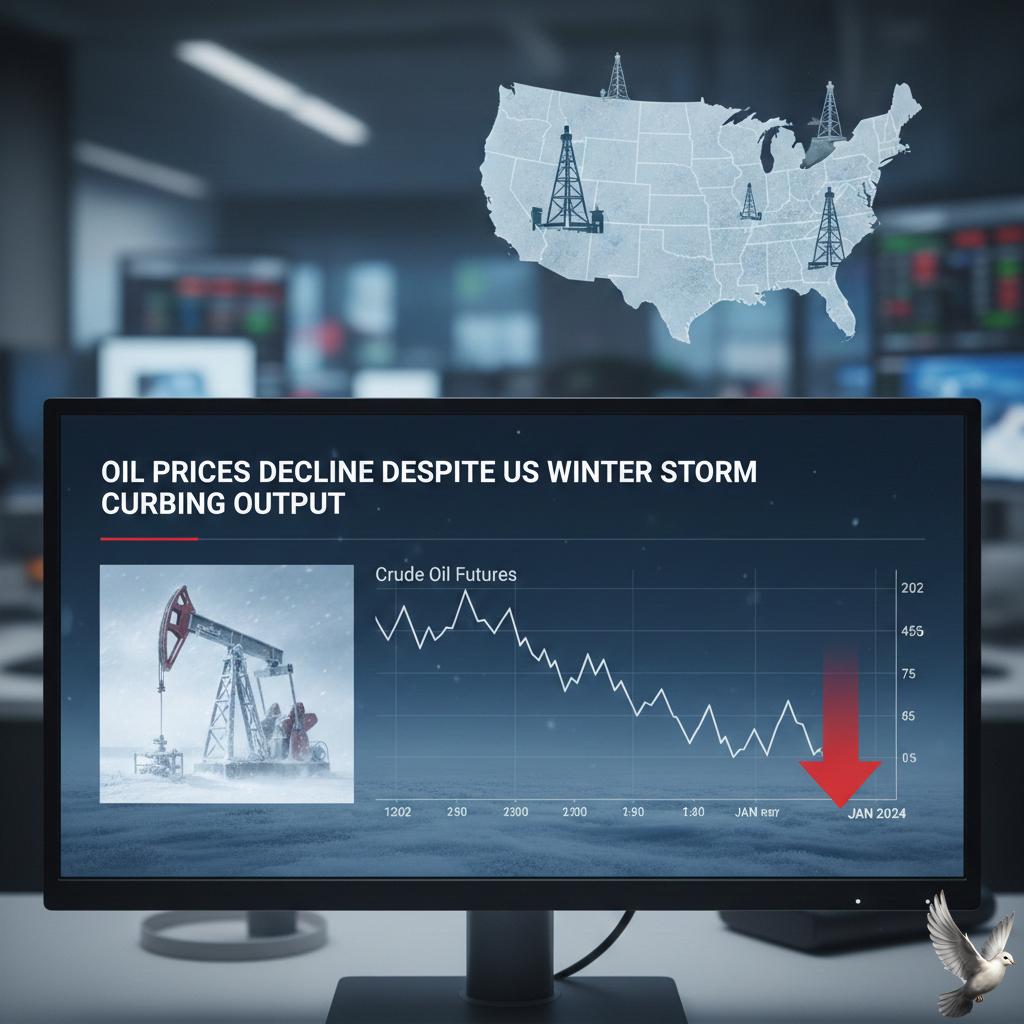
Oil Prices Decline Despite US Winter Storm Curbing Output
Oil Market Briefing: Geopolitical Premium Vs. Supply Surplus
The crude oil market is currently defined by a **precarious equilibrium**, with geopolitical risks providing a firm floor under prices while fundamental oversupply pressures exert a consistent downward pull.
Benchmark futures are trading in a narrow, volatile range. **Brent Crude** hovers near the **$65.70 per barrel** mark, while **West Texas Intermediate (WTI)** sits slightly below **$60.80 per barrel**. This dynamic reflects a struggle between immediate supply fears and a long-term bearish outlook driven by surging global production.
The initial dip in prices, even as a massive **winter storm** severely hampered U.S. energy infrastructure, underscores the market’s resilience to short-term disruptions. Freezing conditions across the Gulf Coast caused major refineries to curtail operations and shut in significant crude output. Analysts estimated the production loss reached as high as **2 million barrels per day** over the peak weekend, roughly **15%** of national output. Yet, prices remained largely subdued, suggesting traders view the weather event as transient against a backdrop of bloated global inventories.
***
Geopolitical Risk and the Supply Threat
Geopolitical tension remains the primary bullish catalyst, injecting a tangible risk premium into crude pricing. The deployment of a **U.S. aircraft carrier** and supporting naval assets to the Middle East confirms the elevated state of readiness in the region, focusing market anxiety on potential disruption to vital shipping lanes, particularly through the Strait of Hormuz.
This military build-up occurs alongside specific supply threats. **Iranian** oil exports have already dropped to approximately **1.6 million barrels per day** in recent months due to intensified pressure and sanctions. Separately, **Venezuelan** crude exports have slumped dramatically, falling to only around **300 thousand barrels per day** in early January following stricter U.S. measures against sanctioned tankers. These cumulative geopolitical impacts act as a continuous check on price declines.
***
OPEC+ Policy and Global Output Expansion
Attention is squarely focused on the upcoming **OPEC+** meeting, where the group is widely expected to formally **maintain its pause** on oil output increases for the month of March. This policy is a continuation of the alliance’s tactical effort to stabilize the market. The voluntary adjustments from eight key members, totaling **1.65 million barrels per day**, are critical to counteracting the current supply glut.
Despite these collective production restraints, the fundamental balance remains in flux due to relentless supply expansion outside the alliance. The **International Energy Agency (IEA)** projects that global oil supply will rise by a substantial **2.5 million barrels per day** in 2026, with non-OPEC+ countries driving the majority of this growth.
This expansion is heavily led by the **Americas quintet**—the United States, Canada, Brazil, Guyana, and Argentina. The U.S. shale patch, in particular, has proven highly resilient, maintaining production near record highs and acting as the global swing producer. This robust non-OPEC+ output, combined with the large volumes of oil accumulated in global storage tanks and at sea over the past year, provides a considerable **cushion** against almost any short-term supply outage, explaining why a major weather event failed to trigger a sustained price rally.
Ultimately, the crude market is navigating two competing forces: the immediate fear of geopolitical supply loss which supports prices, versus the structural reality of rising output and expanding global inventories that limit upward movement. This tension suggests continued **sideways volatility** is likely in the near term.