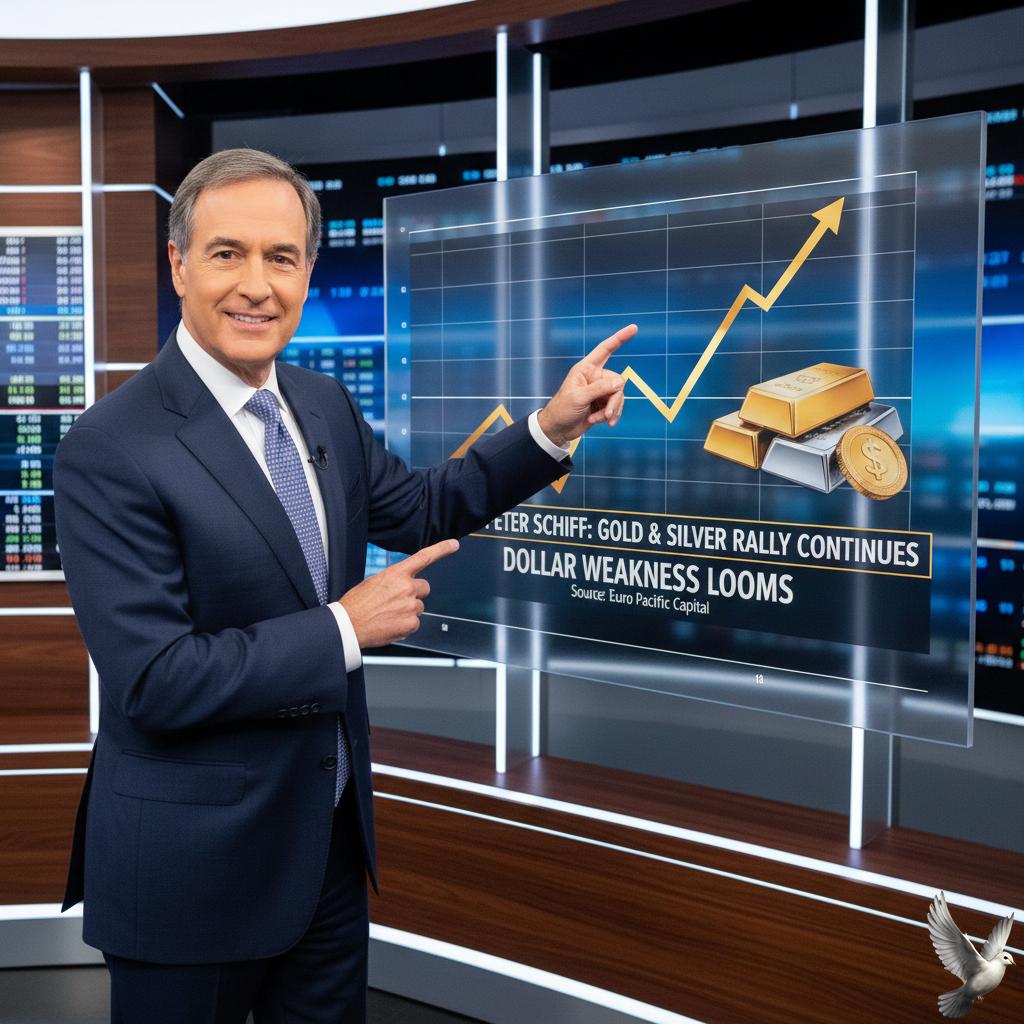
**Peter Schiff Projects Continued Gold and Silver Rally Amid Potential Dollar Weakness**
The precious metals market is currently navigating a period of intense volatility as global monetary trends shift. Gold has recently established a new high-water mark, briefly scaling a record **$5,594** per ounce on January 29, 2026, before entering a corrective phase. As of February 10, 2026, spot gold is trading near **$5,016** per ounce, while silver has seen sharper swings, recently moving back above **$80** per ounce after a significant pullback from its peaks.
Investor Peter Schiff maintains a staunchly bullish outlook, suggesting these metals are far from their ultimate ceilings. Schiff argues that gold is not merely a commodity but a direct reflection of a collapsing currency system. He projects that gold could eventually soar toward **$6,000** in the near term and even reach **$100,000** in the event of a full-scale monetary reset. His thesis rests on the erosion of the U.S. dollar's purchasing power, driven by a national debt that has surpassed **$35 trillion**.
The U.S. Dollar Index (DXY) has faced recent pressure, losing more than **1%** in early February to hold below the **97** level. This weakness is compounded by rising fiscal concerns and a gradual loss of confidence in central bank independence. Reports indicate that global institutions are actively diversifying away from dollar-denominated assets. For instance, Chinese regulators recently advised financial institutions to limit holdings of U.S. Treasuries to mitigate policy risks.
Central banks continue to be a primary pillar of support for the gold market. In February alone, global central bank reserves rose by **24 tonnes**. The National Bank of Poland led this trend, marking its 11th consecutive month of net buying by adding **29 tonnes** to its holdings. Other nations, including China, Turkey, and India, remain consistent accumulators, viewing gold as the essential reserve asset to replace a weakening dollar.
Silver remains a more volatile play, influenced heavily by speculative activity and industrial demand. While it remains roughly **60%** cheaper than gold on a relative historical basis, it has faced selling pressure following a surge that many analysts believe moved ahead of its fundamental value. Current market sentiment is also closely tied to the shifting leadership at the Federal Reserve, with the nomination of Kevin Warsh being viewed by some as a potential pivot toward a more hawkish, inflation-focused policy.
Despite short-term price corrections, the underlying structural drivers remain intact. Rising interest on national debt, persistent inflation, and the "de-dollarization" of global reserves continue to push investors toward hard assets. While tactical rallies and profit-taking may cause near-term dips, the broader trend signals a strategic shift in global capital allocation toward precious metals as the ultimate hedge against fiscal instability.
[Peter Schiff: The Gold and Silver Price Forecast](https://www.youtube.com/watch?v=43aDC6KA_Qs)
This video provides an in-depth look at Peter Schiff's specific price targets and his reasoning behind the predicted surge in gold and silver values.
http://googleusercontent.com/youtube_content/0