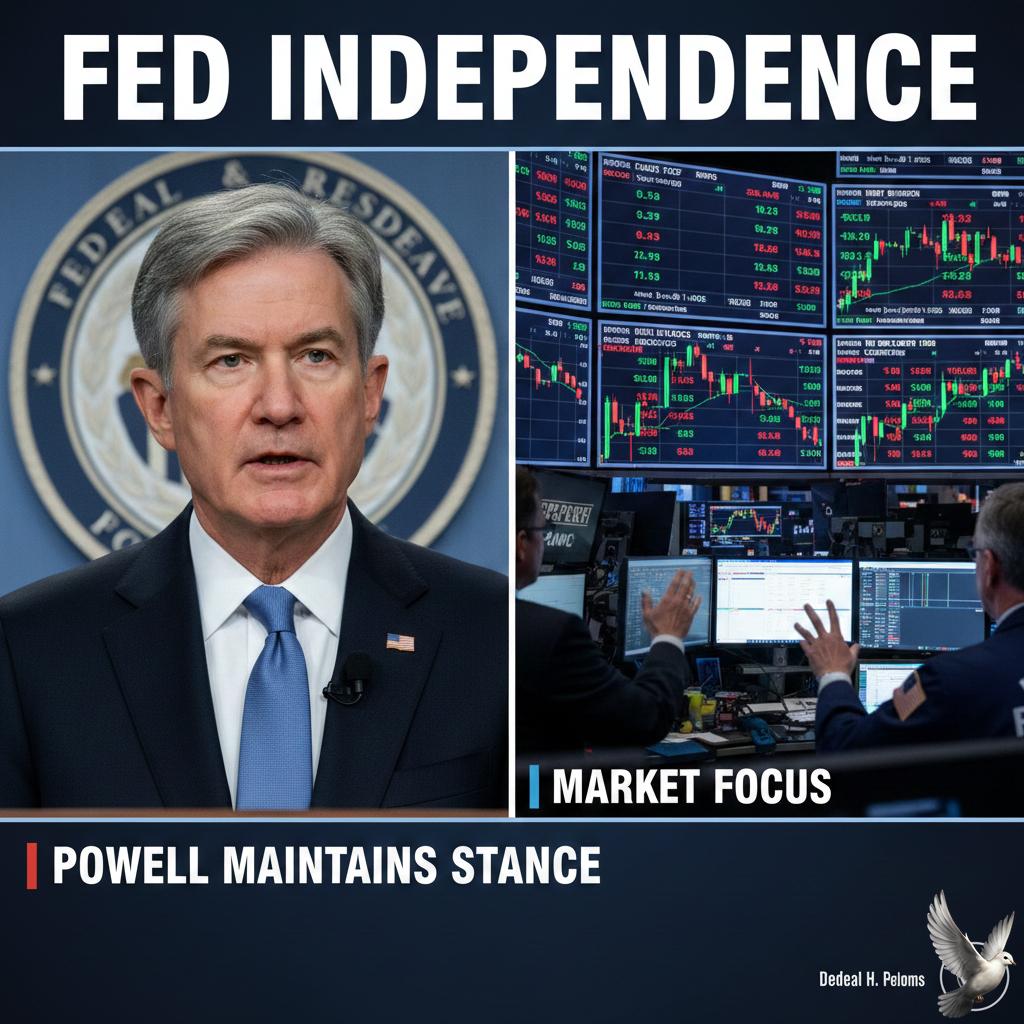
Powell Maintains Stance Amid Market Focus on Fed Independence
The Federal Reserve's most recent policy meeting has amplified market fears regarding the central bank's strained independence, set against the immediate backdrop of a looming leadership change.
Fed Chair Jerome Powell, whose term as chair concludes in **May 2026**, defiantly held the line against unprecedented White House interference following the FOMC meeting this week.
The committee voted to hold the benchmark Federal Funds Rate steady in the range of **3.5% to 3.75%**, pausing a rate-cutting cycle that began late last year.
This decision was made despite relentless political pressure demanding further rate cuts, leading President Donald Trump to renew his verbal attacks on Powell.
***
The political tensions are peaking as President Trump prepares to announce his nominee for the next Fed Chair as early as next week.
The market views this nomination process as a critical test of future monetary policy autonomy. The key concern is the selection of a candidate inclined toward aggressive, politically motivated easing.
Leading contenders include former Fed Governor **Kevin Warsh**, viewed by some as potentially more hawkish, and current Governor **Christopher Waller**, who along with one other member, dissented at the recent meeting, favoring an immediate **25 basis point** rate cut.
The outgoing Chair warned the independence of the Fed is paramount, cautioning that policy must be set by economic evidence, not political preference, a crucial statement underscored by the President's personal attacks and the shadow of an ongoing criminal investigation related to the central bank's operations.
***
The fixed income market is reacting to this uncertainty with increased caution.
The yield on the benchmark **10-Year US Treasury Note** has risen significantly, recently trading around **4.27%**. This upward trend pushes yields near a five-month high, fueled by speculation that the next chair might pursue policies that exacerbate fiscal risks, or by broader concerns over the US government’s growing deficit.
However, a key measure of bond market volatility, the MOVE Index, suggests that while nervous, the fixed income sector is **not** yet signalling a full-blown crisis of confidence in the Fed's long-term institutional structure.
***
Currency markets show distinct pressure. The **US Dollar Index (DXY)** has weakened, trading recently around **96.14**, near multi-month lows.
This softening reflects market expectations that, regardless of the current pause, the Fed's easing cycle will resume in 2026. Policy divergence, with other central banks remaining comparatively tighter, is capping the dollar's ability to sustain any meaningful rally.
Meanwhile, the equity market performance remains mixed, navigating corporate earnings results and policy uncertainty. The **S&P 500 Index** closed near **6,969.01** this week.
The index absorbed a sharp drop in key technology stocks due to investor fears over heavy capital expenditure for artificial intelligence and slightly disappointing growth forecasts.
***
Underneath the market volatility, the economic picture is complicated.
Inflation continues to moderate, with the December Consumer Price Index (CPI) showing a year-over-year increase of **2.7%**, edging closer to the Fed's **2%** target.
The labor market remains resilient, yet the Federal Reserve emphasized that the current rate range of **3.5% to 3.75%** is not perceived as significantly restrictive given the solid underlying economic activity. This suggests the central bank is positioned to wait for more conclusive data before committing to the next policy step, a posture likely to be severely tested once a new political appointee is confirmed.