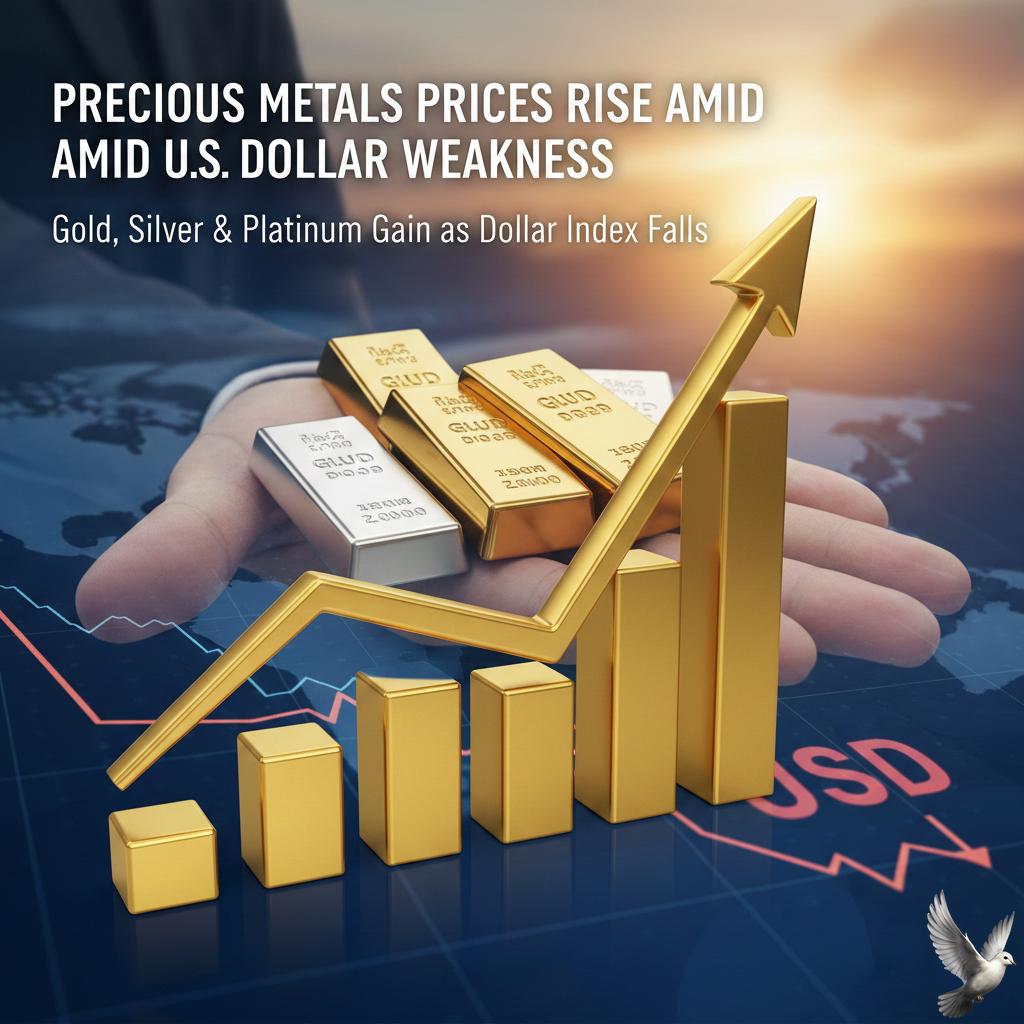
Precious Metals Prices Rise Amid U.S. Dollar Weakness
The global financial landscape is shifting as a softening U.S. dollar breathes new life into the precious metals sector. Early February 2026 trading shows gold and silver reclaiming ground after a period of intense volatility. International gold prices are currently navigating a broad range between $2,100 and $2,300 per ounce, while silver holds a steady recovery near $28 to $30 per ounce.
In regional markets, the impact of currency fluctuations is even more pronounced. In India, retail 24-karat gold has stabilized at approximately 156,600 INR per 10 grams. Silver has shown a resilient rebound to 285,000 INR per kilogram. These levels follow a significant corrective phase, where metals faced pressure from a briefly resurgent dollar following the nomination of a more hawkish future Federal Reserve leadership.
The U.S. Dollar Index (DXY) is currently testing the 97.50 to 98.00 range. While the dollar saw a temporary boost from geopolitical tensions and leadership changes at the Fed, it is now showing signs of stalling. Recent labor data previews have indicated unexpected weakness, fueling expectations that the currency may continue its gradual downward trend through the remainder of the first quarter.
Investor focus has shifted entirely to the upcoming U.S. Non-Farm Payrolls report. This labor market data is critical for determining the Federal Reserve’s interest rate trajectory for 2026. Current market sentiment suggests a "low-hire, low-fire" environment, which may force the Fed to maintain steady rates at 5.25% unless a significant deterioration in employment becomes evident.
Asian equity markets have mirrored this cautious optimism. While technology stocks have faced pressure from high valuations and rising capital expenditure forecasts, mining and energy sectors have rallied. Japan’s Nikkei 225 recently saw a surge of nearly 3%, while markets in South Korea and Australia have posted strong gains, buoyed by de-escalating international tensions and new trade agreements.
The broader outlook for the month suggests continued two-way volatility. Precious metals are increasingly viewed as a necessary hedge against high global debt and inflationary pressures. Silver, in particular, is gaining traction due to a structural supply deficit and rising industrial demand from the clean energy sector, which now accounts for over 15% of its global consumption.
As the week progresses, the interplay between a weakening dollar and the resilience of the U.S. labor market will remain the primary driver for global asset classes. Markets are currently pricing in a high probability of a rate hold in the near term, keeping the window open for further gains in the bullion market if the dollar’s retreat continues.