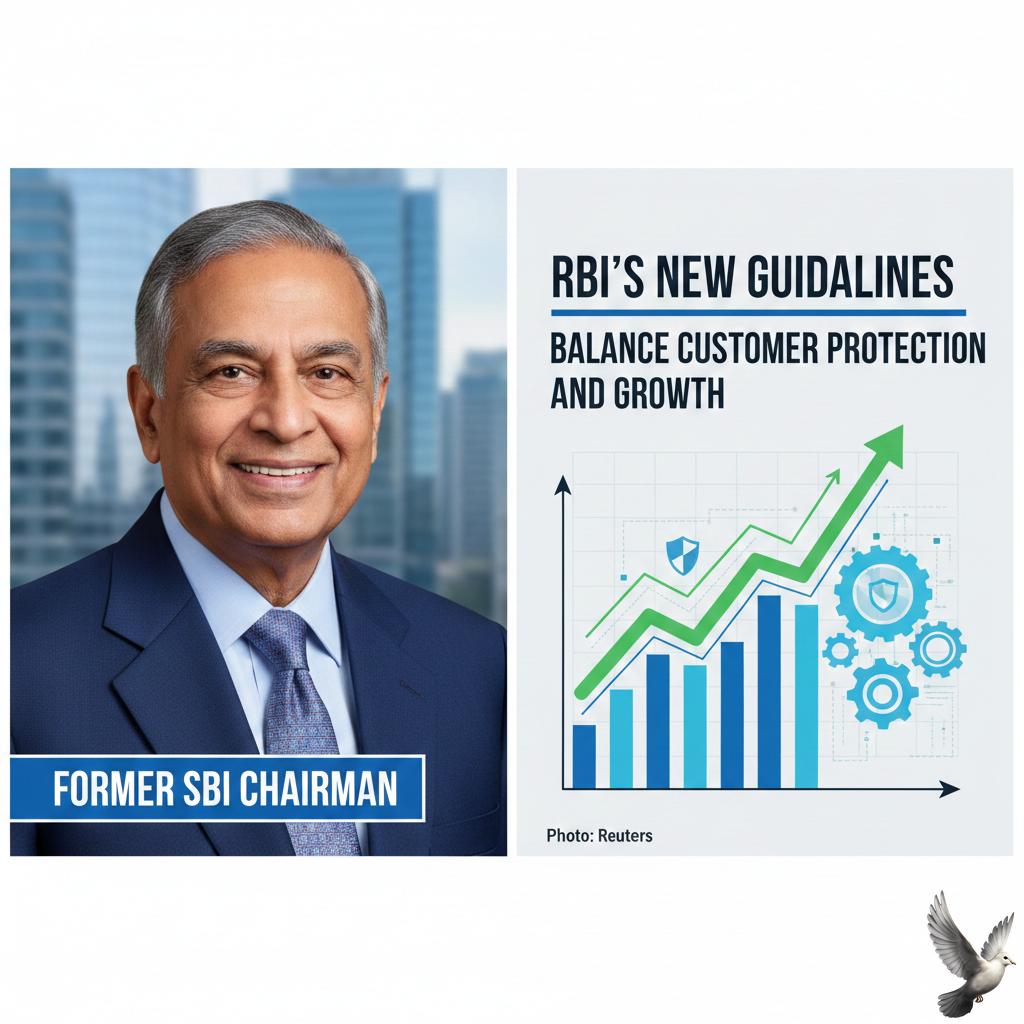
**RBI’s New Guidelines Balance Customer Protection and Growth, Says Former SBI Chairman**
**Market Brief: Banking Sector Overhaul & Regulatory Shift**
**Date:** February 17, 2026
**Focus:** RBI Regulations, Acquisition Finance, & Market Intermediaries
A significant regulatory pivot by the Reserve Bank of India (RBI) is set to reshape the domestic banking landscape effective **April 1, 2026**. The central bank has introduced stringent frameworks targeting mis-selling, acquisition financing, and lending to capital market intermediaries.
**1. Crackdown on Mis-selling & Customer Protection** The RBI has issued draft directions on the *Advertising, Marketing, and Sales of Financial Products*. The core objective is to eliminate "dark patterns" and forced bundling—such as making loan approvals contingent on buying insurance.
* **100% Refund:** Banks must now refund the entire amount plus compensation if mis-selling is proven.
* **Suitability Checks:** Strict profiling is mandatory to ensure products match the customer’s risk appetite and financial literacy.
* **Feedback Loop:** A mandatory **30-day** feedback mechanism post-sale has been introduced to verify customer consent and understanding.
**Context:** The regulator imposed approximately **₹27 crore** in penalties on banks in CY2025 alone, signaling zero tolerance for compliance lapses.
**2. Boost for M&A Financing** In a major structural shift, the RBI’s *Capital Market Exposure Directions* now permit domestic banks to aggressively fund corporate takeovers, a space previously dominated by foreign lenders.
* **75% Funding:** Banks can now finance up to **75%** of the acquisition value for eligible borrowers.
* **Eligibility Floor:** Borrowers must have a minimum net worth of **₹500 crore** and a **3-year** profit track record.
* **Unlisted Access:** Even unlisted companies can access this funding if they hold an investment-grade rating.
Former SBI Chairman **Dinesh Kumar Khara** describes this as a "pragmatic" move that retains deal financing within the Indian banking system while ensuring adequate leverage safeguards.
**3. Tightening Broker & Intermediary Lending** To curb speculative volatility, the RBI has tightened norms for lending to stockbrokers and market intermediaries.
* **100% Collateral:** All credit facilities to intermediaries must now be fully secured; unsecured lines are effectively banned.
* **Cash Trap:** For bank guarantees, brokers must provide **50%** collateral, of which **25%** must be strictly in cash.
* **Prop Trading Ban:** Banks are explicitly prohibited from financing a broker's proprietary trading positions.
**Market Impact:** While this raises the cost of funds for brokers and may squeeze short-term liquidity, experts view it as a necessary step to reduce systemic risk and promote long-term market stability.
**Why this matters:** This video features Dinesh Kumar Khara explaining the rationale behind these specific regulatory changes, offering a deeper understanding of how they balance customer protection with banking sector growth.
[Dinesh Kumar Khara on RBI's new guidelines](https://www.youtube.com/watch?v=FvVXVYNxNeo)
http://googleusercontent.com/youtube_content/0