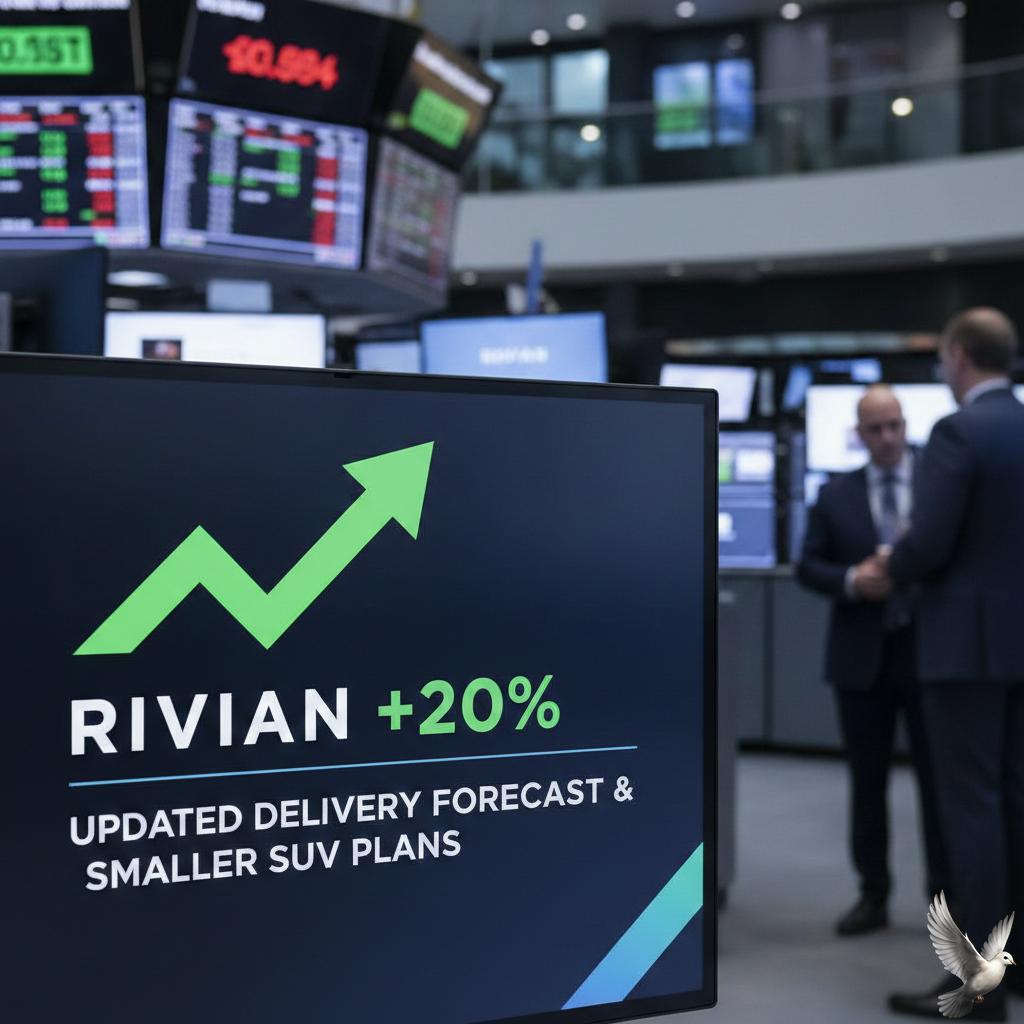
Rivian Shares Rise 20% Following Updated Delivery Forecast and Smaller SUV Plans
Rivian shares surged 20.07% on Friday, February 13, 2026, reaching approximately $16.85. The rally was fueled by the company’s optimistic outlook for 2026, centered on its pivot toward more affordable mass-market electric vehicles.
The automaker reported its first-ever full year of positive gross profit in 2025, a significant $144 million milestone that marks a $1.3 billion improvement over the previous year. This shift toward profitability comes as the company successfully reduced production costs and grew its high-margin software and services revenue, which surged 222% year-over-year to $1.56 billion.
Investors are primarily focused on the upcoming R2 SUV, which is positioned as a direct competitor to the Tesla Model Y. Priced at approximately $45,000, the R2 is expected to begin customer deliveries in the second quarter of 2026. Management projects that this new model will drive a 53% jump in total deliveries for the year.
Projected delivery figures for 2026 are set between 62,000 and 67,000 vehicles. While production of the flagship R1T and R1S models is expected to remain flat, the R2 is expected to represent nearly half of the total volume. Rivian plans to scale this production by adding a second shift at its Illinois plant by late 2026, targeting a rate of 4,000 units per week.
The strategic push toward affordability is a direct response to a challenging market environment. The expiry of federal EV tax credits last year has pressured sales across the industry, forcing manufacturers to lower entry prices to attract a broader buyer base.
Despite the positive momentum, 2026 is being framed as a transitional year. The company expects an adjusted EBITDA loss between $1.8 billion and $2.1 billion as it absorbs the high capital costs of launching the R2 platform. Capital expenditures are projected to double this year, reaching roughly $2 billion.
Liquidity remains a key strength for the company. Rivian ended 2025 with $6.59 billion in total liquidity, including $6.1 billion in cash and short-term investments. This provides a necessary cushion as the company builds its second factory in Georgia and continues its software joint venture with Volkswagen.
Market analysts remain divided on the near-term outlook. Some firms have set price targets as high as $25, citing the success of the R1S as the best-selling premium electric SUV in several U.S. states. Others remain cautious, pointing to the intensive capital requirements and the risk of production hurdles during the R2 ramp-up.
The broader sector is watching closely as Rivian attempts to transform from a luxury niche brand into a high-volume player. The success of this transition hinges on the R2's ability to maintain the brand's premium appeal while meeting the price expectations of the mass market.