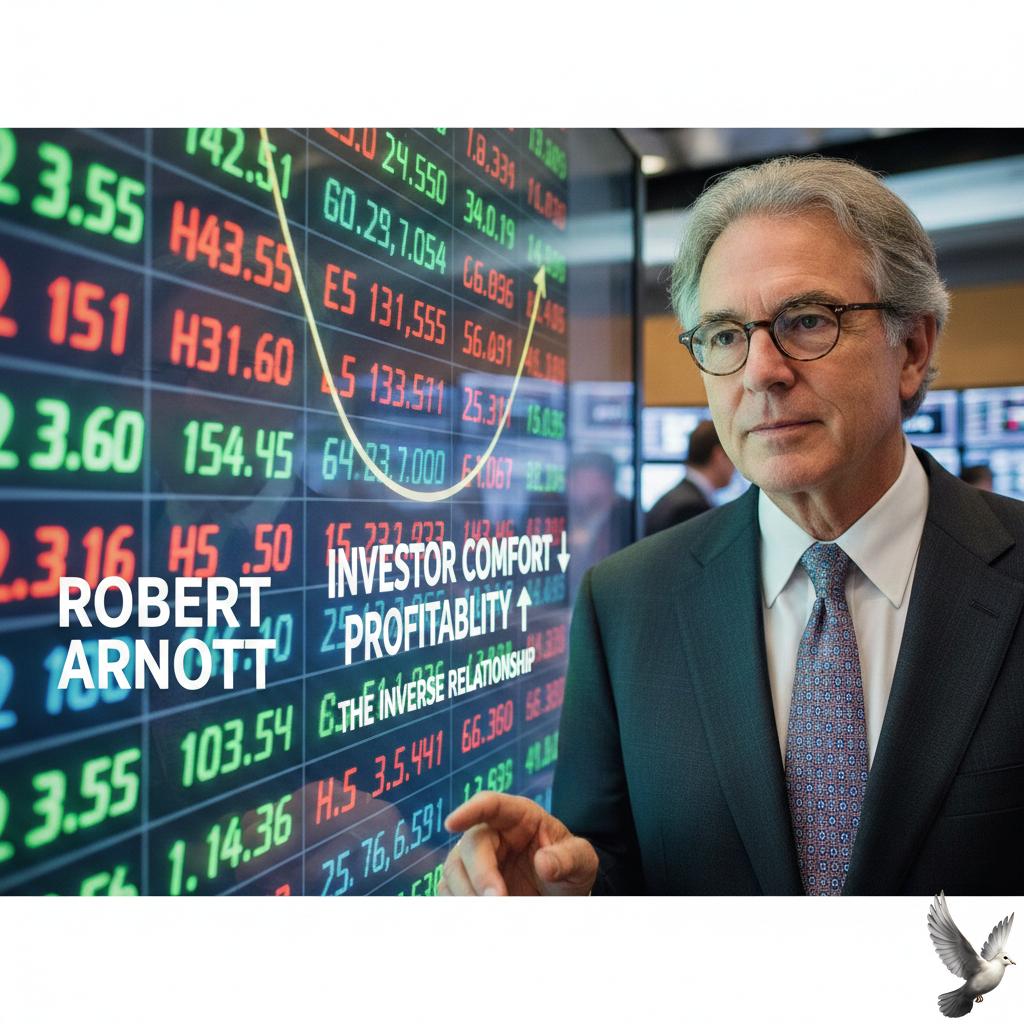
Robert Arnott on the Inverse Relationship Between Investor Comfort and Profitability
Market Brief: Contrarian Strategy in a High-Value Era
Real investment opportunity often thrives in the gap between market noise and fundamental data. As of February 2026, the S&P 500 is trading at a forward P/E ratio of **21.5**, significantly higher than the 10-year average of **18.8**. This suggests a landscape where optimism is high, making the search for value increasingly complex.
Navigating this environment requires looking beyond comfort zones. While the broader indices remain resilient, sector performance reveals deep fragmentation. Software stocks, for instance, have plummeted **20%** year-to-date, hit by skepticism over the immediate returns of certain technology cycles. For the disciplined investor, such pessimistic sentiment often marks a potential entry point where valuations finally align with long-term reality.
Key Performance Indicators
Global markets are currently processing a shift from momentum-driven gains to earnings-driven performance. The S&P 500 closed recently near **6,890**, while in India, the Nifty 50 hovers around **25,482**. Despite these elevated levels, institutional selling has been noted, with foreign investors recording outflows of approximately **638 crore** in specific weekly sessions.
Valuation remains the primary anchor for long-term success. Currently, **18 out of 20** major valuation metrics for the S&P 500 are considered statistically expensive. History shows that in years of double-digit earnings growth—projected at **14.4%** for 2026—multiple compression occurs **66%** of the time. This means stock prices may not rise as quickly as profits, demanding a more selective approach.
Sentiment and Volatility
Volatility, measured by the VIX, remains stable yet sensitive at around **13.5 to 14.4**. This range indicates a "low-hiring, low-firing" economic backdrop, where the U.S. Federal Reserve maintains rates between **3.5% and 3.75%**. In India, the RBI has signaled a prolonged pause on rates, keeping the repo rate steady while inflation is projected to settle near **2.1%** for the fiscal year.
True profitability involves acting on these hard figures rather than popular narratives. While the "crowd" focuses on the next growth surge, contrarian opportunities are emerging in undervalued segments like European banks, which have seen massive gains over a five-year horizon, or the resurgence of metal and pharma sectors during recent sessions of high volatility.
Successful investing in 2026 is defined by the ability to tolerate the discomfort of a "K-shaped" recovery. While specific megacaps dominate the headlines, the broader market's health is found in the rotation toward mid-sized companies and value-oriented assets. By prioritizing data over sentiment, investors can capitalize on the mispricing that uncertainty inevitably creates.