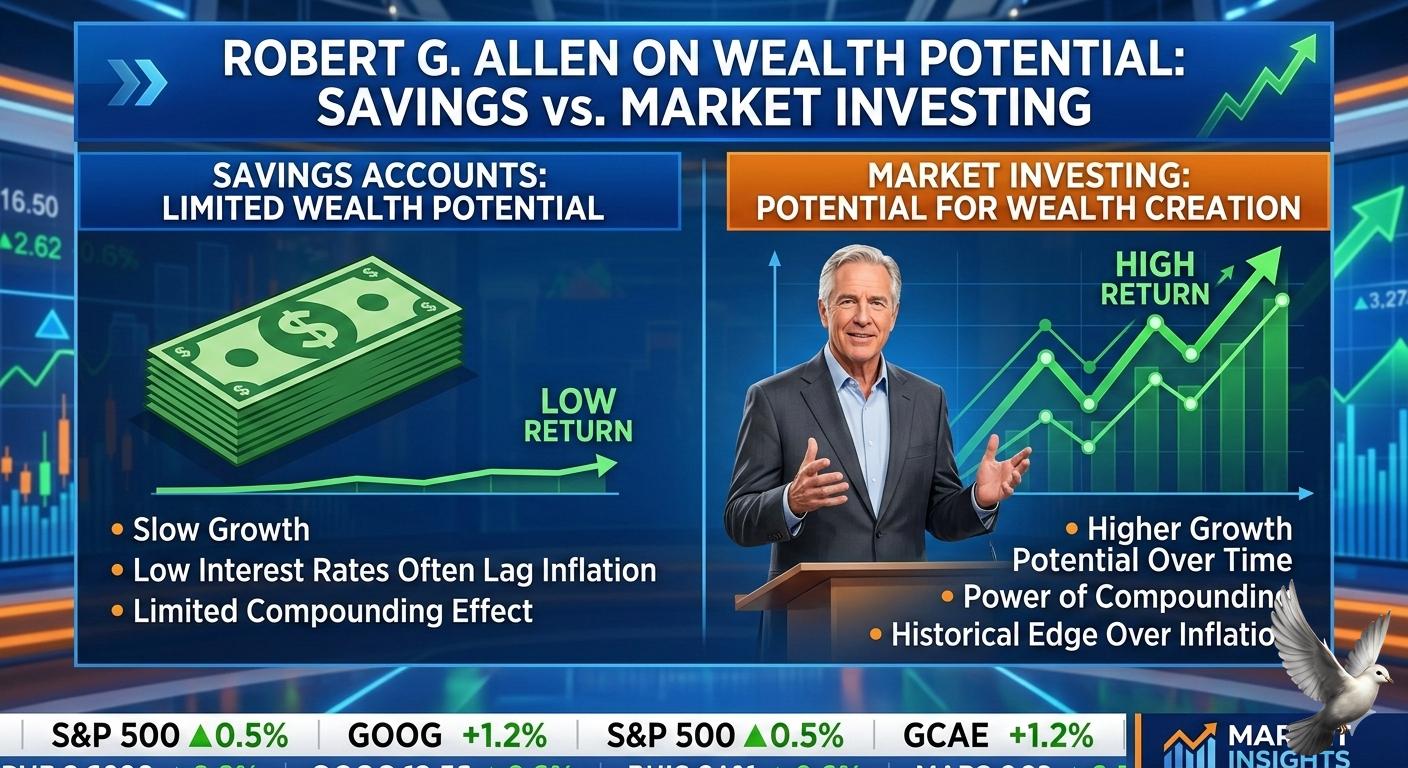
Robert G. Allen on the Limited Wealth Potential of Savings Accounts Compared to Market Investing
Building wealth in 2026 requires a decisive shift from passive saving to strategic investing. While traditional savings accounts offer a sense of security, they currently struggle to protect purchasing power.
As of late February 2026, global core inflation remains stubborn at approximately 2.8%, with U.S. figures projected to hover around 3.2%. In this environment, cash held in standard accounts often yields a negative real return, effectively eroding wealth over time.
Successful wealth creation now centers on assets that historically outpace these inflationary pressures. The S&P 500 continues to serve as a primary engine for growth, with Wall Street analysts forecasting a total return of nearly 12% for the full year 2026. This significantly exceeds the 30-year historical average of 8.1%, driven by strong corporate earnings which saw a 13.6% year-over-year increase in early 2026.
Real estate remains a critical pillar for financial independence. The global market is showing renewed strength as interest rates stabilize. In early 2026, the Bank Rate in major economies like the UK sits at 3.75%, with expectations for gradual easing. Global investment volumes in real estate have rebounded by 19% compared to previous cycles, as investors seek the stability of tangible assets and rental growth, which averaged 6.4% in high-demand sectors recently.
Modern portfolio construction has evolved beyond simple diversification. High-net-worth strategies now frequently incorporate private markets to reduce reliance on public volatility. Approximately 83% of advisors now consider private credit and private equity essential for a resilient portfolio. These alternative assets offer a cushion against the "shock weeks" seen in public markets, where indices can occasionally drop 5% or more due to geopolitical or trade-related events.
The path to financial independence involves embracing calculated risk. Wealth is no longer just preserved; it is engineered through active participation in the global economy. By moving capital from low-yield savings into growth-oriented investments like large-cap equities and commercial real estate, individuals can ensure their fortunes grow faster than the cost of living.
Diversification remains the most effective tool for managing uncertainty. As regional inflation gaps widen between the U.S. and Europe, a global approach to asset allocation helps capture growth while mitigating localized risks. Strategic investors are currently rotating into sectors like energy and industrials, which have shown double-digit leadership in the opening months of the year.
Ultimately, saving preserves what you have, but investing creates what you need for the future. In a market characterized by rapid technological shifts and evolving fiscal policies, the disciplined deployment of capital into productive assets is the only proven method for long-term wealth accumulation.
[Investment vs. Savings: Which is Better?](https://www.youtube.com/watch?v=0_jF7q5N1D8)
This video provides a foundational comparison between saving and investing, illustrating how different asset classes contribute to long-term wealth growth as discussed in the brief.