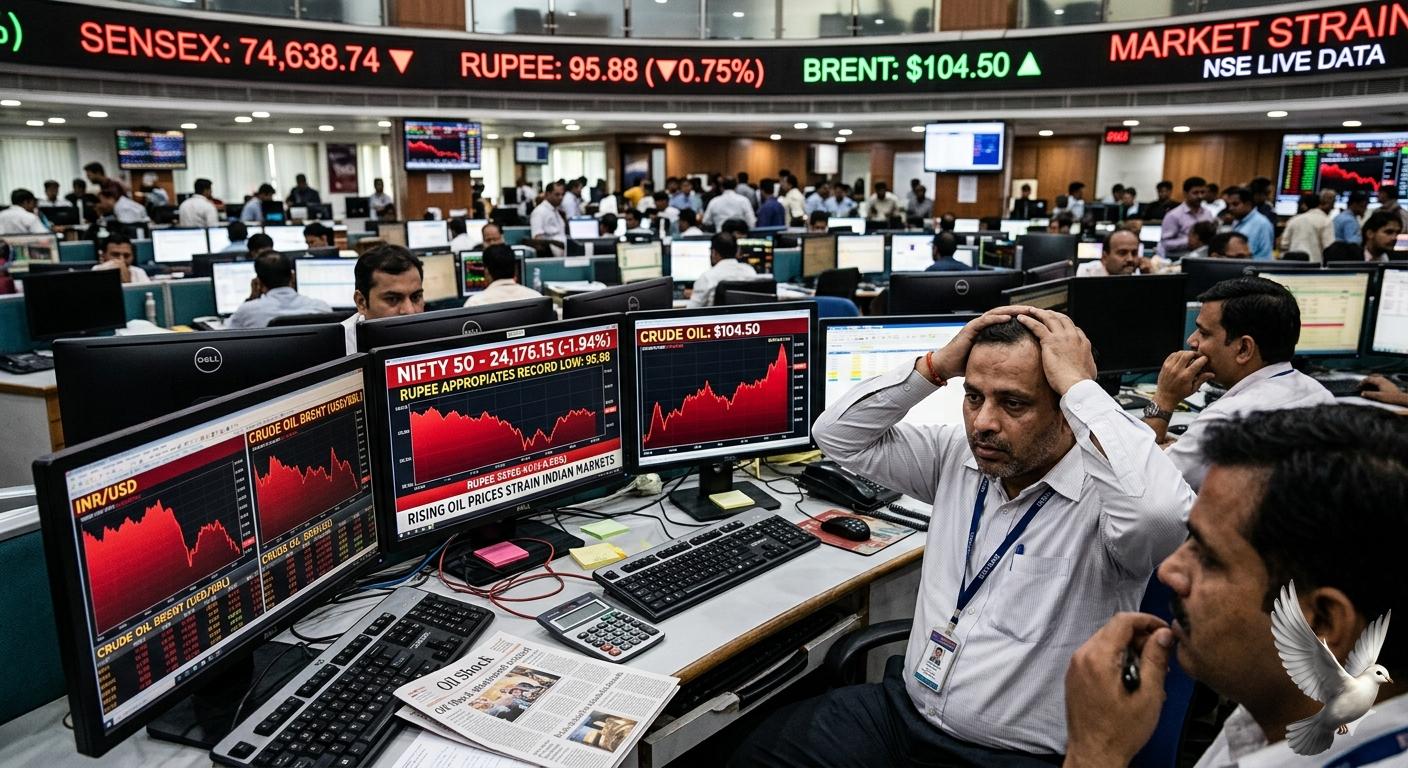
Rupee Approaches Record Low as Rising Oil Prices Strain Indian Markets
The Indian financial ecosystem is managing severe macroeconomic headwinds as geopolitical volatility in West Asia drives a sharp depreciation in the domestic currency. Increased risk aversion and escalating energy import bills have pushed the Indian rupee to historic lows against the US dollar.
The domestic currency recently breached the psychological threshold of **95.00**, touching an all-time intraday low of **95.96** against the US dollar. This move represents a year-to-date decline of more than **6%**, positioning the rupee as the weakest performing major currency in Asia for the year.
A primary driver behind this pressure is the sharp inflation of global energy costs. Brent crude oil futures are trading between **$100 and $110 per barrel**, with the Indian basket averaging **$115 per barrel** in April and hovering near **$106 per barrel** in May. Because India imports approximately **85%** of its crude oil requirements, every **$1** increase per barrel adds an estimated **₹12,000 crore to ₹16,000 crore** to the annual national import bill.
The escalating import bill has rapidly expanded the current account deficit, triggering a surge in corporate dollar demand. In response, authorities have deployed defensive measures to protect foreign exchange reserves and absorb the shock.
The government implemented a sharp tariff adjustment, raising the import duty on gold and silver from **6% to 15%** to curb non-essential dollar outflows. Voluntary demand-side push strategies are also being leveraged, with economic assessments indicating that a modest **10%** reduction in crude imports could preserve up to **$13.4 billion** in foreign exchange reserves.
The Reserve Bank of India has actively intervened in the spot foreign exchange market, utilizing billions of dollars from its **$696.9 billion** foreign exchange reserves buffer to smooth out extreme volatility and prevent an unchecked spiral.
The broader equity markets reflect these underlying macroeconomic strains. Broad-based selling pressure has pushed the benchmark NSE Nifty 50 down to **24,176.15**, while the BSE Sensex trades near **74,638.74**. Foreign institutional investors have intensified capital outflows, offloading equities worth **₹1,959.39 crore** in isolated daily sessions, adding further structural pressure to the equity ecosystem.
Beyond capital flows, the energy shock presents direct challenges to domestic growth and inflation management. Retail inflation rose to **3.48%** in April, while wholesale inflation scaled a three-and-a-half-year high of **8.3%**, driven by escalating transport, food, and energy inputs. Updated economic projections suggest that a sustained crisis could shave up to **0.6%** off India's baseline GDP growth, potentially moderating the expansion rate to **6.3%** for the current fiscal year.