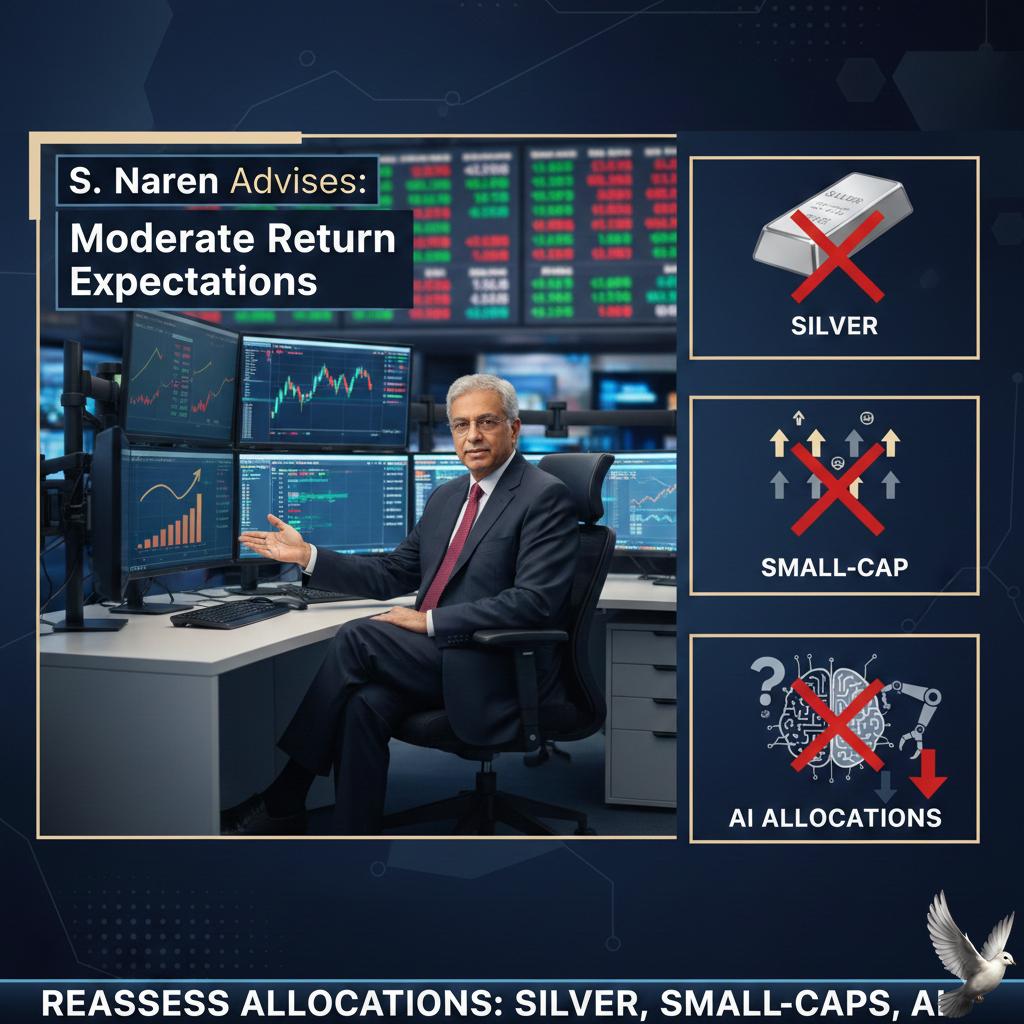
S Naren Advises Investors to Moderate Return Expectations and Reassess Silver, Small-Cap, and AI Allocations
The Indian investment landscape has entered a "boring cycle," a phase defined by market consolidation and the absence of rapid, vertical gains. After a period of high volatility, the Nifty 50 is currently stabilizing around the 25,693 level, while the Sensex maintains a range near 83,580. Market experts, including S Naren of ICICI Prudential AMC, suggest that while the long-term growth story remains intact, investors must now temper their expectations and prepare for moderate, steady returns rather than the explosive growth seen in previous years.
Small-cap and mid-cap segments require particular caution. While the Nifty Smallcap 100 has shown resilience near 13,960, valuations in the broader market remain a concern. The recommendation for 2026 is to maintain current asset allocations but avoid aggressive new bets in overvalued pockets. Patience is the primary strategy for the current year as the market digests recent gains and aligns with macroeconomic fundamentals.
Artificial Intelligence has emerged as a significant structural theme for the Indian economy. While global capital expenditure is currently concentrated in Western technology firms, India is positioning itself as a premier AI user. The domestic AI market is projected to reach approximately 7.8 billion USD, with a massive potential to add 1.7 trillion USD to the economy by 2035. Rather than competing in hardware manufacturing, India's strength lies in applying AI to services, healthcare, and agriculture to drive internal efficiency.
Recent fiscal policy changes are also shaping investor behavior. The hike in the Securities Transaction Tax (STT) on Futures and Options—rising to 0.05% and 0.15% respectively—is viewed as a necessary step for long-term market health. This measure aims to curb excessive retail speculation in the derivatives segment, which has seen a surge in risky, short-term trading. By disincentivizing high-frequency speculation, the policy encourages a shift toward stable, long-term capital formation.
In the commodities space, a clear divergence has appeared between gold and silver. Silver has experienced extreme price swings, recently trading near 2,85,000 INR per kg but showing signs of technical exhaustion. In contrast, gold remains the preferred stable hedge. Despite a correction from its January peak of 1,78,850 INR, gold prices are holding steady around 1,56,660 INR per 10 grams. Investors are advised to view gold as a safer store of value during this consolidation phase, while remaining wary of the high volatility inherent in silver.
Overall, the 2026 outlook favors a balanced approach. With the RBI maintaining the repo rate at 5.25% and a neutral policy stance, the focus shifts to internal earnings growth and disciplined asset allocation. This "boring" phase is not a signal to exit, but a reminder to prioritize risk management over short-term momentum.
[Indian Market Trends 2026](https://www.youtube.com/watch?v=la83cX31BBc)
This video provides a detailed breakdown of how to navigate the 2026 market cycles and effectively manage asset allocation during periods of moderate returns.
http://googleusercontent.com/youtube_content/0