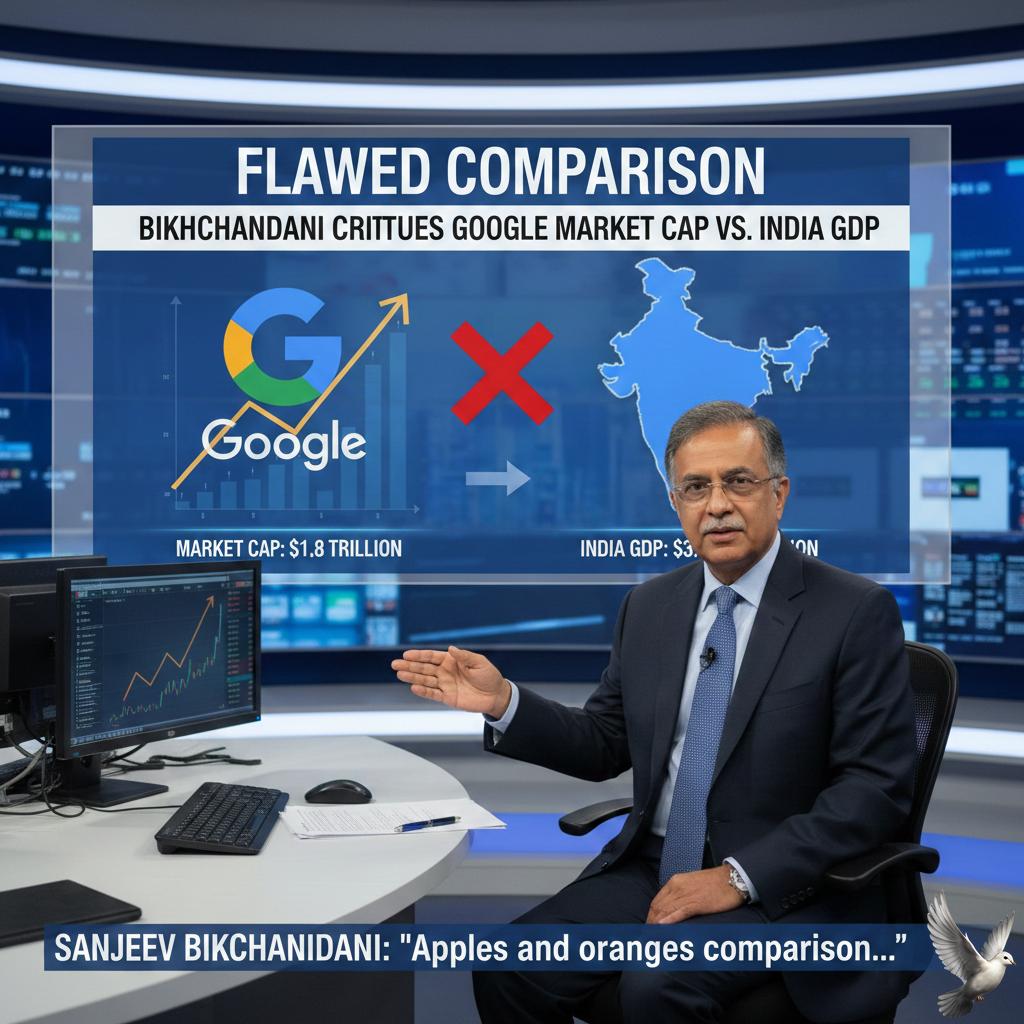
**Sanjeev Bikhchandani Critiques Flawed Comparison of Google Market Cap to India GDP**
Market Brief: Valuation vs. Real Economic Output
A viral claim comparing the market capitalization of Alphabet (Google’s parent company) to India’s Gross Domestic Product (GDP) has sparked a debate on the correct metrics for measuring economic scale. Tech entrepreneur Sanjeev Bikhchandani recently debunked the comparison, labeling it a fundamental misunderstanding of "stock" versus "flow" variables.
The Misalignment of Metrics
Market capitalization represents the total market value of a company's outstanding shares. It is a **stock variable** reflecting future expectations of profit. In contrast, GDP measures the total value of goods and services produced within a country over a specific period—typically one year. It is a **flow variable** reflecting actual economic activity.
India’s Economic Standing in 2026
As of February 2026, India’s nominal GDP is estimated at approximately **$4.51 trillion**. The Indian economy continues to be the fastest-growing major economy globally, with a projected growth rate of **7.4%** for the 2026 fiscal year. This growth is largely driven by a surge in manufacturing and robust private consumption, which now accounts for **61.5%** of the GDP.
Alphabet’s Financial Scale
Alphabet’s current market capitalization fluctuates around **$3.70 trillion**. While this figure appears close to India’s GDP, the actual "size" of the company’s business operations is better reflected in its revenue. In 2025, Alphabet’s annual revenue surpassed the **$400 billion** milestone for the first time, reaching **$402.84 billion**.
Key Data Points
* **India GDP (2026 Est):** $4.51 trillion
* **India GDP Growth:** 7.4%
* **Alphabet Market Cap:** ~$3.70 trillion
* **Alphabet Annual Revenue:** $402.84 billion
* **Alphabet AI Infrastructure Spend (2026):** Up to $185 billion
Deepening Integration
Despite the flawed valuation comparison, the tech giant’s influence in India is expanding through physical and digital infrastructure. Alphabet recently announced a **$15 billion** investment over five years to establish an AI infrastructure hub in southern India.
Furthermore, the new "US-India Connect" initiative involves deploying subsea fiber-optic routes to enhance connectivity. These investments align with India’s push for "open-source AI," a strategy aimed at democratizing technology access for its **1.4 billion** citizens while maintaining digital sovereignty.