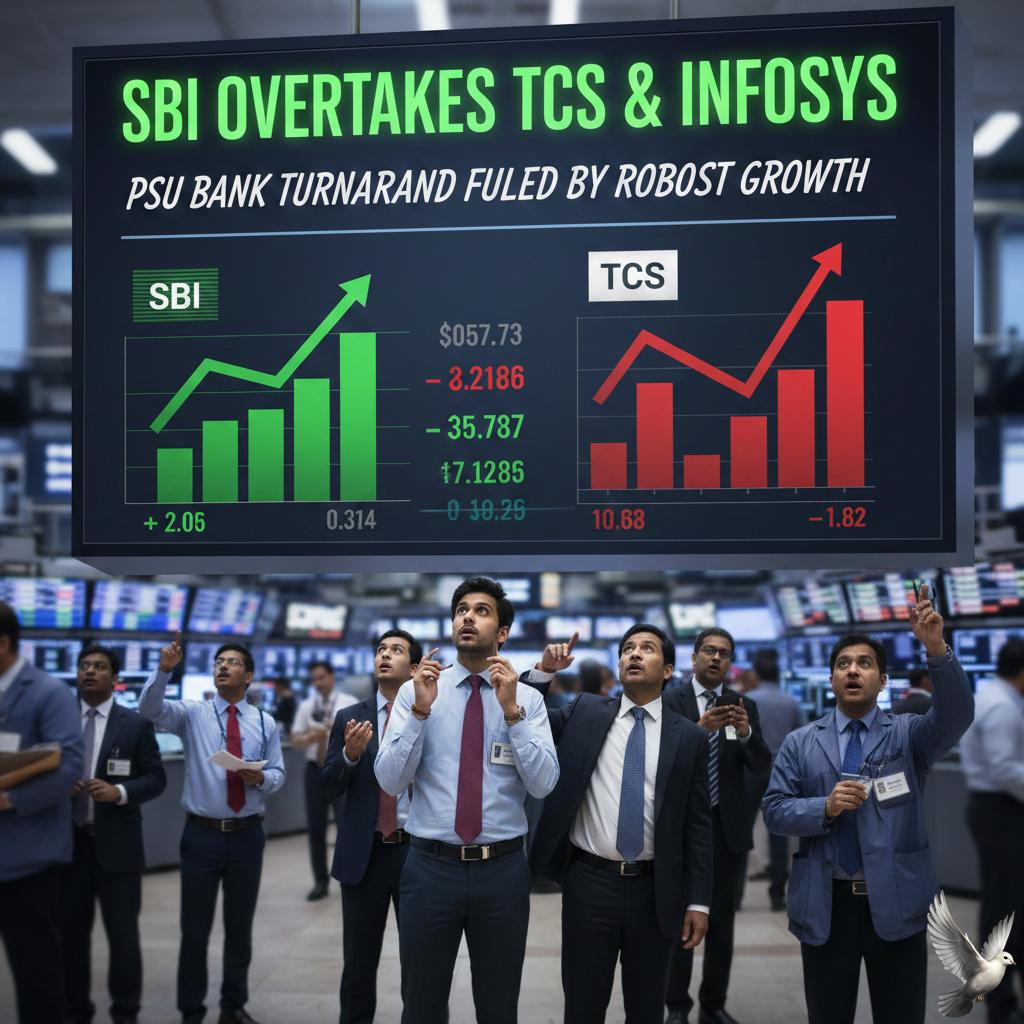
SBI Overtakes TCS and Infosys in Market Capitalization Amid PSU Bank Turnaround
In a historic reshuffle on the Indian bourses, State Bank of India (SBI) has overtaken Tata Consultancy Services (TCS) to become the country's fourth most valuable listed company.
This shift marks a significant rotation in investor preference. For the first time in approximately **15 years**, the state-owned lender's valuation has exceeded that of the IT bellwether.
As of February 12, 2026, SBI's market capitalization reached approximately **₹10.92 lakh crore**, while TCS's valuation slipped to nearly **₹10.52 lakh crore**.
SBI now trails only Reliance Industries, HDFC Bank, and Bharti Airtel in the national rankings.
Banking Surge and Record Profits
The ascent of SBI is underpinned by its strongest-ever quarterly performance. For Q3 FY26, the bank reported a **24%** year-on-year rise in net profit, hitting **₹21,208 crore**.
Key metrics driving this rally include:
* Net Interest Income (NII) growth of **9%** to **₹45,190 crore**.
* Gross Non-Performing Asset (NPA) ratio improving to **1.57%**.
* Credit growth maintaining a healthy pace of **15.6%**.
Management has indicated confidence in sustaining net interest margins above **3%** through the remainder of 2026, supported by robust loan demand and improved asset quality.
IT Sector Headwinds
In contrast, the IT sector is grappling with a de-rating fueled by global uncertainty. TCS shares have declined nearly **4%** in the last week alone, while Infosys has seen its value drop over **21%** on a year-on-year basis.
Investors are currently pricing in the potential for artificial intelligence to disrupt traditional IT service models. This has led to heavy selling across the Nifty IT index, which has faced significant pressure as global tech spending remains cautious.
Sectoral Divergence
The market gap between these sectors continues to widen. While SBI has surged **21%** year-to-date in 2026, major IT counters have largely traded in the red.
The Nifty PSU Bank index has consistently outperformed the broader market, gaining nearly **5%** in recent weekly cycles, driven by institutional buying and a fundamental turnaround in public sector balance sheets.
This structural shift reflects a broader bet on India's domestic credit cycle and infrastructure recovery, contrasting with the export-oriented challenges facing the technology sector.