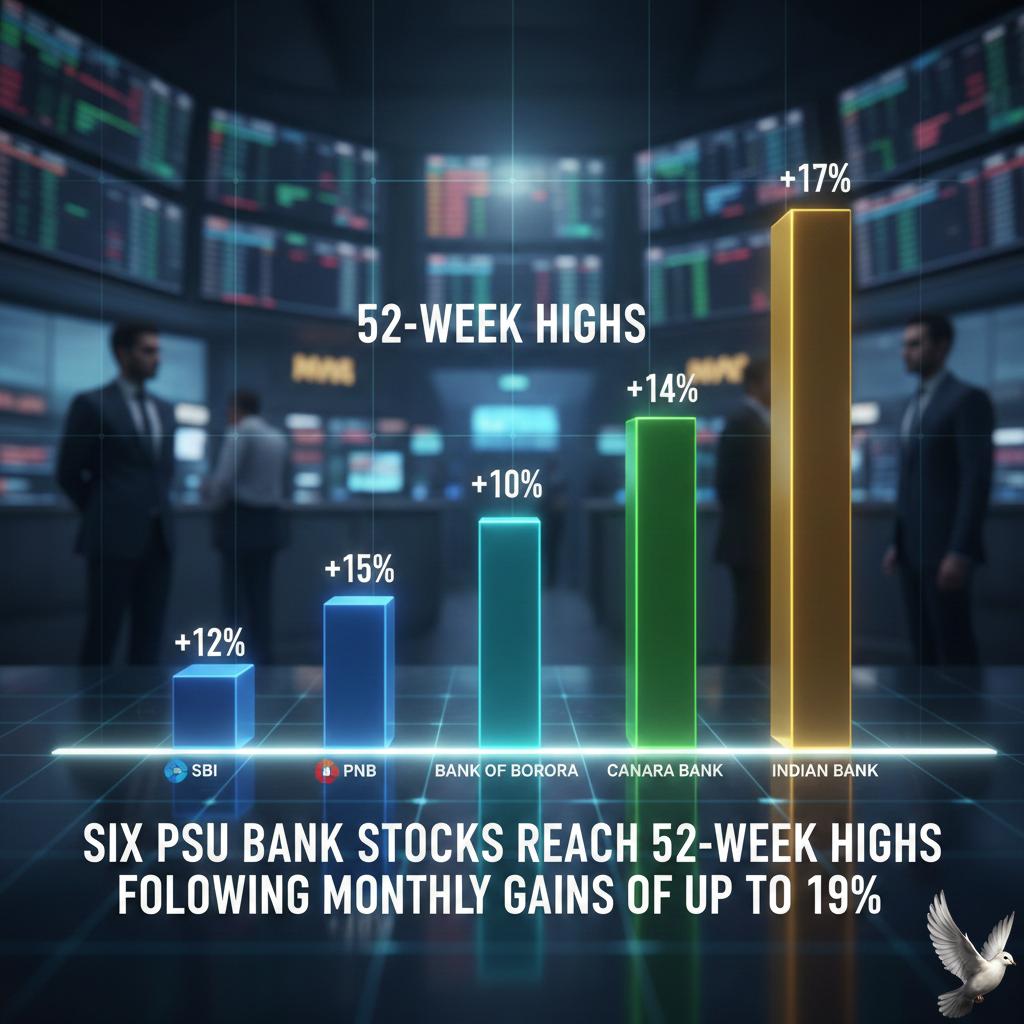
Six PSU Bank Stocks Reach 52-Week Highs Following Monthly Gains of Up to 19%
Market Outlook: February 23, 2026
Global financial markets are navigating a landscape defined by heightened geopolitical friction and shifting economic momentum. Risk aversion has intensified following the sudden implementation of a **15% global tariff** on U.S. imports. This policy shift, combined with escalating tensions between the U.S. and Iran, has led to increased volatility across major indices.
Equities and Benchmarks
U.S. equity futures retreated this morning as investors weighed the impact of trade uncertainty and potential military developments in the Middle East. This follows a volatile start to the month where the **S&P 500** recorded consecutive weekly losses. While the index saw a brief **0.69%** gain last Friday after legal challenges to emergency duties, the long-term outlook remains cautious.
Technology stocks continue to face scrutiny. The **Nasdaq 100** has underperformed recently, dropping for five straight weeks as market leadership shifts toward more defensive, cyclical sectors. All eyes are now on upcoming earnings reports, particularly from the semiconductor industry, which are expected to serve as a bellwether for AI-related capital expenditure and broader sector health.
In Europe and Asia, performance is mixed. European markets rose approximately **3.2%** in January, supported by better-than-expected economic data and approved national budgets. Conversely, Asian markets traded lower today, influenced by negative cues from Wall Street and the Lunar New Year holiday break.
Commodities and Energy
Geopolitical risk premiums have pushed energy prices to six-month highs. **Brent crude** futures reached **$71.99**, while **WTI crude** rose to **$67.05**. Supply concerns are growing due to naval drills in the Strait of Hormuz—a transit point for roughly **20%** of global oil—and ongoing disruptions in Russian refining infrastructure.
Precious metals remain elevated as investors seek "safe haven" assets. **Gold** is trading near **$5,600** per ounce, reflecting a significant **19%** increase since the end of 2025. Silver has also experienced a sharp **9%** bounce recently, often seen as a precursor to broader moves in the metals complex.
Inflation and Central Bank Policy
U.S. inflation data remains a focal point for the Federal Reserve. The Consumer Price Index (**CPI**) rose **2.4%** over the last 12 months, with shelter costs and food prices acting as primary drivers. While energy costs fell **1.5%** in January, the Fed has paused its rate-cutting cycle, keeping the target range at **3.50%–3.75%**.
Central banks in Japan and Australia are moving in the opposite direction, with both signaling potential rate hikes to combat persistent price pressures. In contrast, the European Central Bank maintains a more accommodative stance with its deposit rate at **2.0%**, as the region seeks to balance growth with easing inflation.
Economic Indicators
U.S. **GDP growth** slowed to an annualized rate of **1.4%** in the final quarter of 2025, significantly below previous estimates. Meanwhile, the manufacturing sector shows signs of resilience, with global output matching its highest levels since mid-2024. Investors are now focused on upcoming consumer confidence and producer price data to gauge the likelihood of a mid-year economic recovery.