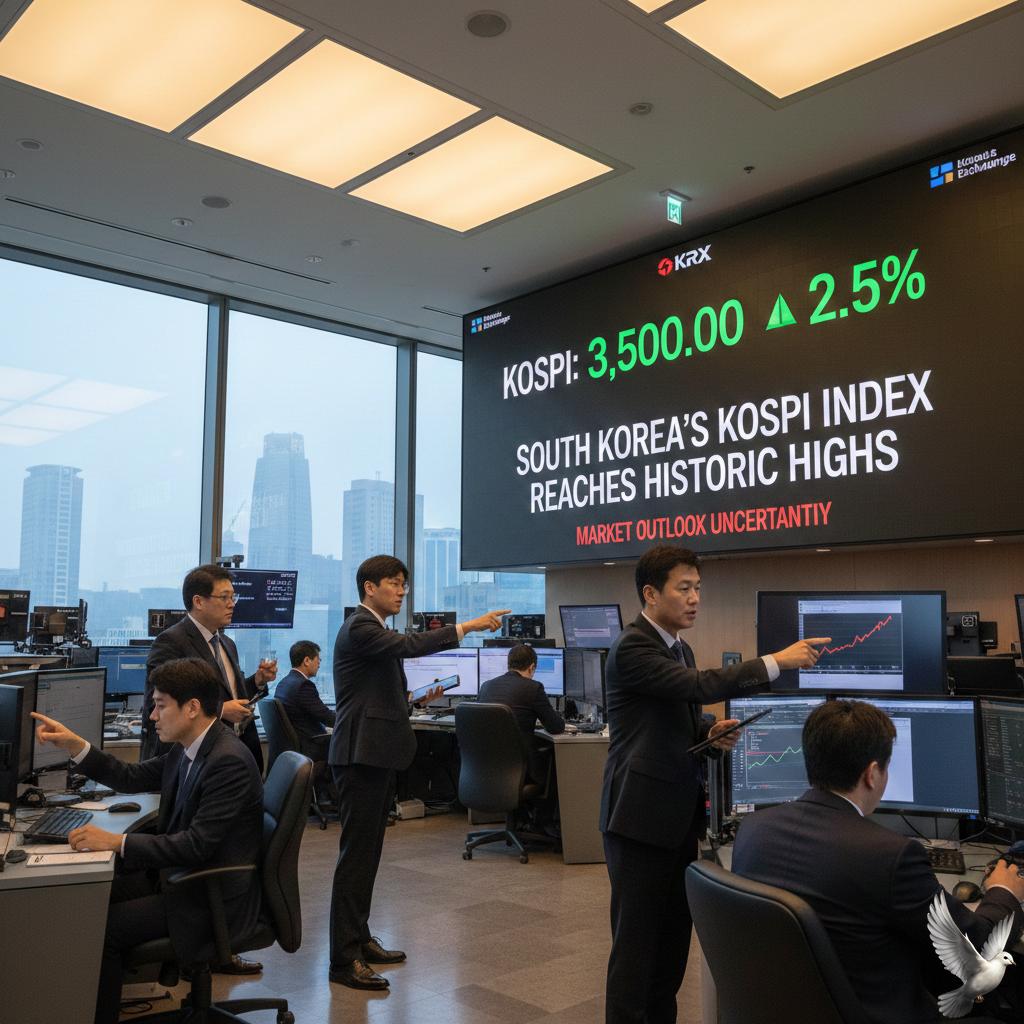
South Korea’s Kospi Index Reaches Historic Highs Amid Market Outlook Uncertainty
South Korea's benchmark KOSPI index has entered a historic era, shattering the symbolic 6,000-point barrier for the first time on February 25, 2026. This milestone represents a staggering 40% gain since the beginning of the year, cementing Seoul’s position as one of the world's best-performing equity markets. The surge has pushed South Korea’s total market capitalization to approximately 3.76 trillion USD, allowing it to overtake France as the ninth-largest stock market globally.
The rally is primarily fueled by the explosive growth in the semiconductor and artificial intelligence sectors. Market leaders Samsung Electronics and SK Hynix have both reached unprecedented price levels, with Samsung recently touching 200,000 KRW and SK Hynix vaulting over 1,000,000 KRW. Analysts have raised price targets further, with some projecting 300,000 KRW for Samsung as the memory boom coincides with massive AI-driven capital expenditures from global big tech firms.
Beyond technology, the government's Corporate Value-up Program is fundamentally altering market dynamics. By incentivizing companies to address the "Korea Discount" through improved governance and higher shareholder returns, the initiative has led to a sharp rebound in dividend payout ratios, which recently climbed to 21.3%. Investors are increasingly rewarding firms that commit to share cancellations and capital efficiency, with high-yield indices and dedicated ETFs gaining significant traction.
Economic indicators provide a stable backdrop for this momentum. The South Korean economy is projected to grow by 1.9% to 2.0% in 2026, supported by robust exports. Inflation has cooled to a five-month low of 2.0%, aligning with the central bank’s target and allowing the Bank of Korea to maintain a steady policy rate of 2.5%. While manufacturing growth has seen some deceleration, the service sector and consumption are showing gradual signs of improvement.
Despite the optimism, the rapid ascent has triggered a parallel rise in cautious sentiment. The KOSPI 200 Volatility Index, often called the "fear index," has climbed for six consecutive sessions, reflecting unease over the pace of the rally. Short-selling reserve funds have hit a record 150 trillion KRW, signaling that a segment of the market is bracing for a potential correction.
Institutional investors currently serve as the primary engine for the index's upward trajectory, often offsetting significant profit-taking by individual and foreign investors. While some analysts maintain a bullish outlook with targets as high as 8,000 points, others warn that the market is entering an overheated phase. This clash of perspectives has introduced heightened daily volatility, with the index frequently experiencing intraday swings exceeding 100 points.