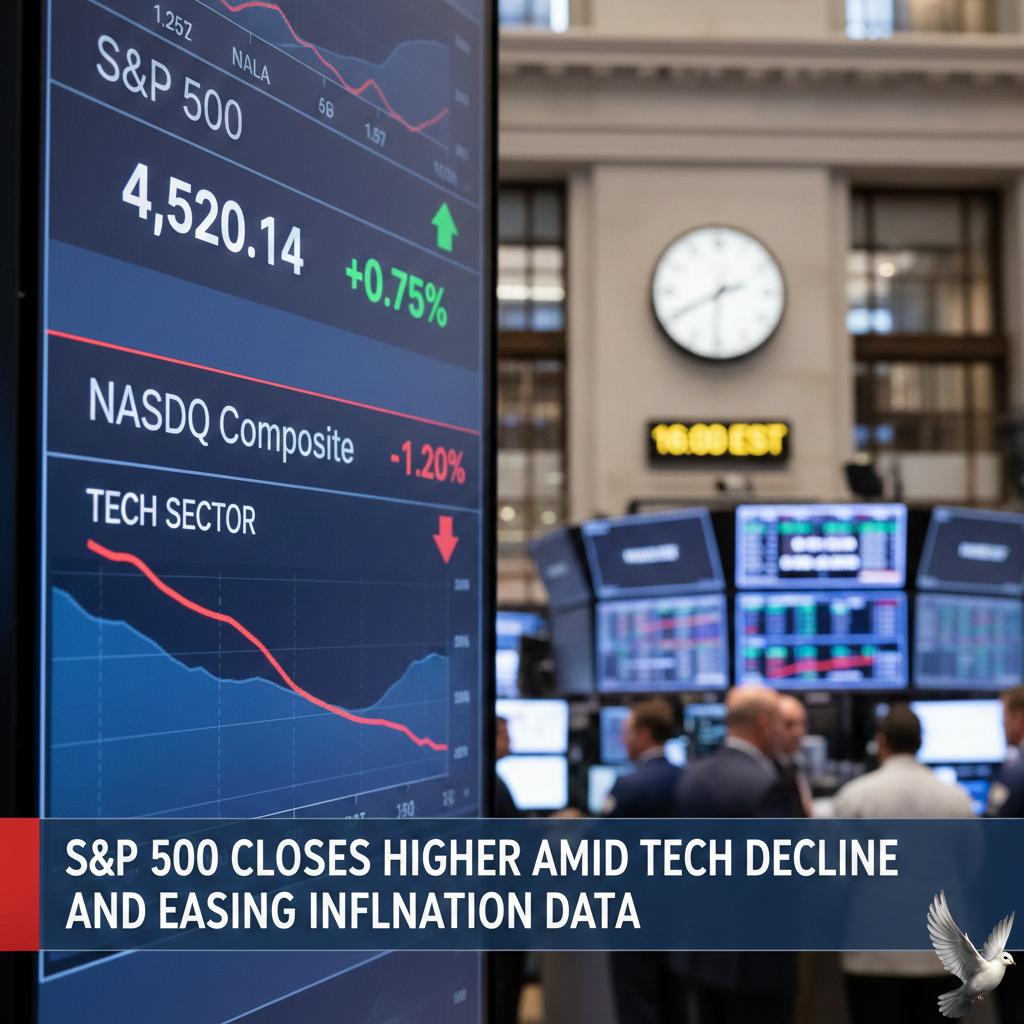
S&P 500 Closes Higher Amid Tech Decline and Easing Inflation Data
Major US indices are navigating a volatile February as the technology sector faces a significant rotation. The Dow Jones Industrial Average, S&P 500, and Nasdaq Composite all posted weekly losses, with the tech-heavy Nasdaq leading the decline at 2.3%. While the Dow recently touched a fresh all-time high of 50,335, it has since retraced by 1.4% as investor sentiment shifts away from growth-oriented sectors.
A primary catalyst for this downward pressure is the intensifying scrutiny of artificial intelligence investments. Major "hyperscalers" have committed over $500 billion to AI infrastructure for 2026, including Alphabet’s projected $50 billion and Amazon’s historic $75 billion capital expenditure. Investors are increasingly concerned that the timeframe for these massive investments to generate meaningful profits remains uncertain, leading to a "roller-coaster" performance for technology stocks.
The market is witnessing a distinct "mirror image" of 2025’s trends. Software and services indices have slumped 15% since late January, while defensive and "old economy" sectors like Consumer Staples and Utilities have gained 1.4% and 1.2% respectively. This rotation reflects fears of AI disruption in traditional business models, such as insurance and wealth management, as well as high capital costs.
Economic indicators are providing a mixed backdrop. January’s Consumer Price Index (CPI) cooled to 2.4% year-over-year, marking a nearly five-year low and beating expectations of 2.7%. Core inflation, excluding food and energy, slowed to 2.5%. While this cooling trend initially boosted hopes for Federal Reserve easing, a robust jobs report—showing 130,000 new positions added in January—has led markets to price in a more cautious approach. Current expectations suggest the Fed may hold rates steady until mid-2026, with approximately 60 basis points of total cuts anticipated by year-end.
In corporate highlights, individual stock performance is diverging sharply. Nvidia continues to report record revenues, reaching $57 billion in its most recent quarter, yet the broader "Magnificent Seven" cohort has underperformed the equal-weighted S&P 500 this year. Hardware providers like Cisco have seen double-digit daily drops after missing margin targets, further weighing on the mega-cap space.
The 10-year Treasury yield recently dropped 7 basis points to reflect a "flight to quality," while gold prices surged over 2% to reach $5,030 per ounce following the softer inflation data. Markets remain focused on upcoming retail sales figures and further inflation metrics to determine if the current tech-led pullback is a temporary correction or a more permanent shift in market leadership.