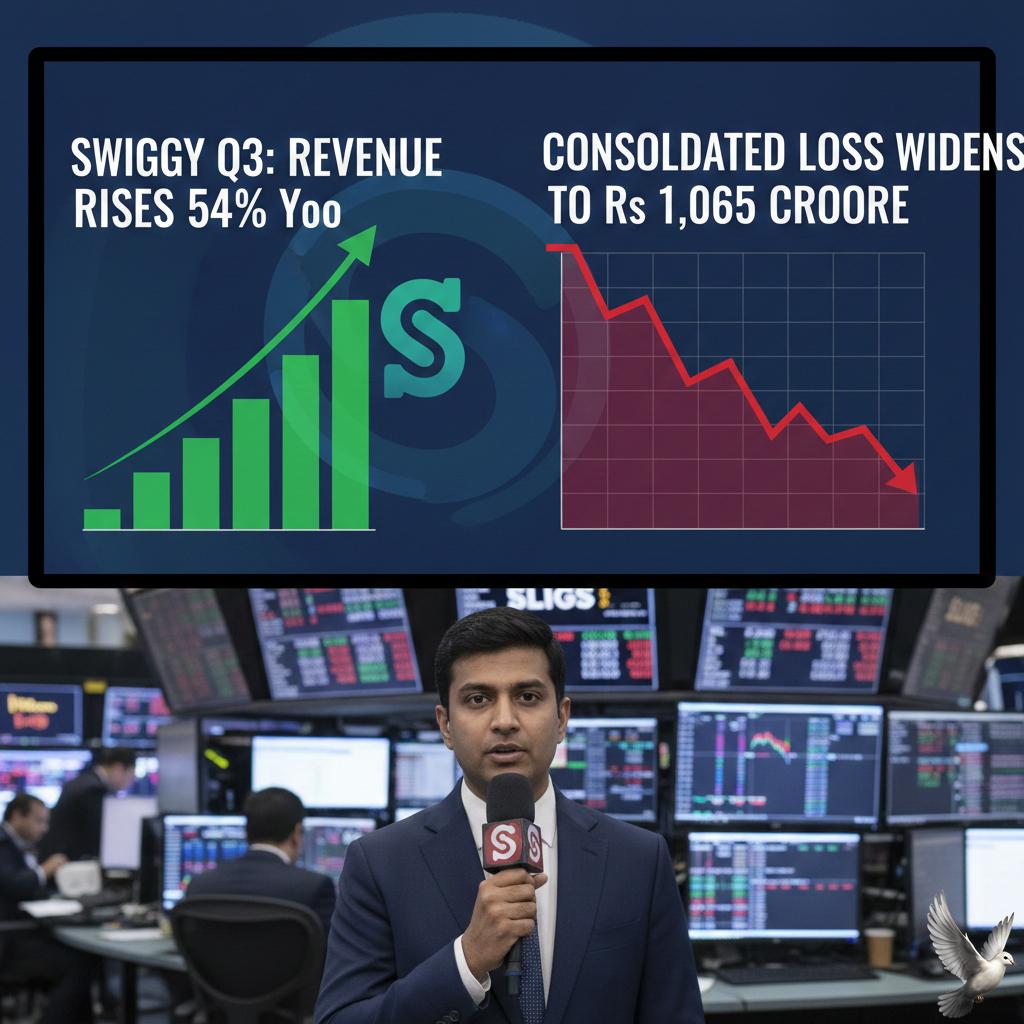
Swiggy Q3: Revenue Rises 54% YoY, Consolidated Loss Widens to Rs 1,065 Crore
**Swiggy Q3 FY26 Market Brief**
**Financial Snapshot**
Swiggy has released its financial results for the third quarter of FY26 (ended December 31, 2025), reporting a consolidated net loss of **₹1,065 crore**, a widening from ₹799 crore in the same period last year. Despite the bottom-line pressure, top-line growth remained robust. Revenue from operations surged **54% year-on-year** to **₹6,148 crore**, driven by aggressive expansion in quick commerce and steady gains in its core food delivery business.
**Segment Performance**
The Quick Commerce arm, Instamart, continues to be the primary growth engine, recording a Gross Order Value (GOV) of **₹7,938 crore**, a massive **103% increase** year-on-year. However, this segment remains a drag on profitability due to high cash burn from dark store expansion and fierce competition.
The core Food Delivery business showed resilience with a **20.5% growth** in GOV, reaching **₹8,959 crore**. This marks the segment's fastest growth rate in three years, aided by a 22% increase in monthly transacting users (18.1 million).
**Market Context & Stock Reaction**
Following the earnings announcement on January 29, 2026, Swiggy’s stock traded in the range of **₹324–₹327**, reflecting a cautious market sentiment. While investors cheered the revenue momentum, the widening loss due to operational expenses—specifically a **47.5% jump in advertising spend**—remains a key concern.
**Competitive Landscape**
Management attributed the profitability headwinds to "irrational competitive intensity" in the quick commerce sector, where rivals like Zomato’s Blinkit and Zepto are locked in a price war. Swiggy has opted not to chase low-value orders aggressively, focusing instead on infrastructure scale-up; the company added **34 new dark stores** this quarter, bringing its total network to 1,136.
**Outlook**
The widened loss is largely strategic, reflecting Swiggy's choice to prioritize market share in the booming quick commerce sector over immediate profitability. With cash reserves bolstered by its recent public listing and QIP, the company signals it is well-capitalized to sustain this high-growth, high-burn phase.