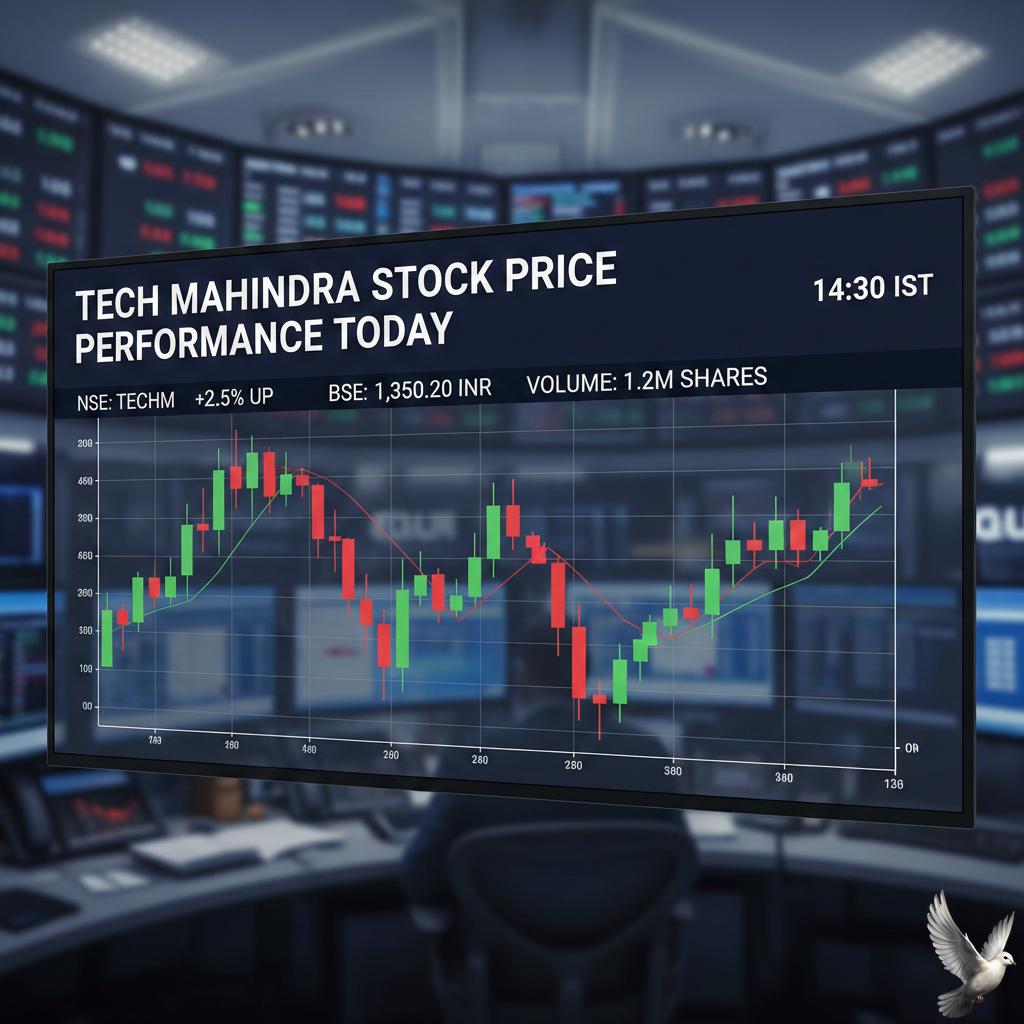
Tech Mahindra Stock Price Performance Today
Market Brief: February 2026 Resilience
The global economy enters mid-February 2026 characterized by a "multidimensional polarization." Markets are currently balancing massive infrastructure investment in technology against a softening labor market and shifting trade policies.
US equity futures showed a cautious start following the Presidents' Day holiday. Contracts for the **S&P 500** dipped **0.4%**, while the **Nasdaq 100** slipped **0.8%**. This risk aversion stems from concerns over AI "cannibalization" in software and business services, despite an overall corporate earnings growth rate of **13%**.
Index and Sector Performance
The major benchmarks have navigated a volatile start to the year. As of February 2026, the **Dow Jones Industrial Average** hovers around **50,121**, the **S&P 500** at **6,941**, and the **Nasdaq Composite** at **23,066**.
While technology stocks have faced pressure due to massive capital expenditure, the Energy sector has seen gains, recently rising **2.6%**. Financial and Communication services have lagged, dropping **1.5%** and **1.3%** respectively.
Inflation and Central Bank Policy
Inflation remains a central theme, though the trajectory is cooling. US retail inflation was recently reported at **2.7%** year-on-year. In other major regions, like India, the new Consumer Price Index (base 2024) stands at **2.75%**, well within the preferred tolerance bands.
Central banks are transitioning from an easing cycle to a "simultaneous hold." Markets are currently pricing in a **93.6%** probability of a **25-basis-point** rate cut by the Federal Reserve in June, as policymakers wait for more definitive signs of labor market stabilization.
Energy and Commodities
Energy markets are experiencing short-term spikes driven by geopolitical tensions. **Brent Crude** averaged **$67** per barrel in January due to supply disruptions and naval exercises near critical shipping corridors.
However, the long-term outlook for 2026 suggests a decline toward **$58** per barrel as global production is expected to exceed demand. Conversely, gold has reached record levels, with forecasts adjusted upward to **$5,600** per ounce due to sustained macroeconomic uncertainty.
Tech Infrastructure Race
The "AI supercycle" is driving an unprecedented expansion in capital spending. The top five US hyperscalers are projected to reach a combined capex of over **$700 billion** in 2026, a staggering **60%** increase from previous years.
Amazon alone has signaled spending near **$200 billion**. While this fuels a **24%** projected growth in the semiconductor industry, it is also stretching the balance sheets of major players, potentially requiring more external financing than in previous decades.