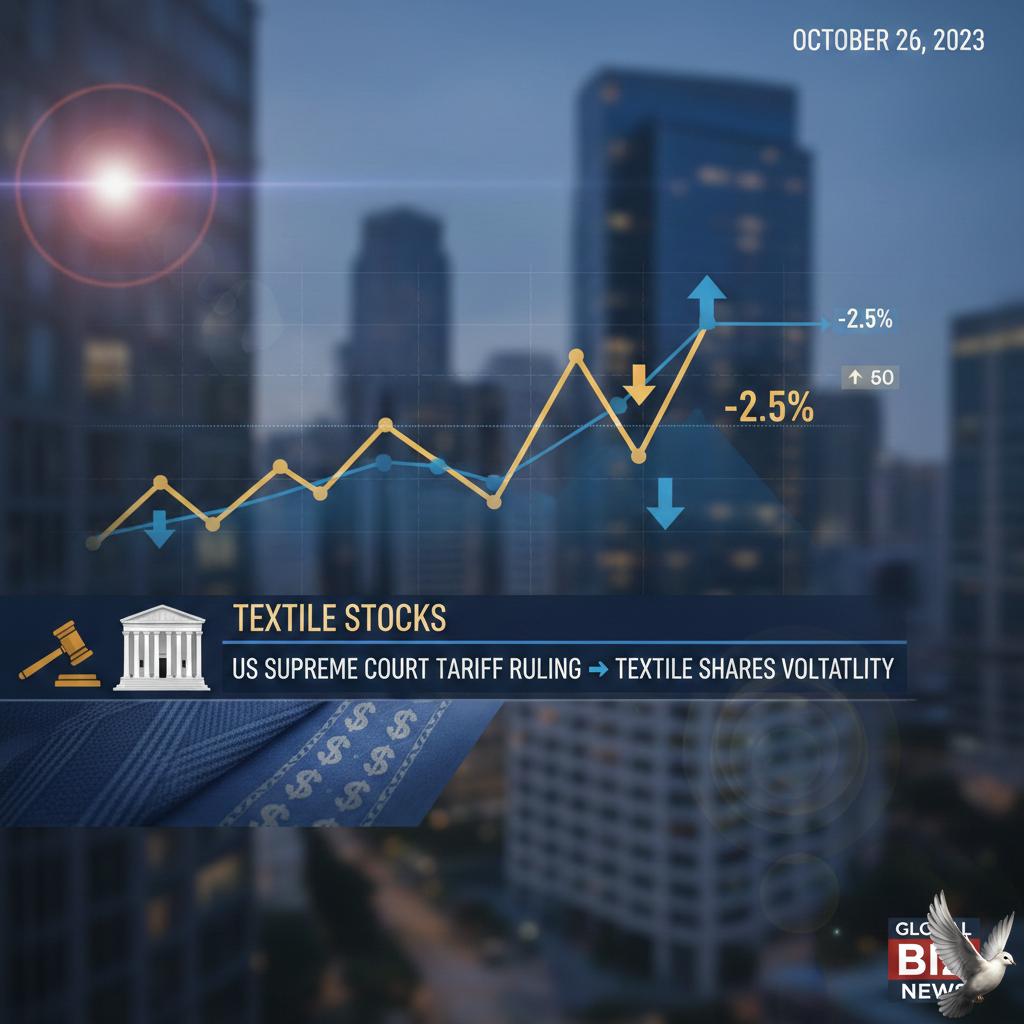
Textile Stocks Fluctuate Following US Supreme Court Tariff Ruling
Market Brief: Indian Textile Sector
The Indian textile sector experienced a dynamic trading session on Monday, February 23, 2026, as markets reacted to a historic legal shift in U.S. trade policy. A landmark ruling by the U.S. Supreme Court invalidated previous sweeping tariffs, initially sparking optimism before a new administrative levy introduced fresh complexity.
Stock Performance and Market Reaction
Indian equity markets advanced on the news, with specific textile players leading the charge. **Kitex Garments** surged by **10.4%**, while **Trident** and **Welspun Living** climbed **7.5%** and **4.2%** respectively. The rally reflects a perceived easing of the extreme tariff pressures that had previously seen duties on Indian goods fluctuate between **26%** and **50%**.
However, the gains were not uniform across the board. **Gokaldas Exports** saw a dip of **4%**, and **Indo Count** slipped **1.3%** in early trade as investors weighed the long-term impact of the new global trade framework. The broader textiles sector market cap currently stands at approximately **₹1,66,969.77 crore**, reflecting a daily increase of **1.91%**.
The U.S. Tariff Reset
The U.S. Supreme Court ruled **6–3** that the use of the International Emergency Economic Powers Act (IEEPA) to impose global tariffs was unauthorized. This decision effectively struck down the "Liberation Day" tariffs that had heavily burdened Indian exporters throughout 2025.
In immediate response, the U.S. administration invoked **Section 122** of the Trade Act of 1974. This move established a new **15%** global tariff, revised upward from an initial **10%** announcement. For Indian textile firms, this represents a significant reduction from the previous **18%** effective rate, though it removes the specific competitive advantage India held over rivals like Bangladesh and Vietnam.
Strategic Trade Rescheduling
The Indian government is currently evaluating the implications of the **150-day** temporary import surcharge. In light of these legal developments, a high-stakes meeting between Indian and U.S. chief negotiators, originally set for February 23 in Washington, has been rescheduled.
Both nations seek to reassess the text of a proposed interim trade pact. Analysts suggest the new **15%** baseline provides a fresh floor for negotiations, as India aims to secure its target of reaching **$100 billion** in textile exports by 2030.
Outlook for Exporters
The shift to a uniform global tariff is expected to alleviate margin pressures for small and mid-cap engineering and textile firms. While the uniform rate places all competing nations on equal footing, the reduction from higher 2025 levels is viewed as a net positive for Indian order books.
The domestic industry remains a pillar of the economy, contributing **2%** to India's GDP and providing livelihoods for over **45 million** people. Investors are now focused on the mid-March window, when the final text of the India-US bilateral agreement is expected to provide definitive clarity on duty-free access and long-term trade stability.