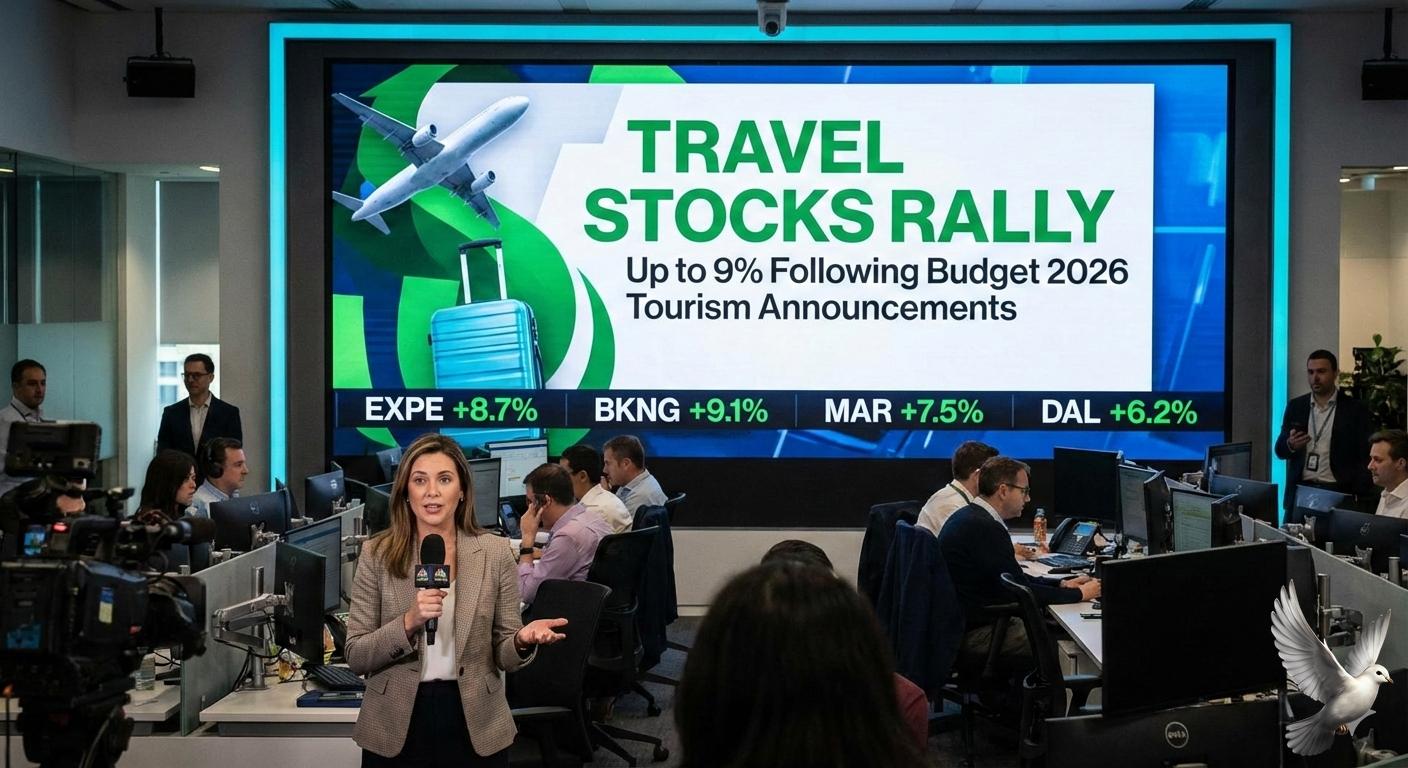
Travel Stocks Rally Up to 9% Following Budget 2026 Tourism Announcements
**Market Brief: Tourism Stocks Defy Budget Sell-Off**
**Date:** February 1, 2026
**Event:** Union Budget 2026-27 Reaction
**Snapshot**
Tourism and hospitality stocks emerged as a rare bright spot today, surging against a broader market crash. While the Sensex plunged ~1,500 points following a hike in Securities Transaction Tax (STT) on F&O, travel counters rallied on sector-specific stimulants.
**Key Drivers**
* **TCS Rationalization:** A major boost for outbound travel—Tax Collected at Source (TCS) on overseas tour packages slashed to a uniform **2%** (down from higher slabs), aimed at lowering upfront costs for travelers.
* **Medical & Skilling Push:** Announcement of **5 regional medical tourism hubs** and a new **National Institute of Hospitality** to bridge the skills gap.
* **Infrastructure:** Development of an integrated **East Coast tourism corridor** and Buddhist circuits in the North East.
**Sector Performance**
* **Easy Trip Planners:** The day's standout gainer, surging **9–11%**. The stock reacted sharply to the TCS cut, which directly aids volume growth for international bookings.
* **Lemon Tree Hotels:** Jumped **~6%**, outperforming peers as mid-segment demand remains robust.
* **Premium Hospitality:** **Indian Hotels** (+1%), **EIH** (+2%), and **ITC Hotels** (+1%) held firm in green territory, supported by the long-term infrastructure narrative.
* **Contrasting Moves:** **ITC Ltd** (parent entity) faced pressure, dropping **~3-4%** to 52-week lows due to a statutory hike in cigarette taxes and NCCD rates. **Thomas Cook** saw minor profit-booking (-2%) despite favorable policy.
**Outlook**
The Budget’s multi-pronged approach—combining immediate tax relief (TCS cut) with long-term capacity building (medical hubs, skilling)—signals sustained government support. While the broader market digests the STT shock, the hospitality sector appears positioned for a structural upcycle driven by domestic infrastructure and revived outbound demand.