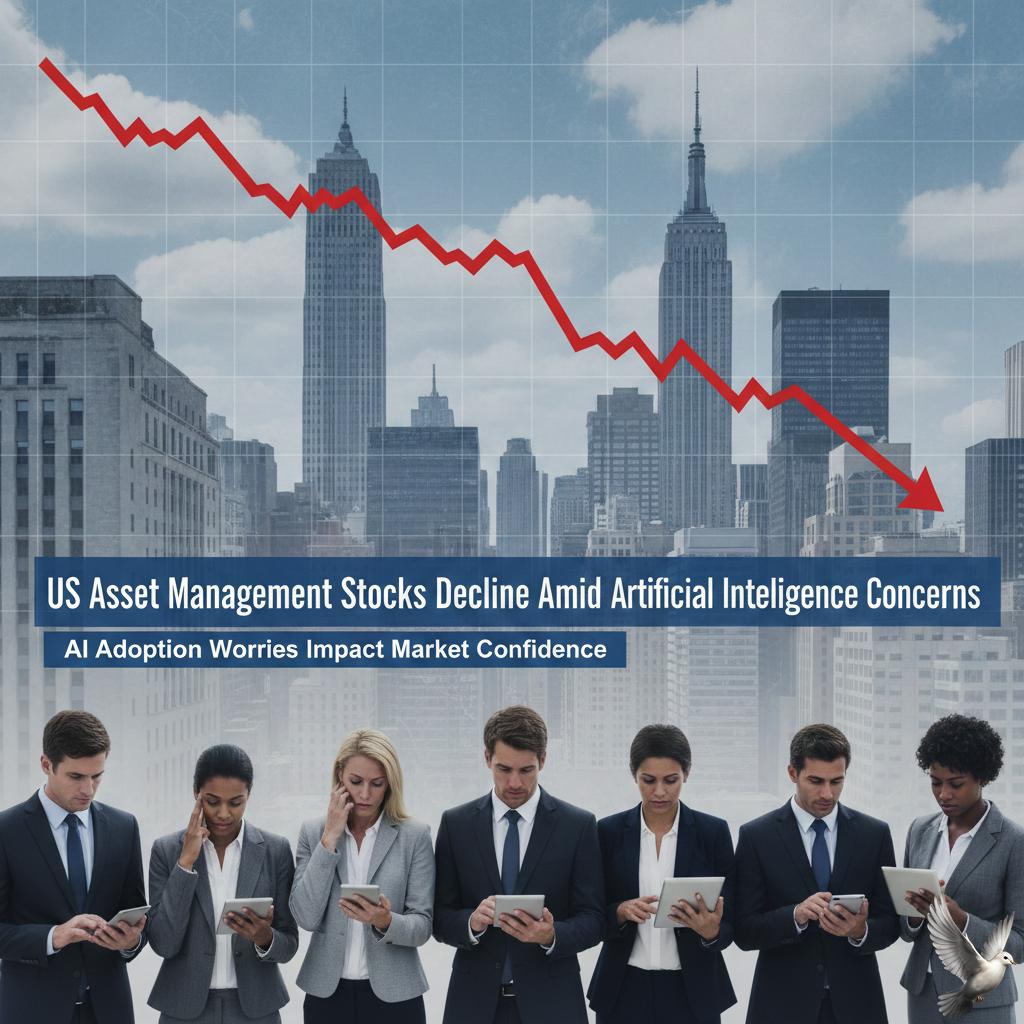
US Asset Management Stocks Decline Amid Artificial Intelligence Concerns
US wealth management stocks suffered a sharp decline Tuesday following the launch of a disruptive AI tool by Altruist Corp. The new technology, designed to automate complex tax strategies and personalize client planning in minutes, sparked immediate fears that traditional human-led advisory models are reaching a tipping point of obsolescence.
The market reaction was swift and severe. **Charles Schwab** closed down **7.4%** after an intraday plunge of **9.5%**. **Raymond James Financial** fell nearly **9%**, while **LPL Financial Holdings** saw a drop of over **8%** by the closing bell. **Stifel Financial** also finished the session **3.8%** lower, despite attempts to recover from deeper midday losses.
The sell-off underscores a growing "AI panic" across the financial services sector. Investors are increasingly concerned about long-term fee compression and the potential for tech upstarts to capture significant market share. This anxiety mirrors recent turbulence in the insurance brokerage space, where the **S&P 500 Insurance Index** fell **3.9%** just 24 hours prior.
This volatility is part of a broader trend affecting the "trust industries." Last week, similar AI-driven fears wiped out **$611 billion** in market value across 164 stocks in the software and asset management sectors. High-profile firms like **Thomson Reuters** and **Morningstar** experienced their worst weekly performances in over a decade as automated research tools gain traction.
Market analysts suggest that while these AI applications may currently act as efficiency boosters for human advisors, investors are pricing in a future where automated "agentic" systems handle end-to-end financial workflows. The shift suggests that the historical link between revenue growth and headcount in the wealth sector may be permanently decoupling.
Industry leaders are now under pressure to prove the ongoing value of human empathy and nuanced judgment. With AI budgets rising across the board, the focus has shifted toward how established firms can integrate these tools to protect their margins before low-cost automated competitors erode their core business.