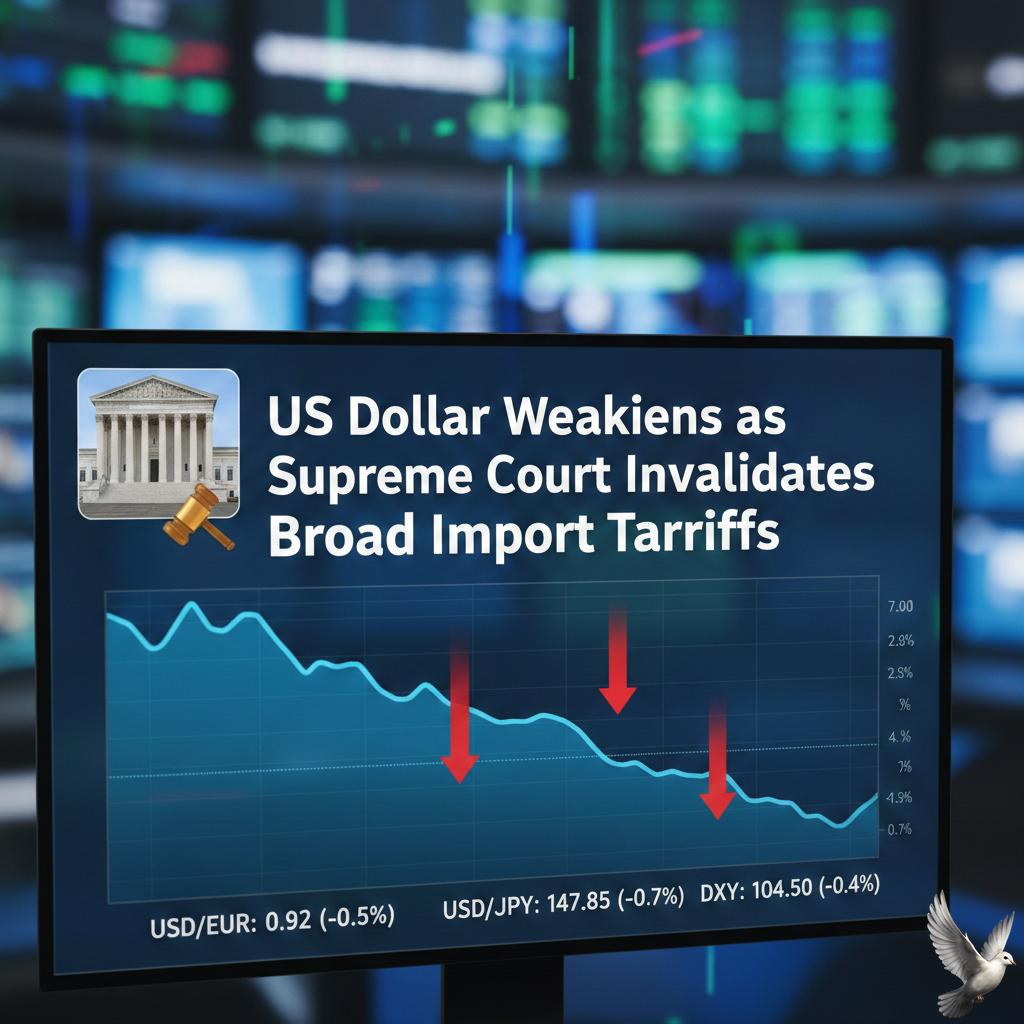
US Dollar Weakens as Supreme Court Invalidates Broad Import Tariffs
The US dollar faced downward pressure following a landmark Supreme Court ruling on Friday, February 20, 2026. The 6-3 decision invalidated the administration's use of emergency powers to impose broad global tariffs. This ruling has created immediate fiscal uncertainty, as the government now faces potential refund claims exceeding **$100 billion** for duties already collected.
Economic data released alongside the legal verdict confirmed a significant cooling of the American economy. Real GDP grew at an annual rate of just **1.4%** in the fourth quarter of 2025. This figure represents a sharp deceleration from the **4.4%** growth seen in the third quarter and fell well below the market consensus of **3.0%**. The slowdown was driven by a contraction in government spending and a marked decline in exports.
Inflation continues to present a complex challenge for policymakers. While the annual Consumer Price Index (CPI) slowed to **2.4%** in January, the core Personal Consumption Expenditures (PCE) price index—the Federal Reserve's preferred metric—rose by **2.7%** on a quarterly basis. Persistent price pressures in services and the delayed pass-through of previous trade costs suggest that inflation may remain above the **2.0%** target for longer than anticipated.
The US Dollar Index (DXY) exhibited volatility, recently hovering near the **97.90** level. The currency weakened as investors weighed the GDP miss against the legal blow to trade policy. In contrast, the British Pound and Japanese Yen found room to maneuver. Sterling benefitted from the dollar’s soft patch, while the Yen saw renewed interest as a safe haven amid the shifting US trade landscape.
Market expectations for Federal Reserve policy have turned cautious. Although the benchmark interest rate remains held at **3.50% to 3.75%**, the combination of sluggish growth and "sticky" core inflation has clouded the path for rate cuts. Recent FOMC minutes revealed that some officials are even considering the possibility of future rate hikes if inflation does not stabilize. Investors have scaled back bets on a March cut, with many now looking toward the second half of 2026 for a potential shift in policy.
The invalidation of the International Emergency Economic Powers Act (IEEPA) as a tool for tariff imposition has added a layer of "dynamic uncertainty" to global trade. While the White House has already signaled a move toward a **10%** baseline duty under different legal authorities, the immediate loss of the broader tariff structure has removed a key pillar of support for the dollar's recent strength.