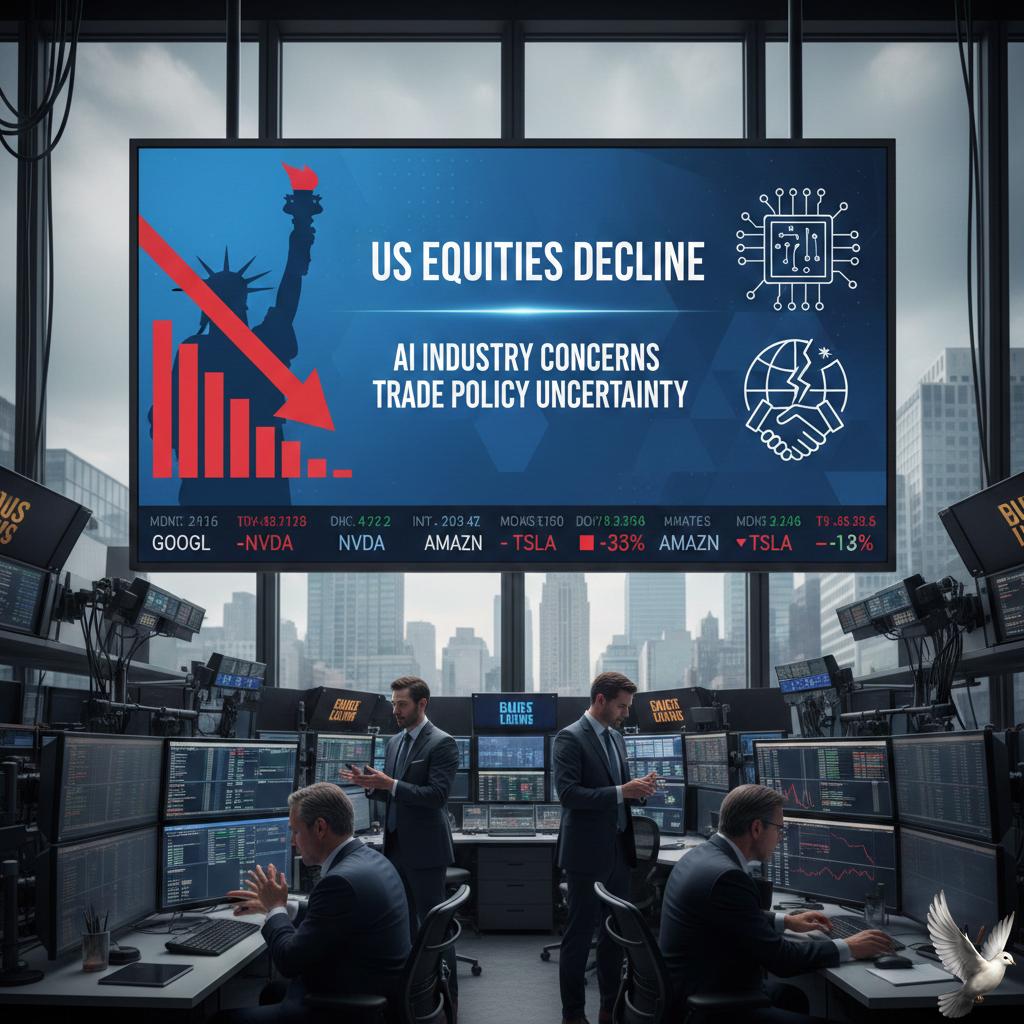
US Equities Decline on AI Industry Concerns and Trade Policy Uncertainty
A broad market selloff intensified as the first year of President Trump’s second term continues to grapple with policy shifts. All three major U.S. stock indexes fell more than 1% by the closing bell on February 23, 2026. The Dow Jones Industrial Average led the retreat, dropping 761.58 points or 1.53% to finish at 48,864.39.
The S&P 500 slipped 1.14% to 6,830.45, while the Nasdaq Composite shed 1.13% to close at 17,914.54. Risk appetite has been severely dampened by a combination of technological disruption and erratic trade signals.
Artificial intelligence remains a primary source of volatility. New advancements are sparking fears of industry-wide displacement, particularly in the software and financial services sectors. IBM shares plunged 13.1% after the release of sophisticated new coding tools by Anthropic, while American Express sank 7.2% following research highlighting risks to the traditional consumer credit labor force.
Trade policy has added further layers of uncertainty. Following a Supreme Court ruling that struck down previous global tariffs, the administration moved to impose a new 150-day temporary tariff framework under Section 122. This measure includes a 10% to 15% import duty, which has triggered friction with European and Chinese trade partners.
Economic indicators show a complex backdrop for these moves. While corporate earnings for the S&P 500 grew by 13.2% in the final quarter of 2025, job growth has slowed significantly. The U.S. economy added only 181,000 jobs throughout 2025, the lowest non-recessionary level since 2003.
Investors are now pivoting toward safety. U.S. Treasury yields have retreated from their mid-2025 peaks, with the 10-year yield settling near 4.1%. Gold has emerged as a major beneficiary of the instability, climbing above $4,300 per ounce as markets price in persistent geopolitical and financial risks.
Market focus now shifts to high-stakes earnings reports from major tech and retail players later this week. Traders are watching for signs of whether AI can deliver immediate revenue growth to offset the rising costs and structural disruptions currently fueling the selloff.