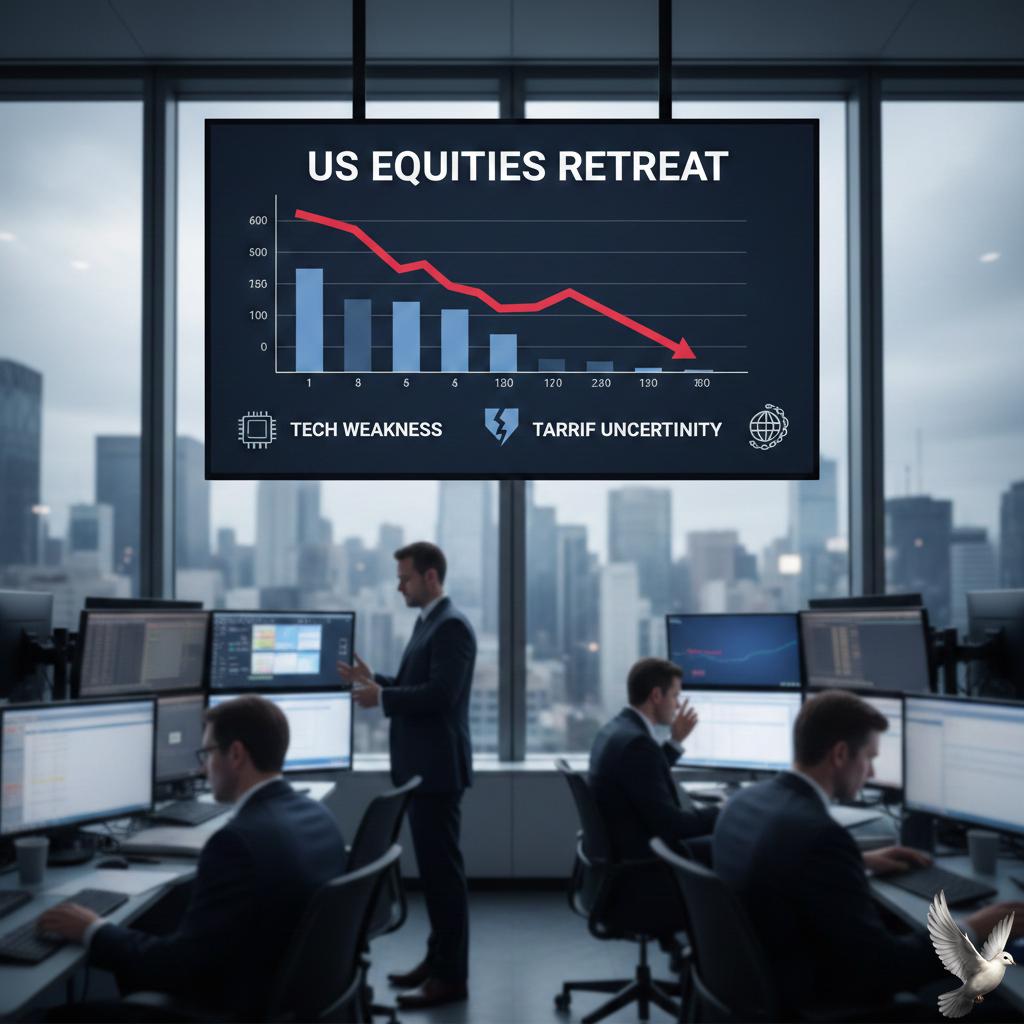
**US Equities Retreat Amid Tech Weakness and Tariff Uncertainty**
US stock markets faced sharp downward pressure on Monday as renewed trade policy volatility rattled investor confidence. The decline followed a weekend of rapid developments involving executive tariff powers and a landmark judicial reversal.
The Dow Jones Industrial Average fell over **600 points**, or roughly **1.32%**, to settle near **48,968**. The S&P 500 dropped **0.76%** to **6,856**, while the Nasdaq Composite slipped **0.63%** to end at **22,741**.
Market volatility was triggered by the US Supreme Court's **6-3 ruling** that struck down previous broad tariffs imposed under emergency powers. In a swift response, a new **15% global tariff** was announced under a different legal statute, the Trade Act’s Section 122.
These new levies are designed to address international payment imbalances but are limited to a **150-day** window unless extended by Congress. The sudden shift back to high-rate protectionism has created fresh uncertainty for multinational corporations and trade partners.
The financial sector led the retreat among blue-chip stocks. American Express saw a significant **7% tumble**, weighing heavily on the Dow. Banking giants JPMorgan and Goldman Sachs also faced selling pressure as investors weighed the potential for higher inflation and a more restrictive trade environment.
Tech shares showed mixed results but remained generally weak ahead of a pivotal week for the sector. While software companies like Oracle and Palantir dropped approximately **4%** on AI-related disruption fears, Nvidia managed a modest gain of **1.3%** as the market braced for its upcoming earnings report.
Broader economic indicators suggest a slowing momentum. Recent data shows US GDP growth for the final quarter of the previous year cooled to **1.4%**, a sharp drop from the **4.4%** recorded in the third quarter. Headline inflation remains sticky at **2.9%**, keeping the Federal Reserve's path for future rate cuts uncertain.
Market sentiment is currently defined by a "wait-and-see" approach. Traders are closely monitoring whether the new **15% duties** will face immediate legal challenges and how major trading partners in Europe and Asia will respond to the revised US trade stance.