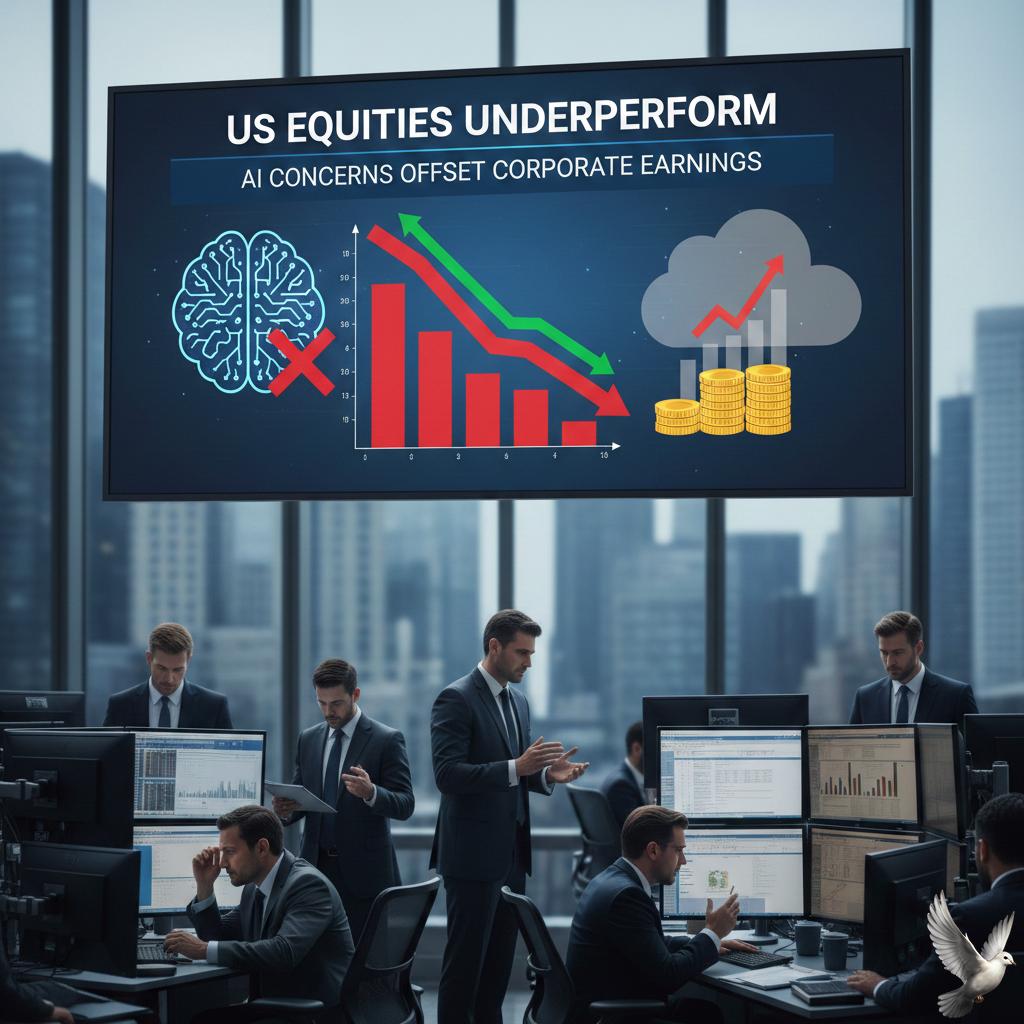
**US Equities Underperform as AI Concerns Offset Corporate Earnings**
The S&P 500 enters the final days of February 2026 in a state of paradox. Corporate America has just delivered a formidable earnings season, with the index reporting a blended earnings growth rate of 13.2%. This marks the fifth consecutive quarter of double-digit gains, supported by a 9.0% increase in revenue—the strongest top-line performance in over three years.
Despite these fundamentals, the market has decoupled from reality. The S&P 500 has shed roughly 1.4% this month, with heavy selling hitting the technology sector particularly hard. Microsoft, Alphabet, and Apple have all seen significant retreats, with some falling as much as 10% to 20% year-to-date. This "scare trade" is driven by three distinct pillars of uncertainty.
The first is the sudden shift in the AI narrative. While 2025 was defined by broad AI enthusiasm, 2026 has introduced a "disruption panic." The release of advanced autonomous coding and agentic tools has triggered fears that existing software business models are being rendered obsolete. High-profile names like IBM and Salesforce have faced single-day plunges of up to 13%, as investors move from "picks and shovels" providers to questioning the survival of established platforms.
Geopolitical escalation in the Middle East serves as the second pressure point. Naval drills near the Strait of Hormuz and a diplomatic stalemate in Geneva have injected a risk premium of at least $10 per barrel into energy markets. Brent crude has spiked toward $71 as military build-ups in the region reach their highest levels in two decades. This has turned the Energy sector into a volatile hedge, with the XLE index jumping over 14% while the broader market stumbles.
Concerns in the private credit market comprise the third pillar. With assets under management nearing $2 trillion, the sector is facing scrutiny over its interconnectivity with traditional banks. Investors are wary of "contagion risk" as private lenders increasingly compete for the same deals as public markets, particularly in digital infrastructure and real estate. This has led to steep declines in private credit stocks like TPG and Blue Owl, which have dropped more than 30% in early 2026.
Current valuations remain a hurdle for a quick recovery. The forward 12-month P/E ratio for the S&P 500 stands at 21.5, well above the 10-year average of 18.8. While analysts still project 14.4% earnings growth for the full year, the market is currently prioritizing risk mitigation. Money is rotating into low-volatility defensive plays and energy as a shield against the "disruption" and "geopolitical" premiums currently weighing on sentiment.