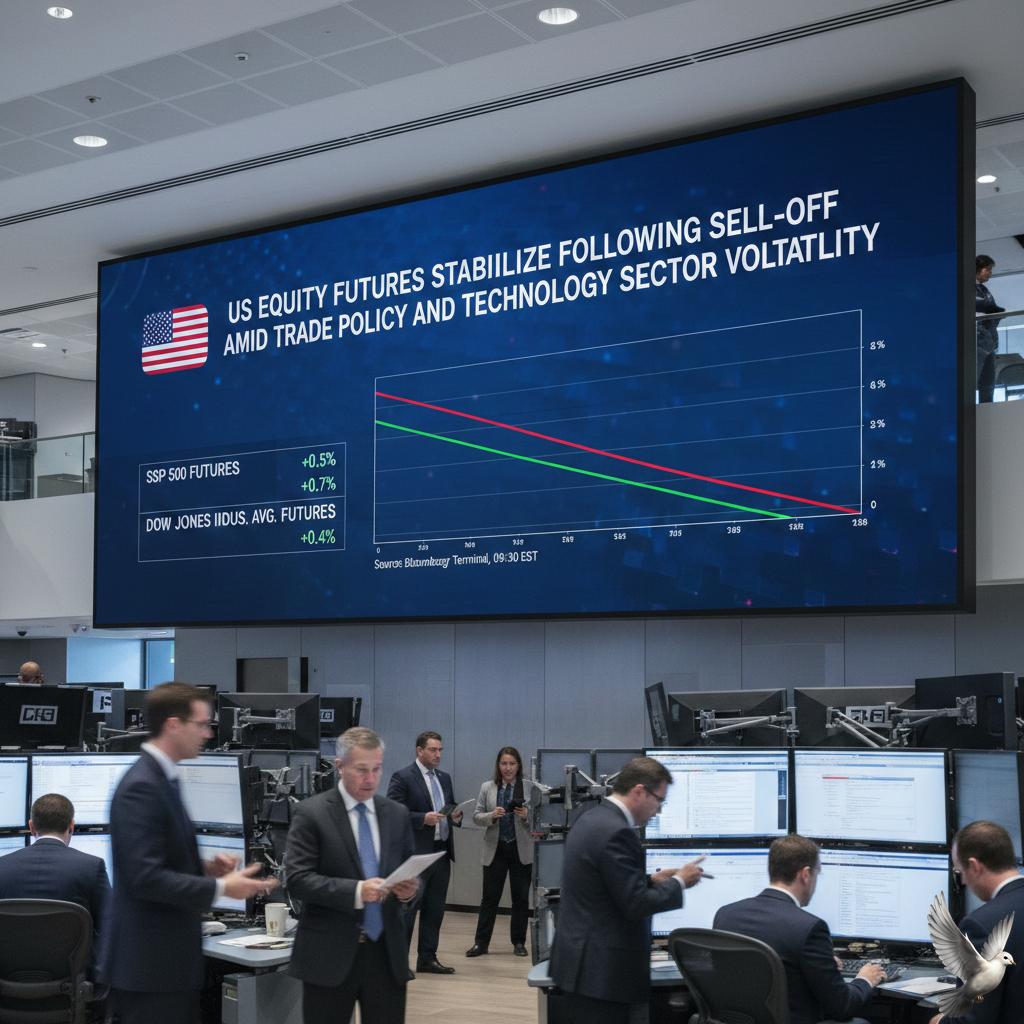
US Equity Futures Stabilize Following Sell-off Amid Trade Policy and Technology Sector Volatility
U.S. stock index futures marked a cautious recovery on Tuesday morning, attempting to stabilize after a volatile session that saw the Dow Jones Industrial Average plunge more than 800 points.
Market sentiment is currently defined by a "scare trade" driven by two primary catalysts: aggressive new trade policies from the White House and mounting structural concerns regarding the long-term impact of artificial intelligence on traditional business models.
As of early Tuesday, Dow Jones Futures rose 152 points, a gain of 0.31%, bringing the contract to 49,001. S&P 500 Futures edged up by 0.20% to 6,865.50, while Nasdaq 100 Futures climbed 0.28% to reach 24,831.75.
This modest bounce follows a sharp broad-market selloff on Monday triggered by President Donald Trump's announcement to raise global tariffs to 15%. This move followed a Supreme Court ruling that had previously challenged the administration's legal authority to impose "reciprocal" taxes.
The trade escalation has injected fresh uncertainty into global supply chains. Markets are particularly sensitive to the 15% levy, which many economists view as a significant macroeconomic shock. Current estimates suggest that a sustained 25% tariff increase could potentially reduce U.S. GDP growth by 2.5% and push inflation higher by 1.5% over the next two years.
The tech sector faces additional pressure from a deepening "AI scare." Skepticism is growing over the immediate return on massive AI investments. This anxiety was exacerbated by a significant 13% drop in IBM shares following reports that new AI tools could disrupt its core legacy systems.
Investors are now pivoting their focus toward the upcoming Nvidia earnings report on Wednesday, which is widely seen as a critical litmus test for the continued viability of the AI trade.
Broader economic indicators reflect a complex landscape. While the U.S. economy grew at a 1.4% annualized rate in the final quarter of 2025, consumer confidence has recently touched its lowest level since 2014.
The labor market remains a point of contention, with the unemployment rate hovering around 4.0%, even as fears persist that rapid AI automation could eventually trigger higher joblessness in white-collar sectors.
In other asset classes, gold has maintained its position as a primary hedge, trading near $5,193 per ounce despite a slight 0.61% dip Tuesday morning. Crude oil prices remained relatively flat at $66.23 per barrel.
Traders are now awaiting the President’s State of the Union address and fresh consumer data for further direction. The prevailing mood remains skittish, as participants weigh whether the current recovery is a genuine floor or merely a temporary pause in a larger structural realignment.