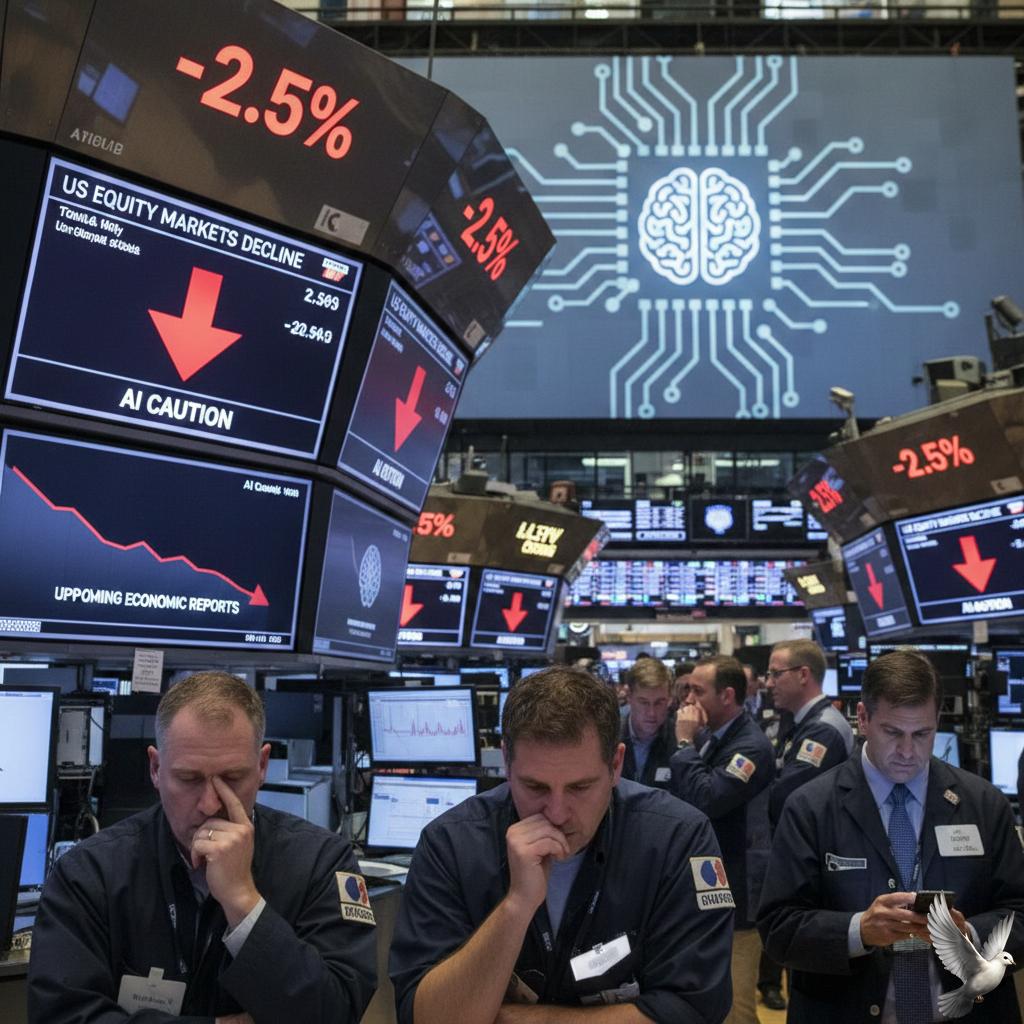
US Equity Markets Decline Amid AI Sector Caution and Upcoming Economic Reports
Wall Street is navigating a high-stakes opening this Monday, February 9, 2026, as the market digests a historic milestone alongside deepening anxiety over technological disruption.
The Dow Jones Industrial Average is the focal point of global finance after a massive surge of 1,200 points on Friday. This rally pushed the index to its first-ever close above the 50,000 mark. Despite this record, futures for the major indexes are edging lower this morning, reflecting a cautious "wait-and-see" mood among institutional traders.
The technology sector remains the primary source of volatility. Last week, software stocks experienced a significant 7.5% decline, driven by fears that new autonomous AI tools are beginning to displace traditional enterprise software models.
Investors are closely tracking capital expenditure from the "Hyperscalers"—Amazon, Microsoft, Alphabet, and Meta. These companies are projected to spend a staggering $600 billion to $650 billion on AI infrastructure in 2026. This massive investment represents an 80% increase from 2025 levels, putting significant pressure on corporate free cash flow.
Economic data releases scheduled for this week are expected to dictate the Federal Reserve's next moves. The market is awaiting the January Jobs Report and fresh Consumer Price Index (CPI) figures, which were previously delayed by government disruptions.
The Federal Reserve currently maintains interest rates in the 3.50% to 3.75% range. While the central bank paused its cutting cycle in January, most analysts expect two additional 25-basis-point cuts later this year.
Inflation indicators remain a concern. Core CPI was last recorded at 2.6%, still above the Fed’s 2.0% target. Traders are scanning this week’s data for any signs of "sticky" inflation that could force the Fed to keep rates higher for longer.
Under the surface of the major indices, a significant sector rotation is underway. While tech struggles with a 18.6% year-to-date loss in the software sub-sector, energy stocks have gained traction, supported by a 12% rise in oil prices since the start of the year.
The S&P 500 closed the previous week at 6,932.30, while the Nasdaq-100 is struggling to reclaim its 50-day moving average. Technical analysts are watching for a potential rebound in software, which has reached "oversold" levels not seen in nearly 15 years.
In the digital asset space, Bitcoin has retreated below the $70,000 level, currently trading near $69,000. This downward trend follows the broader risk-off sentiment affecting high-growth assets.
This week’s compressed economic calendar, featuring retail sales on Tuesday and employment data on Wednesday, is likely to trigger sharp intraday price swings as the market recalibrates its 2026 outlook.