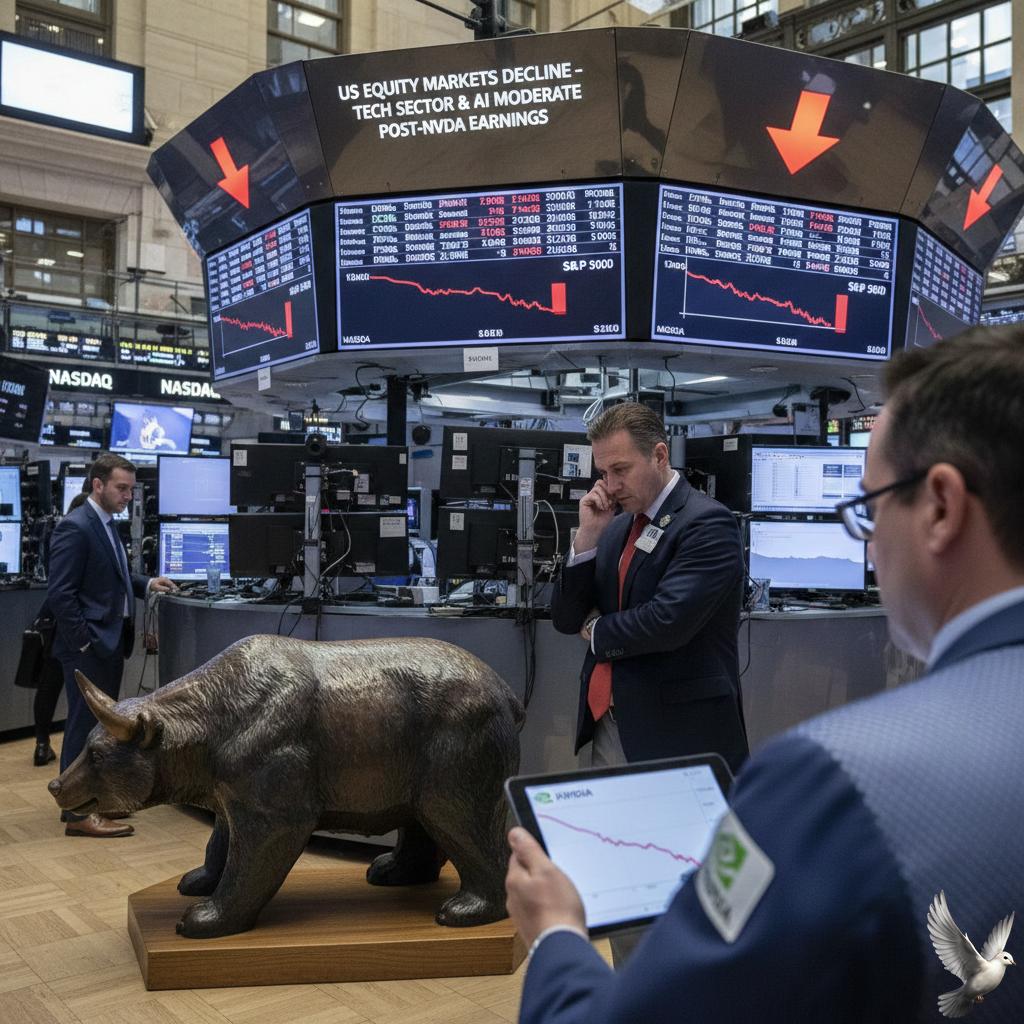
US Equity Markets Decline as Technology Sector and AI Momentum Moderate Following Nvidia Earnings
U.S. equity markets experienced significant volatility on Thursday, February 26, 2026, as a sharp tech selloff overshadowed record-breaking financial results from industry bellwether Nvidia. While the Dow Jones Industrial Average managed a fractional gain of **0.03%** to close at **49,499.20**, the broader market struggled under the weight of profit-taking in the semiconductor sector.
The tech-heavy Nasdaq Composite bore the brunt of the decline, falling **1.18%** to finish at **22,878.38**. This downward pressure was mirrored in the S&P 500, which slipped **0.54%** to end the session at **6,908.86**.
Nvidia’s fourth-quarter earnings report, released late Wednesday, surpassed expectations with record revenue of **$68.1 billion**—a **73%** increase year-over-year. Despite guiding for **$78 billion** in the upcoming quarter, the stock tumbled **5.5%** on Thursday. Analysts noted that the "pump-and-dump" price action reflected exhaustion among investors who had already priced in a perfect result.
The Philadelphia SE Semiconductor Index (SOX) dropped significantly, threatening to snap an **11-week** winning streak. This retreat highlights growing skepticism regarding the long-term return on investment for artificial intelligence. While hyperscalers are projected to spend over **$500 billion** on AI infrastructure in 2026, concerns about a potential "AI bubble" are driving rotation into defensive and cyclical sectors.
The software sector also faced headwinds, with Salesforce falling **3.5%** following a conservative revenue outlook. Volatility has been exacerbated by the high costs of maintaining AI models and fears that automation may disrupt traditional software seat demand. Market participants are increasingly focused on how sustained infrastructure demand will translate into tangible corporate productivity gains.
Trading volume reached **351 million** shares for Nvidia alone, more than double its three-month average. While the majority of S&P 500 constituents actually traded higher, the sheer market capitalization of the declining tech giants pulled the major indices lower.
Looking ahead, the market remains rangebound as it approaches the end of February. Traders are closely monitoring a widening gap between record earnings and stock price sustainability, particularly as the VIX volatility index climbed nearly **4%** to **18.63** during the session.