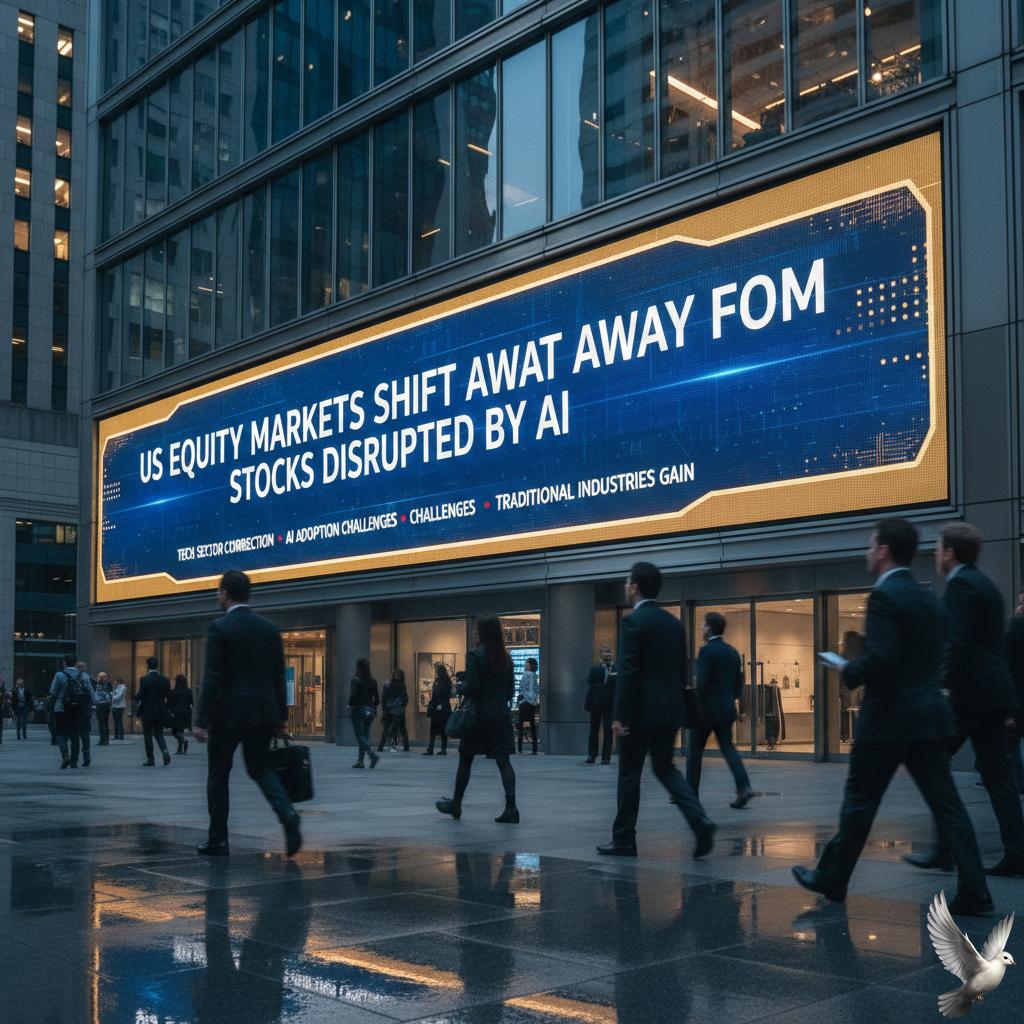
**US Equity Markets Shift Away From Stocks Disrupted by AI**
Market dynamics are shifting as Wall Street transitions from a "buy everything AI" phase to a strategic sell-off of traditional firms vulnerable to automation. Investors are increasingly focused on avoiding potential disruption rather than chasing winners, leading to a "sell first, ask questions later" mentality across service-heavy industries.
Financial Services and Wealth Management
The wealth management sector recently faced intense pressure following the launch of an AI-powered tax-strategy tool by the startup Altruist. The product, which automates personalized tax planning and analyzes financial documents without manual input, triggered a significant retreat in major stocks.
On **February 10, 2026**, market reactions were swift:
* **Raymond James Financial** plummeted **8.8%**, its steepest decline in years.
* **LPL Financial Holdings** dropped **8.3%**.
* **Charles Schwab** shares fell **7.4%**, moving away from its recent high of **$107.21**.
This trend reflects deep-seated fears that AI will disintermediate human advisors and compress long-standing fee structures.
Broader Sector Disruption
The anxiety is not limited to finance. In early **February 2026**, product rollouts from firms like Anthropic and Insurify sparked similar panics in other verticals:
* **Legal and Software:** Anthropic’s new productivity tools for in-house legal teams caused a sharp sell-off in legal software and information-services firms like **Thomson Reuters** and **RELX**.
* **Insurance:** The S&P 500 insurance index sank **3.9%** in a single session after an AI-driven car insurance comparison tool raised concerns about the long-term viability of traditional brokers.
* **Business Software:** Established players like **Salesforce** and **Adobe** have faced months of volatility as the market questions if their SaaS business models are becoming obsolete. Even **Palantir**, a former AI darling, saw shares drop more than **11%** in recent trading.
The Great Divergence
A "Great Divergence" is forming in the technology trade. While software and service companies are being penalized, infrastructure providers continue to attract massive capital.
* **Capital Expenditure:** Hyperscalers (Alphabet, Meta, Microsoft, and Amazon) are projected to spend a combined **$527 billion** in **2026**, up from **$465 billion**.
* **Semiconductors:** This sector remains a primary pillar, with global sales reaching **$179.7 billion** in a single quarter, supported by nearly **20%** year-over-year growth.
* **Valuation Gaps:** AI infrastructure and chip companies are being rewarded for visible revenue links, while "AI Productivity Beneficiaries" are underperforming due to uncertainty regarding the timing of actual earnings gains.
Strategic Outlook
The narrative has shifted toward a "Crisis of Distinctiveness." In content-centric sectors like marketing and legal services, the abundance of low-cost synthetic assets is devaluing traditional service models.
Current market data suggests that while high-net-worth clients still value human relationships, the administrative and technical aspects of wealth management—such as trade execution, tax harvesting, and compliance—are being rapidly commoditized by autonomous agents. Investors are now pricing in a future where only firms that successfully augment their staff with AI, rather than competing against it, will survive margin compression.