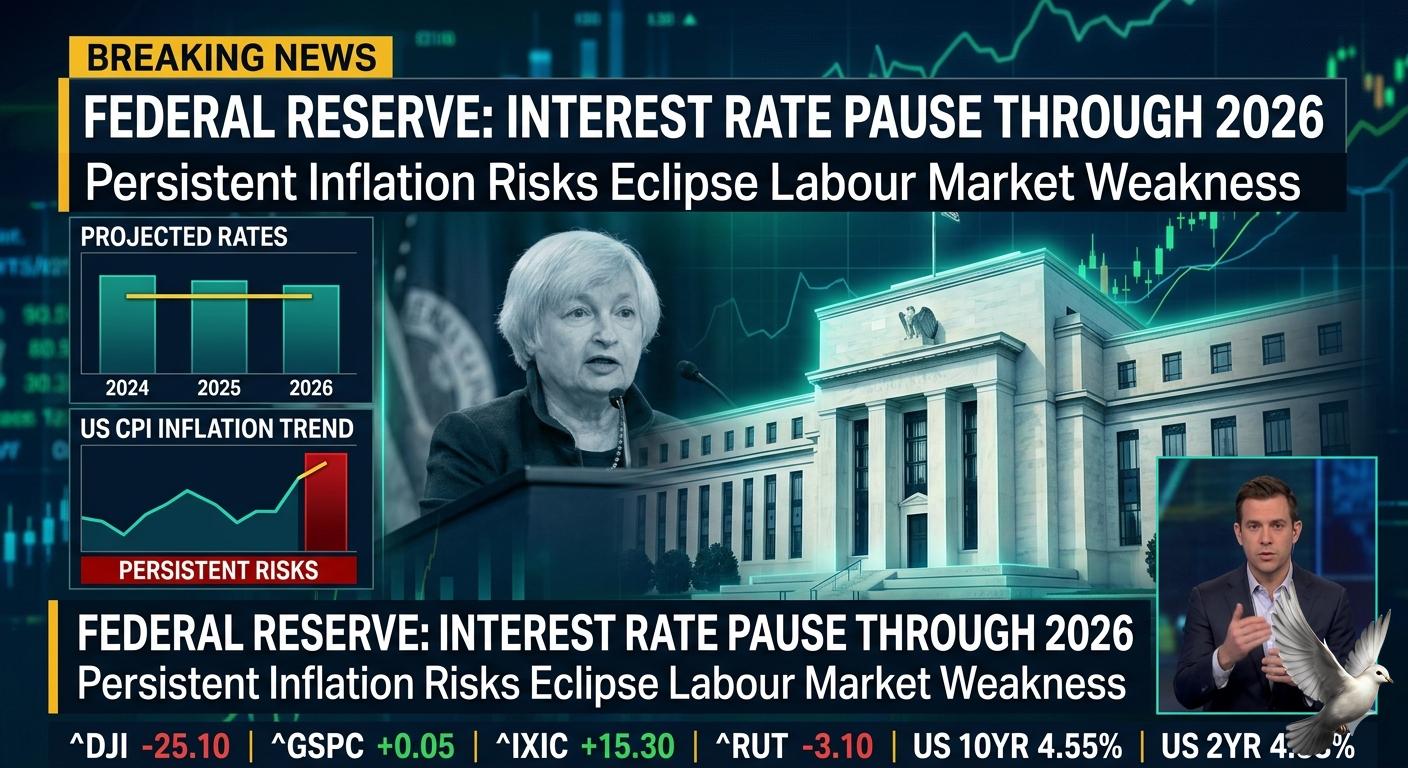
US Federal Reserve Projecting Interest Rate Pause Throughout 2026 as Persistent Inflation Concerns Eclipse Labour Market Moderation
The US Federal Reserve is structurally altering its monetary policy trajectory. Institutional research reports indicate that the central bank is highly likely to abandon its previous interest rate easing bias at the upcoming Federal Open Market Committee meeting. This pivot signals a strategic shift toward a prolonged tightening or holding stance extending through the calendar year.
Macroeconomic modeling outlines a conditional escalating risk profile for fixed-income markets. Analysts highlight a **20%** probability of a **25 basis point** interest rate hike during the December policy meeting. This tightening scenario is contingent upon persistent supply-side shocks, specifically if strategic maritime chokepoints like the Strait of Hormuz experience extended closures, forcing global energy benchmarks to spike further.
The broader shift in the Federal Reserve's policy framework is heavily influenced by stubborn consumer price trajectories. While components of the domestic labor market have shown signs of subtle moderation and cooling, stickier structural inflation dynamics continue to eclipse employment concerns. This forced co-existence of high pricing pressures and softening job metrics has complicated the central bank's path toward dual-mandate stabilization.
Global bond and equity markets are already pricing in this higher-for-longer interest rate scenario. The benchmark US **10-year** Treasury yield has climbed significantly, consolidating near the **4.55%** threshold. Concurrently, the **2-year** Treasury yield, which remains highly sensitive to immediate central bank policy shifts, has pushed upward to trade near **4.88%**, reflecting market expectations that interest rate cuts are completely off the table for the foreseeable future.
This domestic fixed-income adjustment has injected substantial momentum into foreign exchange clearing matrices. The US Dollar Index, which measures the greenback against a basket of six major global currencies, has strengthened considerably to test the **106.30** mark. A stronger dollar continues to exert compounding pressure on emerging market asset classes and cross-border capital flows.
On the domestic equity front, major tracking benchmarks are navigating increased volatility as institutional portfolios recalibrate for sustained high borrowing costs. The S&P 500 index recently pulled back to negotiate support near the **5,120** level, while the tech-heavy Nasdaq Composite has felt the brunt of escalating yields, retreating toward the **16,100** mark.
Higher structural interest rates are also altering corporate credit dynamics. High-yield corporate bond spreads have begun to widen slightly as refinancing risks rise for leveraged corporate balance sheets. Industrial commodities are displaying divergent trends, with gold retaining a geopolitical risk premium near **$2,350 per ounce**, while international Brent crude trades firmly above **$84 per barrel** on localized supply anxieties.