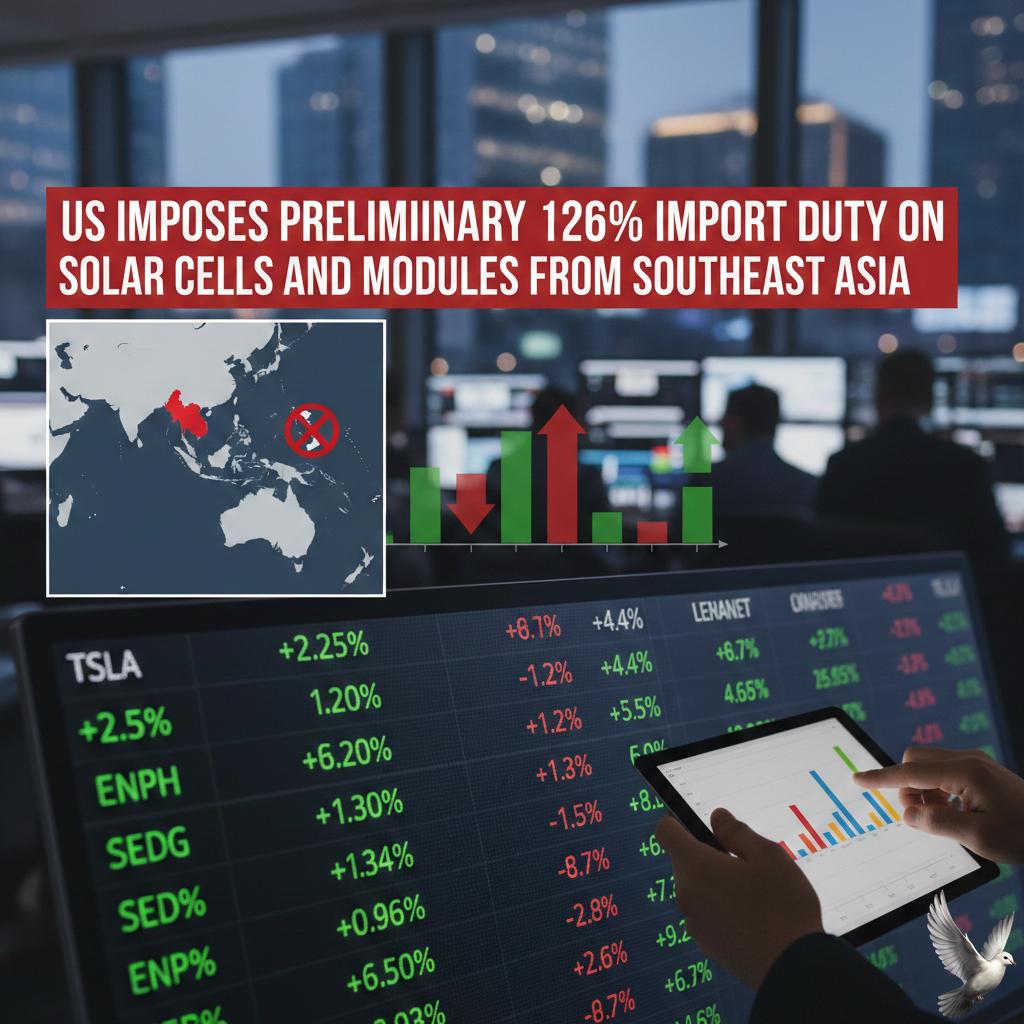
US Imposes Preliminary 126% Import Duty on Solar Cells and Modules From Southeast Asia
The US Commerce Department has sent shockwaves through the renewable energy sector by imposing preliminary countervailing duties of 126% on solar imports from India.
This move follows a determination that Indian manufacturers benefit from unfair subsidies, allowing them to undercut American producers. The decision effectively makes the US market inaccessible for many Indian exporters who had recently seen a surge in demand.
India, Indonesia, and Laos combined to supply 57% of US solar module imports in the first half of 2025. For India, the stakes are high as the US remains its primary export destination, accounting for roughly 97% of all solar module shipments. In 2024 alone, Indian solar exports to the US were valued at 792.6 million dollars—a nine-fold increase from 2022.
Market leaders like Waaree Energies and Premier Energies are now in the spotlight as they navigate this trade barrier. Waaree Energies, with a market capitalization of approximately 83,873 crore rupees, has moved to mitigate such risks by establishing manufacturing capacity within the US. In contrast, Premier Energies maintains a smaller export footprint to the US but faces increased competition in the domestic market as export-diverted supply grows.
The timing of this duty is particularly significant. It comes just weeks after a bilateral trade framework aimed to reduce tariffs on Indian solar products to 18%. Instead, the new 126% levy, coupled with a baseline 10% global tariff recently issued by the US administration, creates a formidable wall for Indian solar hardware.
Analysts note that these duties may lead to a supply glut within India. Domestic manufacturing capacity has expanded rapidly, reaching 55 GW for modules and 52 GW for cells by late 2025. With the US market closing, manufacturers may be forced to aggressively target domestic projects or seek new markets in Europe and Africa.
Despite the export hurdle, India's internal solar market remains robust. The country added a record 37.9 GW of solar capacity in 2025, a nearly 55% increase year-on-year. Government initiatives like the PM Surya Ghar program, which targets solar for 10 million households, continue to provide a critical safety net for domestic manufacturers.
A final determination on these subsidy investigations is expected by July 2026. Until then, Indian solar stocks are likely to experience heightened volatility as firms recalibrate their global sales strategies and accelerate local deployment to offset international losses.