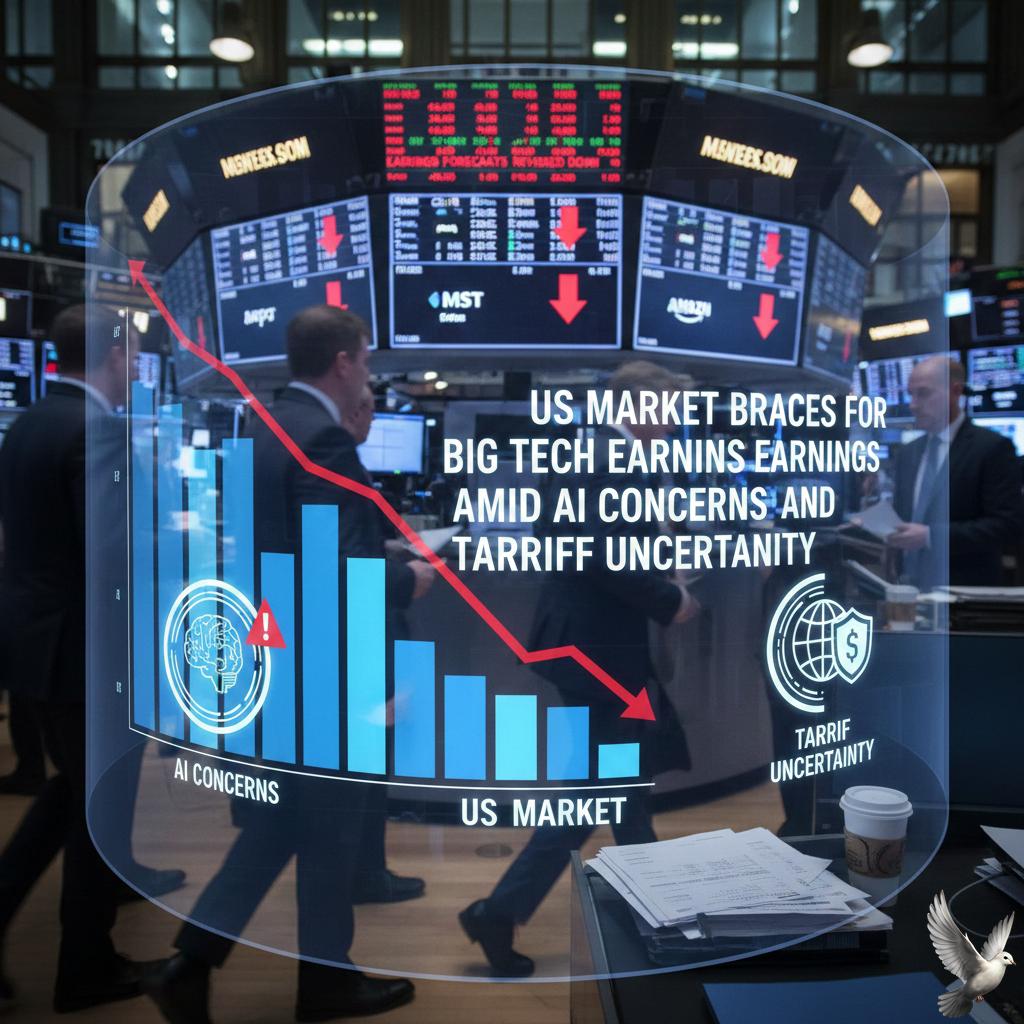
US Market Braces for Big Tech Earnings Amid AI Concerns and Tariff Uncertainty
Market Outlook: AI Resilience Amid Sector Rotation
Global markets enter a defining week as tech heavyweights prepare to report, with the focus squarely on the sustainability of the AI investment cycle. While the **S&P 500** and **Dow Jones** maintain an upward bias, a significant internal rotation is underway. Investors are increasingly pivoting toward "real economy" sectors, with **Energy** and **Industrials** outperforming the broader market by a wide margin in early 2026.
The Nvidia Benchmark
Nvidia remains the primary barometer for the AI trade. The market anticipates its fourth-quarter fiscal 2026 results on **February 25**, with revenue expectations set at **$65.68 billion**. This follows a record-breaking third quarter where the company hit **$57 billion** in revenue, marking a **62%** year-on-year increase.
Key metrics for investors:
* **Earnings Per Share (EPS):** Consensus estimates sit at **$1.46**.
* **Gross Margins:** Projected to climb toward **74.97%**.
* **Data Center Revenue:** Expected to reach **$59.9 billion**, driven by the Blackwell chip ramp-up.
Trade Policy and Global Shifts
Recent shifts in U.S. trade policy are beginning to reshape capital flows. A landmark bilateral trade agreement between the U.S. and India, announced in early February, has reduced reciprocal tariffs on Indian exports from **25%** to **18%**. This "reset" is designed to stabilize trade relations but also introduces new purchase commitments for India in the energy and technology sectors.
While policy clarity has improved, tech stocks remain sensitive to export control updates. Nvidia recently flagged a potential **$8 billion** revenue loss for the upcoming quarter due to tighter licensing requirements on high-end AI hardware shipments to specific regions.
Indian IT Facing Structural Headwinds
The Indian IT sector is navigating a period of intense volatility. While the **BSE Sensex** has shown modest gains of **0.4%** recently, major IT players like **Wipro** and **L&T Technology Services** have seen year-to-date declines between **22%** and **35%**.
Traditional service models are under pressure as AI disrupts core functions like testing and coding. Analysts have downgraded several large-cap firms, forecasting a modest **6%** earnings growth through 2028. However, specific AI-centric companies are bucking the trend:
* **Netweb Technologies** reported a **141%** year-on-year revenue surge.
* **TCS** has secured an annualized AI service revenue of **$1.8 billion**.
* India's total IT industry is still on track to reach **$350 billion** by the end of 2026.
The Rise of "Real Economy" Stocks
A distinct market rotation is favoring sectors that provide essential services and physical infrastructure. **Energy stocks** have surged more than **22%** since the start of the year, supported by rising oil prices and geopolitical tensions.
**Industrials** are also leading, with companies like Caterpillar and GE Vernova benefiting from the massive data center buildout required to support global AI demand. This shift indicates that while the "AI trade" is narrowing, the infrastructure behind it remains a powerful growth engine for the broader economy.