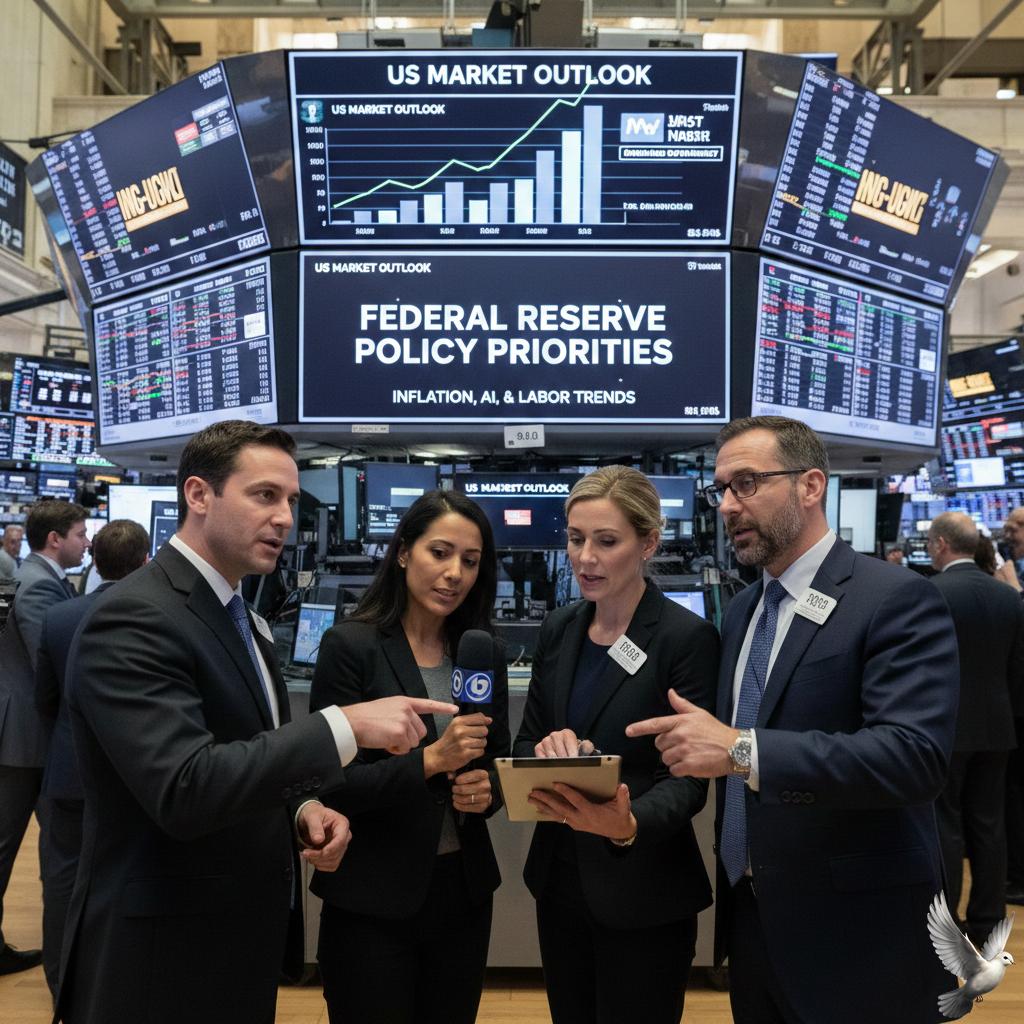
US Market Outlook: Federal Reserve Policy Priorities Amid Inflation, AI, and Labor Trends
San Francisco Fed President Mary Daly recently reaffirmed the central bank’s commitment to a restrictive policy stance, emphasizing that inflation reduction remains the primary objective. Despite market optimism regarding artificial intelligence, Daly noted a significant lack of macroeconomic evidence showing an AI-driven productivity surge.
The Federal Reserve is currently maintaining the federal funds rate in a target range of 3.50% to 3.75%. While the central bank implemented three rate cuts in late 2025, the FOMC voted 10–2 in late January 2026 to hold rates steady. This "hawkish pause" reflects concerns over core inflation, which remains stubbornly elevated near 3.0%.
Macroeconomic data highlights a complex economic landscape. Headlines show the U.S. economy is projected to grow by 2.25% to 2.5% in 2026. However, the labor market is entering a "selective thaw" characterized by a "low-hire, low-fire" environment. Job openings have plummeted to 6.5 million, the lowest level since 2020.
Labor market vulnerabilities are becoming more apparent as hiring becomes highly concentrated. In January 2026, the healthcare sector accounted for 123,500 new jobs, nearly four times the gains of any other sector. Meanwhile, professional and business services saw a sharp decline of 257,000 openings, suggesting that firms are exercising extreme caution.
The impact of AI on corporate earnings remains uneven. While "Magnificent Seven" tech giants are projected to see 18% earnings growth this year fueled by a combined $700 billion in capital expenditure, the rest of the S&P 500 expects a more modest 11% increase. Analysts suggest that most companies outside the tech sector have yet to see AI translate into improved profit margins.
Daly drew historical parallels to the 1990s tech boom, suggesting that while AI could eventually boost productivity by 0.3% to 0.6% annually, the economy is "not there yet." For now, the Fed remains focused on ensuring that growth does not reignite price pressures, with the next potential rate cut not anticipated by markets until June 2026.
Current indicators show headline PCE inflation at 2.4% and core PCE at 2.5%, down from 3.0% in late 2025. Despite this progress, officials like Daly and Governor Michael Barr signal that rates must remain steady to ensure a sustainable return to the 2% target. Business leaders continue to navigate this environment by prioritizing efficiency over aggressive payroll expansion.