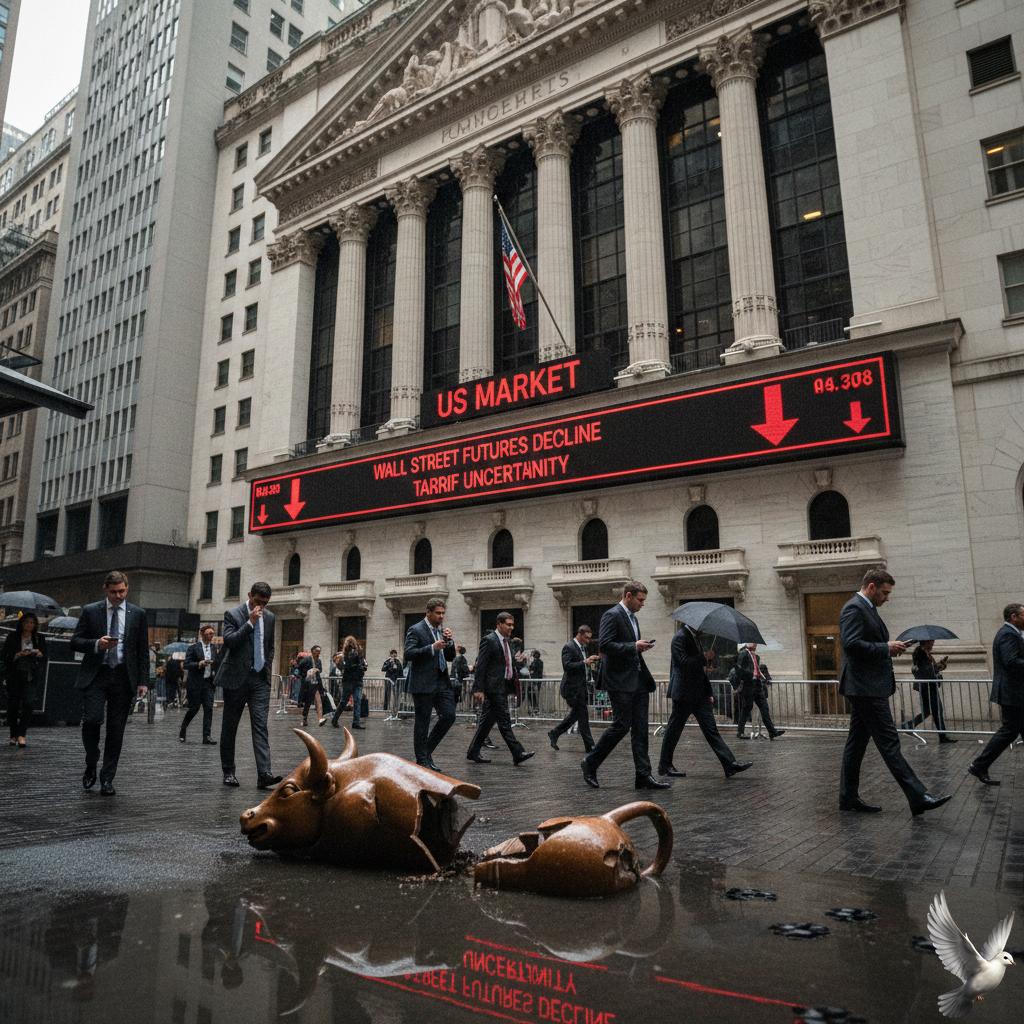
US Market: Wall Street Futures Decline Amid Tariff Uncertainty
U.S. stock index futures dropped on Monday, February 23, 2026, as renewed trade uncertainty hit global markets. Investor sentiment soured after President Donald Trump announced a new 15% global tariff, despite a major legal setback at the Supreme Court.
The high court ruled 6-3 on Friday that the administration’s previous broad levies were illegal under the International Emergency Economic Powers Act. While the market initially cheered the ruling, the administration quickly shifted to Section 122 of the Trade Act to reimpose duties.
Market Snapshot (Pre-Market):
- Dow E-minis: Down 224 points (0.50%)
- S&P 500 E-minis: Down 40 points (0.60%)
- Nasdaq 100 E-minis: Down 185 points (0.70%)
The new 15% flat-rate tariff is expected to take effect immediately. Under current legal frameworks, this levy can last up to 150 days without Congressional approval. This creates a volatile environment for supply chain planning and corporate revenue forecasting through the first half of 2026.
Economic data is further complicating the outlook. Recent reports show U.S. business activity at a 10-month low, with GDP growth slowing and inflation remaining stubborn. This "stagflation" signal has weakened the U.S. dollar, which fell 0.4% against a basket of currencies this morning.
Safe-haven assets are seeing increased demand amid the chaos. Gold jumped 0.6% to reach $5,135 per ounce, its highest level since late January. Meanwhile, oil prices retreated, with Brent crude falling 1.3% to $70.39 and WTI dropping to $65.55 as traders weighed the impact of trade friction on global demand.
Corporate Focus:
- Nvidia: Shares ticked up 0.2% ahead of quarterly earnings due Wednesday, which will serve as a critical health check for the AI sector.
- Alphabet: Gained 0.5% in pre-market trading, continuing a recovery from the previous session.
- Retail/Manufacturing: These sectors face significant volatility as they navigate potential refunds of $175 billion from the overturned tariffs versus the costs of the new 15% duty.
Global partners are already reacting. The European Union and India have signaled potential delays in trade negotiations. Analysts suggest that while the previous "scaffolding" of tariffs was removed by the court, a new, more unpredictable trade regime is already being built.