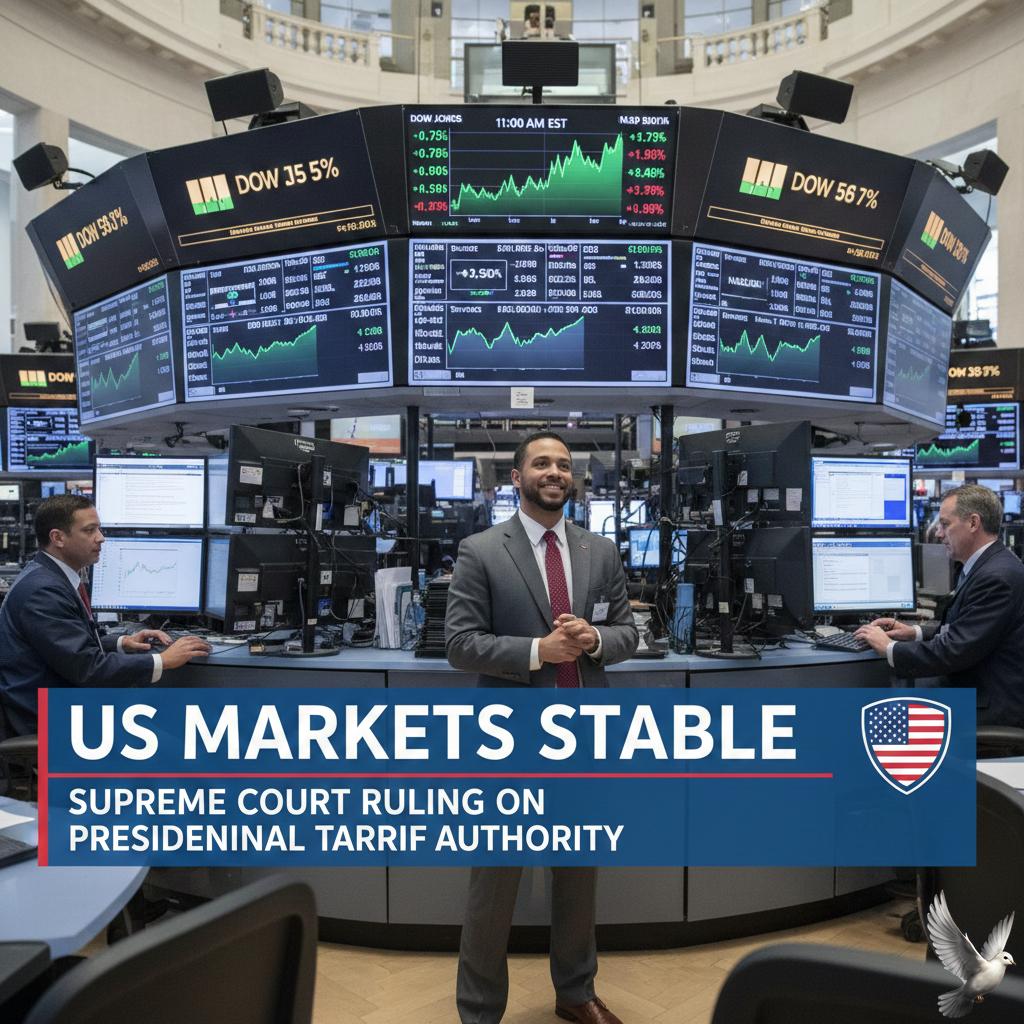
US Markets Stable Following Supreme Court Ruling on Presidential Tariff Authority
Market Brief: Global Trade Policy Shifts
**February 23, 2026**
The global trade landscape has entered a period of intense volatility following a landmark **6-3 Supreme Court ruling** on February 20. The Court struck down broad "reciprocal" tariffs previously imposed under the International Emergency Economic Powers Act (IEEPA), ruling the executive branch exceeded its authority.
The decision has immediate fiscal implications, with an estimated **$175 billion to $284 billion** in collected duties now potentially subject to corporate refunds. Major US refiners and retailers are already initiating litigation to recover these payments.
Immediate Policy Response
In a direct pivot to bypass the judicial setback, a new **15% global baseline tariff** has been announced. This measure utilizes **Section 122 of the Trade Act of 1974**, a different legal framework designed to address balance-of-payment deficits.
This new levy is currently set for a **150-day window**. Extension beyond this period will require congressional approval, setting the stage for a significant legislative battle by late summer 2026.
Market and Sector Reactions
Financial markets reacted with a "Sell America" narrative over the weekend. The **US Dollar Index shed 0.2%**, while **S&P 500 and Nasdaq 100 futures dropped by 0.7% and 0.9%** respectively during Monday’s Asia session. Gold prices have surged, testing resistance at **$5,170 per ounce** as investors seek safety.
In the logistics sector, the **Drewry World Container Index** showed a slight decline to **$1,919 per 40-foot container**, reflecting a "shippers' market" characterized by soft demand and excess capacity despite the policy turbulence.
Regional Impact: China and South Korea
South Korean exports demonstrated resilience despite the uncertainty. Data for the first 20 days of February shows outbound shipments jumped **23.5% to $43.52 billion**. This growth was propelled by a **134% surge in semiconductor exports**, totaling **$15.12 billion**.
While South Korea maintains a trade surplus of **$4.95 billion**, the automotive sector remains a weak point, with shipments dipping **26.6%** amid the tariff shifts. Exports to China notably rose nearly **31%**, while shipments to the US increased **22%** in the same period.
Stability of Existing Deals
US trade officials have moved to reassure partners that the approximately **20 bilateral framework deals** struck over the last year remain in force. This includes specific agreements with the UK, EU, and India.
The EU has expressed concern that the new **15% levy** might be layered on top of existing negotiated rates, though US representatives insist these deals are separate from the global baseline. Strategic carve-outs for industries like UK pharmaceuticals and Indian energy remain critical components of current trade stability.