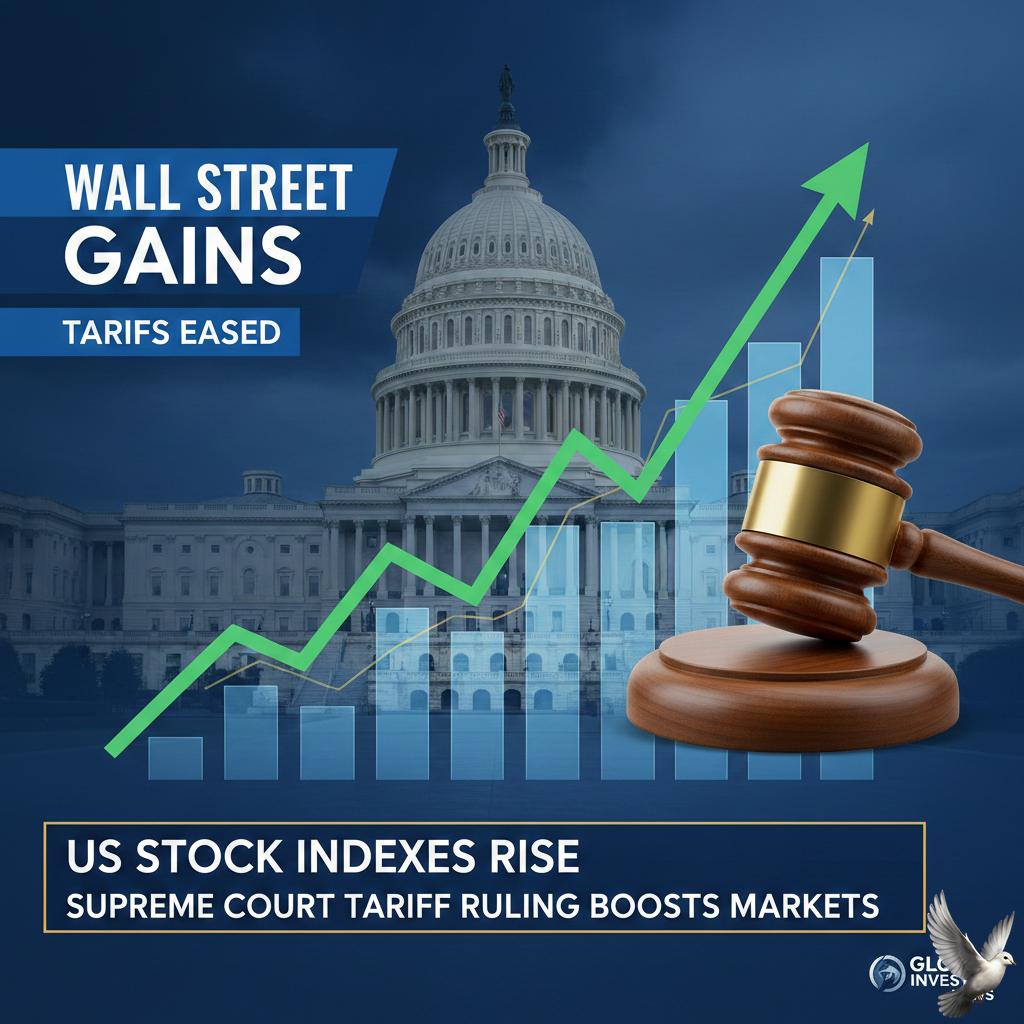
US Stock Indexes Rise Following Supreme Court Ruling on Tariffs
Wall Street surged on Friday as investors reacted to a landmark Supreme Court decision. In a 6-3 ruling, the court struck down the sweeping "Liberation Day" tariffs imposed by the administration under the 1977 International Emergency Economic Powers Act. The decision invalidates broad import taxes that had been in place since February 2025.
The ruling ignited a sharp market reversal. Earlier in the day, indexes had slumped following disappointing economic data showing fourth-quarter GDP growth at just 1.4%, well below the 2.5% forecast. However, the news from the high court provided immediate relief to thousands of companies that had challenged the legality of the levies.
Market performance reflected a significant boost in investor confidence. The Dow Jones Industrial Average gained 130 points to close at 49,525.59. The S&P 500 rose 0.66% to reach 6,907.34, while the tech-heavy Nasdaq Composite led the rally with a 1.11% surge, finishing the day at 22,935.19.
Retailers and technology firms with global supply chains saw some of the strongest gains. Many on Wall Street viewed the decision as a critical check on executive power, shifting the authority over trade and taxation back toward Congress. This shift is seen as a stabilizing force that reduces the risk of abrupt, unilateral economic actions.
The financial implications of the ruling are massive. Analysts estimate that more than $175 billion in previously collected tariffs may now be subject to refunds. While the government has collected roughly $160 billion under this specific emergency law, the ruling could eventually trigger repayments that reach into the hundreds of billions.
Volatility declined following the announcement. The VIX, often referred to as the market's "fear gauge," dropped 5% as the legal uncertainty surrounding global trade policy cleared. Major corporate gainers included Walmart, which rose 2.23% to $129.44, and Chevron, which climbed 1.78% to $187.15.
Despite the positive market reaction, some trade measures remain. Industry-specific tariffs on steel, aluminum, and automobiles—implemented under separate national security laws—were not affected by this specific ruling. However, the invalidation of the broader global duties has effectively removed a major tax burden from the U.S. economy.
International markets also tracked the gains on Wall Street. European and Asian indexes edged higher on hopes of a more predictable trade environment and a lower risk of retaliatory measures from key trading partners. The U.S. dollar weakened slightly as the shift in trade policy eased some inflationary concerns.