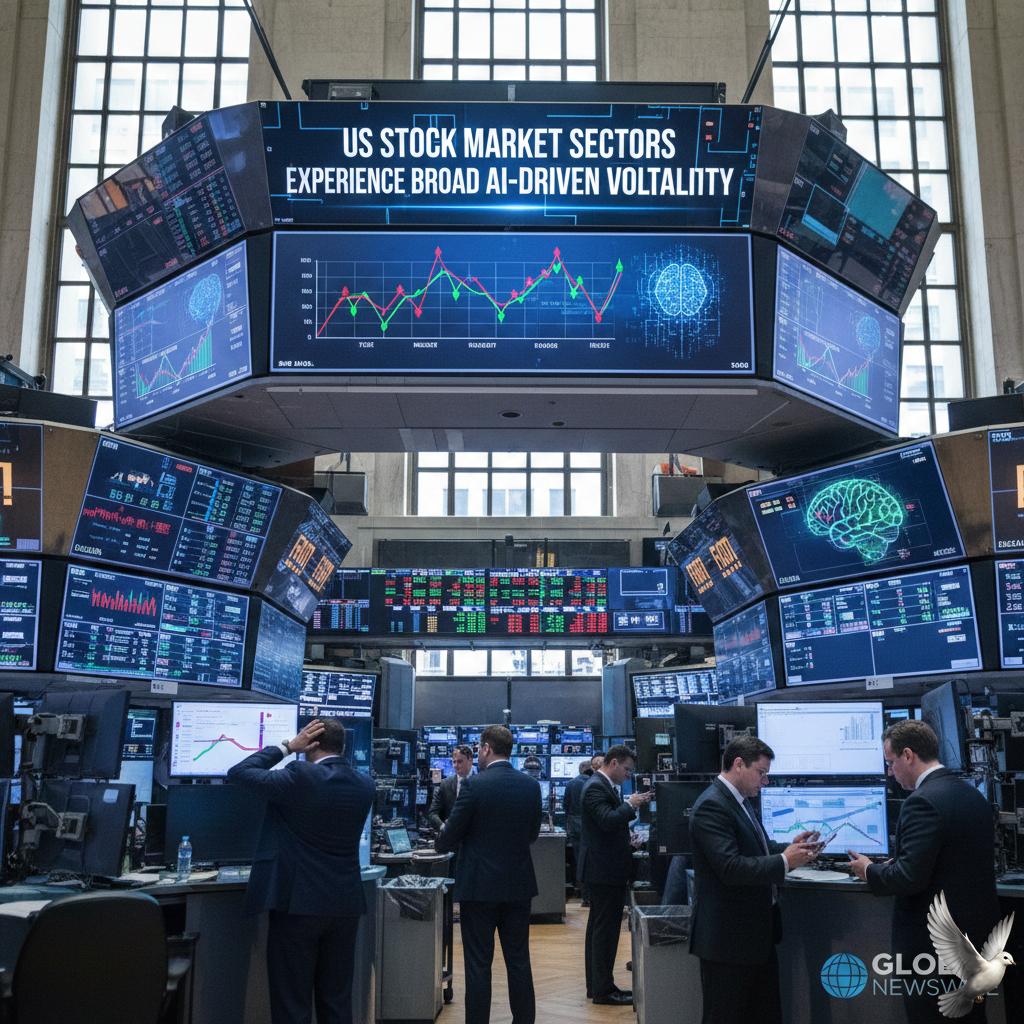
US Stock Market Sectors Experience Broad AI-Driven Volatility
Market Brief: The AI Disruption Scare
Wall Street is currently navigating a period of intense volatility as a "scare trade" regarding artificial intelligence (AI) shifts from optimism to widespread disruption fears. The sentiment has evolved from viewing AI as a universal growth engine to identifying it as a primary threat to established business models.
The sell-off initially hit the software sector with significant force. The S&P North American Technology Software Index has tumbled 19% since the start of the year, while the iShares Expanded Tech-Software Sector ETF (IGV) has plunged 31% from its peak, officially entering bear market territory.
Market panic deepened this week following the release of advanced "agentic" AI models capable of automating complex professional workflows. Investors are aggressively offloading shares in companies perceived as vulnerable to these autonomous tools, leading to a "sell first, think later" mentality across trading floors.
Sectoral Impact and Key Losses:
Software & IT: The software/IT sector has seen a sharp repricing. Loan prices in the syndicated market fell nearly 465 basis points in just one month, reaching an average bid of 90.4 on February 6, 2026.
Infrastructure & Networking: Cisco Systems saw its shares plummet 12% after providing disappointing guidance, which many analysts interpreted as a sign of shifting enterprise spending cycles away from legacy hardware.
Transportation & Logistics: The Dow Jones Transport Average sank 4% in a single session. Logistics leader C.H. Robinson plunged 14% on fears that AI-driven automation will compress margins and displace traditional freight brokerage services.
Financial Services: Major firms including Morgan Stanley and Goldman Sachs saw declines between 3% and 5%. The market is actively debating how AI-driven wealth management platforms might erode traditional advisory revenue streams.
Real Estate & Tech-Services: Concerns regarding AI-induced job losses have spilled into real estate, with CBRE falling 9%. High-valuation marketing platforms like AppLovin have also been hit hard, tumbling nearly 20% amid intense competitive pressure.
Despite the rout in "AI losers," the infrastructure race continues at a record pace. The top five U.S. hyperscalers—Amazon, Microsoft, Alphabet, Meta, and Oracle—have committed to a staggering $690 billion in capital expenditure for 2026. This represents a near-doubling of investment from 2025 levels.
While pure-play AI vendors like OpenAI have reached an annual recurring revenue of $20 billion, this remains a fraction of the capital being deployed. This widening gap between massive spending and actual monetization is contributing to a "prove it" year for the technology.
Investors are currently rotating capital into defensive havens to hedge against further volatility. Retail giants like Walmart and consumer staple stocks like Coca-Cola have bucked the downward trend, gaining ground as traders reposition for a more cautious economic landscape.