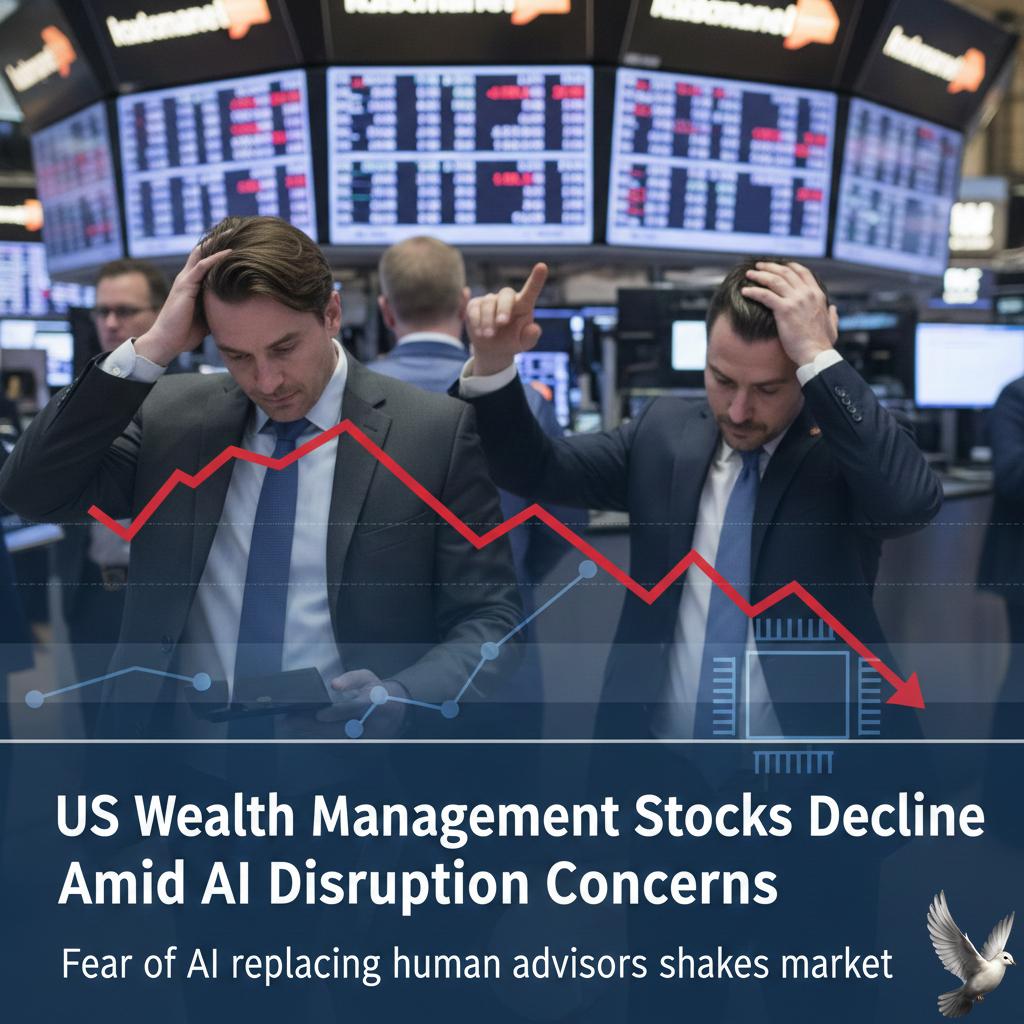
US Wealth Management Stocks Decline Amid AI Disruption Concerns
Recent market activity has seen a sharp divergence in the financial services sector as emerging generative AI tools rattle traditional wealth management and brokerage models. A major selloff on February 10, 2026, was triggered by the debut of advanced tax-planning automation, causing significant intraday volatility for established industry leaders.
Market Impact and Key Declines
The selloff was most pronounced in the brokerage space, where automation is seen as a direct threat to high-margin advisory services. Charles Schwab (SCHW) experienced a significant drop, plunging more than 9% during the February 10 session. This reaction followed the launch of a new AI tool by fintech platform Altruist, designed to automate complex tax strategies—a service historically reserved for human advisors.
Broad market sentiment across the sector was similarly pressured:
* The S&P 500 Financials sector was hit hard as investors re-evaluated business "moats."
* Morgan Stanley (MS) saw its stock retreat from its January 15 all-time high of 190.18, closing near 180.78.
* The volatility mirrored a 4% decline in the S&P 500 Insurance Index earlier in the week, sparked by similar AI-driven disruption in insurance brokerage.
The Shift Toward "Software 2.0"
Investors are increasingly concerned about fee compression as "Software 2.0" enters the wealth management space. New AI agents are now capable of analyzing 1040 forms, pay stubs, and meeting notes to generate interactive tax plans instantly. This transition threatens to commoditize advanced planning, with 83% of advisors already expecting to charge less than 1% for high-net-worth clients by the end of 2026.
Sector Outlook and Resilience
Despite the immediate selloff, market analysts suggest the reaction may be an overcorrection. Large-scale firms retain significant advantages through their vast data ecosystems and "unified client brains." Established players like Fidelity and JPMorgan are aggressively scaling their own AI infrastructure, with industry-wide AI spending projected to exceed $500 billion this year.
The emerging consensus points to a "profitability paradox." While total assets under management are projected to rise globally, profit margins are under pressure from a stuck cost-to-income ratio of approximately 68%. The winners in this environment are expected to be firms that successfully use AI to augment rather than replace the human element, focusing on emotional management and complex trade-offs that algorithms cannot yet resolve.
Current indicators suggest that while AI tax tools are a "door-opener" for client engagement, the human-in-the-loop remains essential for regulatory compliance and high-stakes decision-making. Wealth management stocks are now entering a phase where valuations will be tied to how effectively they decouple revenue growth from operational cost increases via these new technologies.