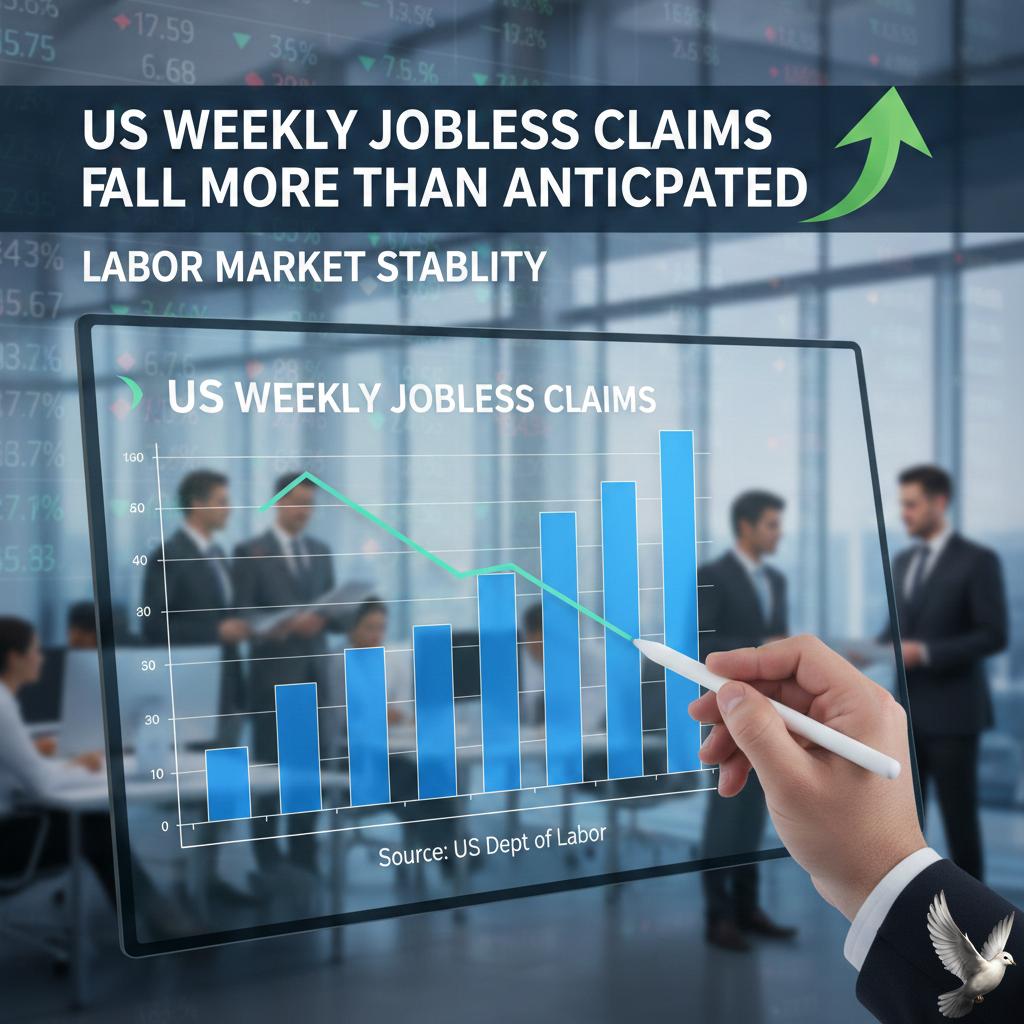
US Weekly Jobless Claims Fall More Than Anticipated Amid Labor Market Stability
US Labor Market Brief: February 2026
The US labor market showed unexpected signs of resilience this week as new applications for unemployment benefits fell to their lowest level since November. Initial jobless claims dropped by **23,000** to a seasonally adjusted **206,000** for the week ending February 14. This figure significantly outperformed market expectations, as economists had forecast a much higher volume of **225,000** claims.
This sharp decline in filings suggests that layoffs remain historically low across most private sectors. The four-week moving average, which provides a clearer view of long-term trends by filtering out weekly volatility, also edged down to **219,000**. These figures indicate a stabilization in the workforce following a brief spike in claims at the end of January.
Employment and Job Growth
Recent data confirms that while the labor market is cooling compared to previous years, it remains on a steady footing. Nonfarm payrolls grew by **130,000** in January, far exceeding initial estimates that ranged between **55,000** and **80,000**. The national unemployment rate currently sits at **4.3%**, a slight improvement from December’s **4.4%**.
Sector performance remains highly concentrated. The healthcare and social assistance sector accounted for the vast majority of gains, adding **123,500** jobs. Construction also showed strength with **33,000** new positions. Conversely, the federal government saw a decline of **34,000** jobs, continuing a downward trend that has resulted in a loss of over **320,000** public sector roles over the last twelve months.
Continuing Claims and Wage Trends
While new layoffs are infrequent, the pace of re-employment appears to be slowing. Continuing claims—the number of people already receiving benefits—rose to **1.87 million** for the week ending February 7. This increase suggests that workers who do lose their jobs are taking longer to find new opportunities in a "low-hire, low-fire" environment.
Wage growth is also showing signs of moderation. Average hourly earnings rose by **0.4%** in January to reach **$37.17**. On a year-over-year basis, wage inflation has cooled to **3.7%**, down from higher peaks seen in 2025. This deceleration is consistent with broader economic trends as headline consumer inflation recently moderated to **2.4%**.
Federal Reserve Outlook
The stability of the labor market has shifted expectations for monetary policy. According to recent meeting minutes, the Federal Reserve remains attentive to the balance between maintaining employment and reaching its **2%** inflation target.
With job growth proving more resilient than anticipated, market participants have pushed back expectations for interest rate cuts. Many analysts now look toward July 2026 for potential policy easing, rather than earlier summer projections. The central bank continues to monitor whether the concentration of job gains in a few sectors signals a underlying vulnerability or if the broader economy can maintain its current trajectory of modest, steady growth.