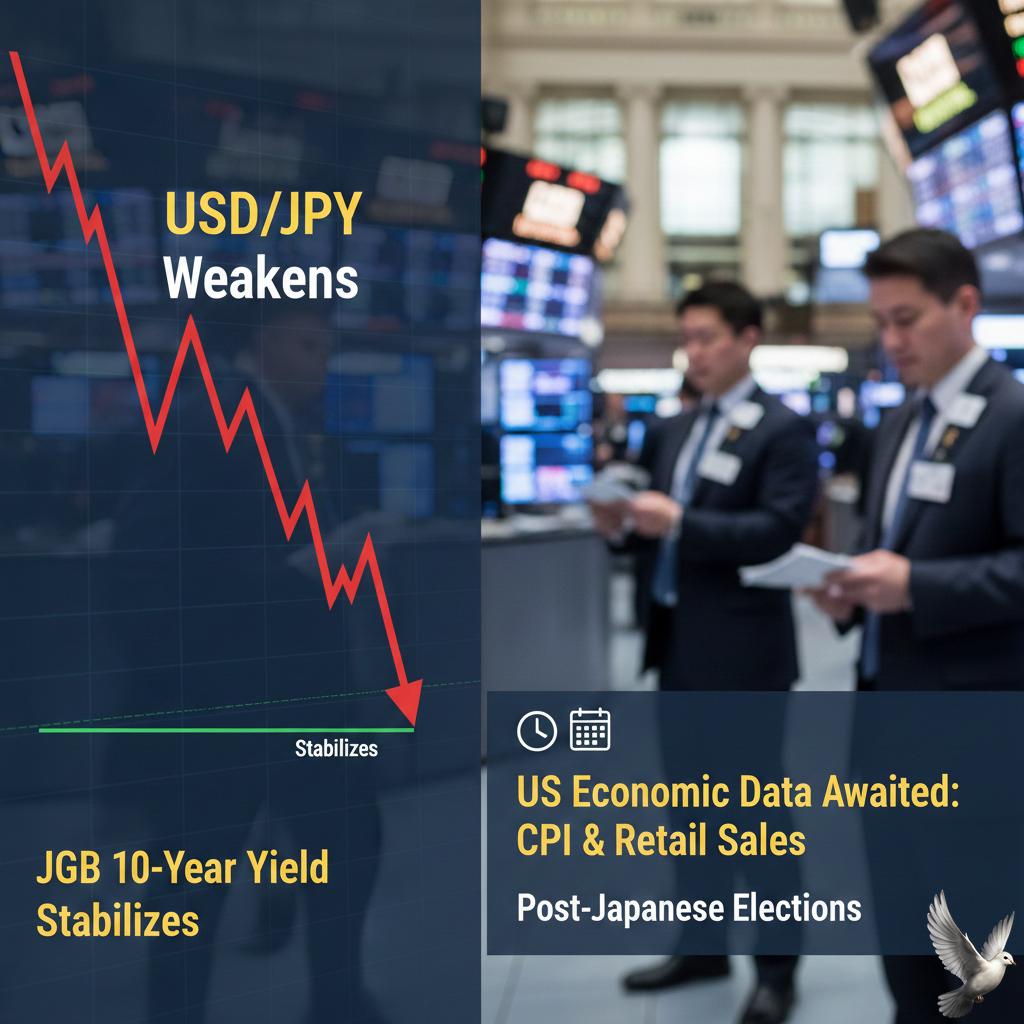
USD weakens and JPY stabilizes as markets await US economic data following Japanese elections
Market Brief: February 10, 2026
The U.S. dollar is trading with a downward bias as the market prepares for a significant influx of delayed economic data. The Dollar Index recently dipped 0.2% to 97.43, reflecting cautious sentiment ahead of high-stakes releases. Investors are focusing on the January Jobs Report and Consumer Price Index (CPI), both of which were rescheduled following a recent partial government shutdown.
Expectations for the U.S. labor market remain modest, with nonfarm payrolls forecast to rise by 70,000. The unemployment rate is projected to hold steady at 4.4%, near a four-year high. Analysts note that hiring has slowed significantly compared to 2024, with the economy adding an average of only 50,000 jobs per month over the last year.
Inflation data is anticipated to show a slight moderation. Forecasts suggest a month-on-month increase of 0.3% for January, while core inflation may accelerate to 0.3%. Household inflation expectations for the year ahead have declined slightly to 3.1%, providing a nuanced backdrop for the Federal Reserve's upcoming policy decisions.
In Asia, the Japanese yen has strengthened following a decisive electoral victory for Prime Minister Sanae Takaichi. Her conservative Liberal Democratic Party secured a two-thirds majority in a snap lower house election. The yen rose 0.5% to 156.43 per dollar as markets reacted to the political stability and Takaichi’s mandate for a major fiscal spending agenda.
Despite the political triumph, the yen faces pressure from Japan's high debt-to-GDP ratio and rising food prices. While the Nikkei 225 surged past 57,000 points for the first time, experts warn that balancing expansionary fiscal policy with currency stability remains a challenge. Speculation persists regarding potential official intervention if the yen approaches the 158 level again.
The British pound remains steady at approximately 1.3615 against the dollar. Resilience in the currency persists despite significant political headwinds and a recent scandal involving the Prime Minister’s diplomatic appointments. Markets are closely watching for signs of a potential leadership change, which could trigger volatility in gilt yields and the pound's valuation.
The Bank of England recently held interest rates at 3.75%, but the narrative is shifting toward potential easing. While futures markets previously priced in a single cut for April 2026, growing speculation now suggests the first reduction could arrive in March, with a second possible cut in June.
Commodity markets have mirrored the dollar's weakness, with gold prices rebounding to approximately $5,000 per ounce. The yellow metal has gained 1.23% as investors seek safe havens amid the delayed U.S. data and geopolitical tensions. Silver has shown even higher volatility, recovering to above $80 per ounce after a sharp correction earlier in the month.
The convergence of employment, inflation, and retail sales data this week is expected to generate sharp intraday reactions. Traders are particularly attentive to whether consumer spending remains resilient at 0.5% growth, as these figures will dictate the short-term trajectory for global currency pairs and bond yields.