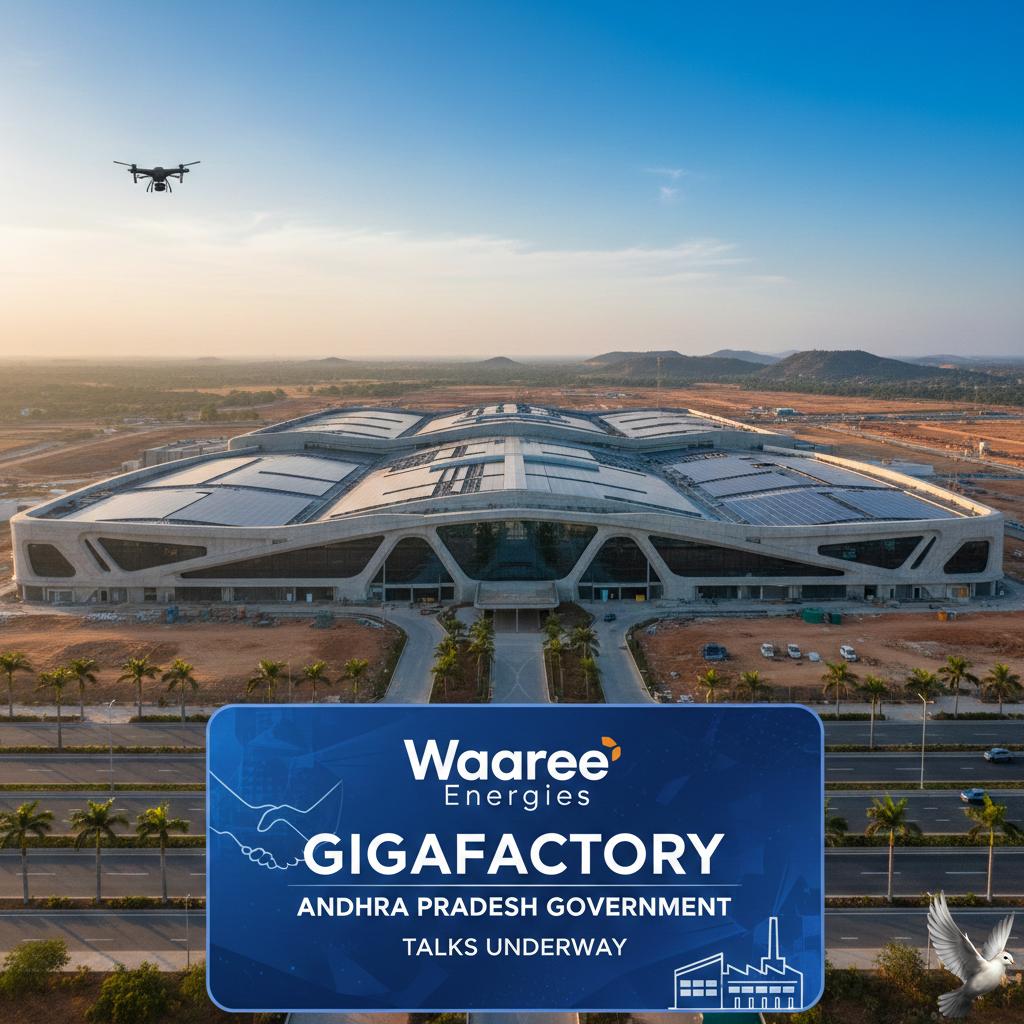
Waaree Energies in Talks with Andhra Pradesh Government to Establish Gigafactory
Waaree Energies is rapidly expanding its footprint in the energy storage sector, confirming plans to establish India’s largest integrated lithium-ion battery gigafactory in Andhra Pradesh.
The project involves a significant investment of 8,175 crore. The facility will be located at Rambilli in the Anakapalli district. This greenfield project is designed to reach a massive capacity of 16 GWh.
The factory will cover the entire battery value chain. This includes the production of advanced chemistry cells, battery packs, and large-scale Battery Energy Storage Systems.
The project has received in-principle approval from the state government. It is expected to create 3,000 direct jobs and significantly reduce India's reliance on imported energy storage technology.
On the stock market, Waaree Energies shares were trading near 2,874 as of late February 2026. The stock has seen a 1-year return of approximately 29.5%.
Financial performance remains robust. For the quarter ending December 2025, the company reported a total revenue of 7,761 crore. This represents a 24.6% increase from the previous quarter.
Net profit for the same period reached 1,106 crore, marking a 26% growth compared to the September 2025 quarter. The company maintains healthy operating margins of around 22%.
Market trends show a decisive shift toward energy storage. India’s power sector is increasingly tilting toward hybrid and storage-based tenders to stabilize the grid as renewable capacity grows.
Solar-hour electricity prices remained low at 4.3 per kWh in January 2026. This price stability is driving the commercial and industrial segments to adopt integrated solar-plus-storage solutions.
The government is supporting this transition through the 18,100 crore Production Linked Incentive scheme for Advanced Chemistry Cells. Over 10 manufacturers have now announced a combined 178 GWh of future capacity.
Waaree’s expansion is timed to meet this rising demand. The company is transitioning from a solar module leader to a fully integrated energy player, aligning with the national goal of 500 GW of non-fossil fuel capacity by 2030.