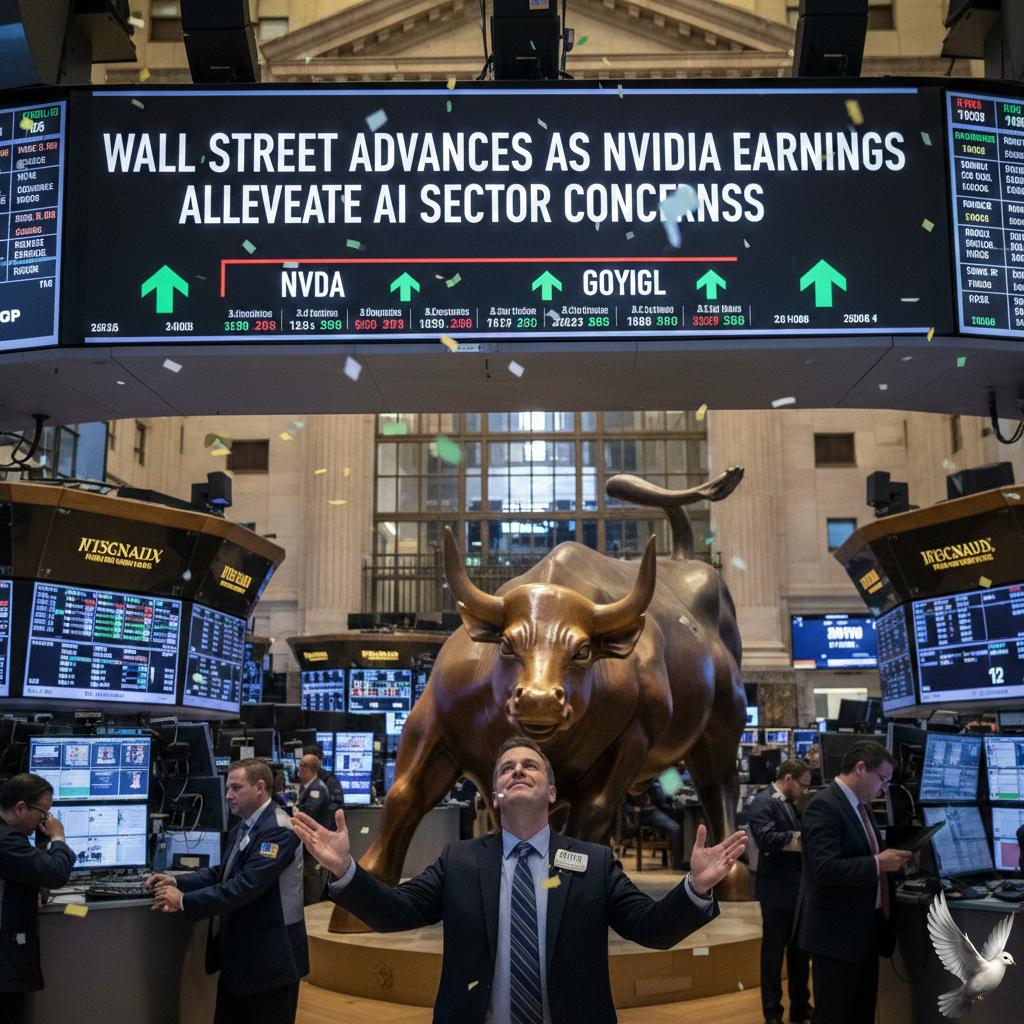
**Wall Street Advances as Nvidia Earnings Alleviate AI Sector Concerns**
Market Brief: AI Optimism Propels Wall Street to Two-Week Highs
Wall Street indexes surged to two-week highs as tech sector momentum regained its footing. The rally was spearheaded by a significant rebound in semiconductor and software equities, effectively pushing the Nasdaq Composite back above the **23,100** level.
Investor sentiment shifted decisively toward the long-term economic benefits of artificial intelligence. This optimism successfully neutralized recent anxieties regarding the high capital costs of AI infrastructure and the potential for industry-wide disruption.
Tech Giants Drive the Surge
Nvidia remains the primary catalyst for the current market direction. The chipmaker reported a record-breaking quarterly revenue of **$68.13 billion**, comfortably exceeding analyst expectations. This performance was largely fueled by its Data Center division, which alone generated **$62.3 billion** in revenue.
Following the earnings release, Nvidia shares climbed approximately **3%** in extended trading. The company’s forward-looking guidance remains aggressive, with a revenue outlook for the next quarter projected at **$78.0 billion**, plus or minus **2%**.
Other key players in the semiconductor space also saw gains. The Philadelphia SE Semiconductor index rose **1.6%**, while individual gains were noted in firms like AMD, which rallied **8.8%** following a major hardware deal with Meta Platforms.
Major Index Performance
The broad-based rally lifted all three major U.S. indexes. The S&P 500 gained **56.06 points**, or **0.81%**, to close at **6,946.13**. Meanwhile, the Dow Jones Industrial Average added **307.65 points**, or **0.63%**, reaching **49,482.15**.
The Nasdaq Composite recorded the day's strongest percentage gain, rising **1.26%** to finish at **23,152.08**. This recovery has narrowed the Nasdaq’s year-to-date losses to just **0.54%**, signaling a stabilization in the tech-heavy index after a volatile start to the year.
Shifting Sentiment and Macro Factors
The market’s focus has moved from "proof-of-concept" to "proof-of-impact." Investors are now prioritizing the tangible efficiency gains provided by AI tools over existential risks. The software sector, in particular, saw a notable bounce of **2.9%** as fears of AI replacing legacy platforms were replaced by excitement over AI-integrated enterprise tools.
Economic indicators also supported the upward trend. U.S. consumer confidence improved in February, with the headline index rising to **91.2**. This uptick in sentiment suggests a resilient consumer base, providing a supportive backdrop for high-growth technology investments.
While geopolitical factors and trade policies remain under observation, the "Inference Economy" is currently the dominant driver of market value. Total global spending on AI is now projected to exceed **$2.02 trillion** in 2026, marking a **36%** annual increase as enterprises scale their autonomous agent frameworks.