Bearish News
Collection
Impact of Anthropic AI Plug-ins on IT Stock Volatility and Investor Outlook
**MARKET BRIEF: AI Fears Trigger Historic IT Sell-Off** **Date:** February 5, 2026 **Topic:** Indian IT Sector & The "SaaSpocalypse" **The Flash Crash** Indian IT stocks witnessed their worst single-day widespread rout since **March 2020** on Wednesday, erasing approximately **₹1.9 lakh crore ($23 billion)** in investor wealth within hours. The **Nifty IT index** plunged nearly **6–7%**, decoupling violently from broader market trends. The sell-off was indiscriminate, punishing industry titans and mid-cap players alike: * **Infosys:** Down **~8%**, marking its sharpest fall since April 2023. * **TCS:** Shed **~7%**, wiping out massive equity value. * **LTIMindtree, Coforge & Persistent Systems:** Crashed between **6% and 8%**. * **Wipro & HCL Tech:** Slid **4–5%**. **The Trigger: "SaaSpocalypse"** The panic originated in the US following **Anthropic’s** launch of new "agentic" plugins for its **Claude Cowork** platform. Unlike previous AI tools that assisted humans, these new agents act as autonomous workers—capable of executing end-to-end workflows in legal review, compliance, data analysis, and coding with minimal human oversight. Wall Street analysts, including those at **Jefferies**, have termed this the **"SaaSpocalypse,"** signaling a fear that AI is pivoting from a productivity enhancer to a **workforce replacer**. **The Structural Fear** Investors are pricing in an existential threat to the traditional **"Billable Hour" model**. * **Old Reality:** IT firms charge based on headcount and time spent on projects. * **New Fear:** If an AI agent can perform 40 hours of coding/testing in minutes for pennies, the revenue tethered to human deployment evaporates. The market is no longer viewing AI as a tailwind for IT service providers but as a direct competitor that erodes pricing power and deepens competitive moats. **Analyst & Industry Counter-View** Despite the carnage, key voices argue the market has overreacted: * **Tech Mahindra CEO Mohit Joshi** labeled the sell-off a "significant overreaction," noting that 99% of enterprise environments are "legacy estates" that cannot easily switch to autonomous AI overnight. * **Jensen Huang (Nvidia)** dismissed the notion that AI will render software companies obsolete as "illogical." * **Contrarian Opportunity:** Some analysts suggest the drop offers a bifurcation entry point—favoring niche firms that successfully decouple revenue from headcount over volume-based legacy players. **Bottom Line:** The market has shifted from "AI Hype" to "AI Panic." The coming weeks will determine if this is a temporary sentiment shock or a permanent re-rating of the Indian IT sector.

Indian Bond Rally May Ease Ahead of RBI Debt Purchase and Rate Decision
**Market Brief: Indian Bond Yields & RBI Policy Watch** **Current Status: Yields at 1-Year Highs** Indian bond markets are trading with heightened caution today, Feb 5, 2026, as the benchmark 10-year government bond yield tests **6.78%** — its highest level in over a year. The sharp upward movement follows the Union Budget's announcement of a record **₹17.2 trillion** gross borrowing target for FY27, a figure significantly above street estimates of ₹16.5 trillion. **The Catalyst: Supply Concerns** The unexpected surge in projected bond supply has triggered a sell-off, pushing yields up by approximately **8 basis points** this week. Market participants fear the heavy issuance calendar will outstrip demand without active intervention. The fiscal deficit target has been pegged at **4.3%** of GDP, signaling continued consolidation, yet the sheer volume of debt hitting the market remains the primary friction point. **Investor Focus: RBI MPC Decision Tomorrow** All eyes are now on the Reserve Bank of India’s Monetary Policy Committee (MPC) meeting, which concludes tomorrow, **Friday, Feb 6**. While the consensus expects the repo rate to remain unchanged (currently **5.25%** after 125 bps of cuts since early 2025), the market's priority has shifted entirely to liquidity management. **Liquidity & OMO Expectations** Investors are positioning for a distinct signal on **Open Market Operations (OMOs)** or bond buybacks. The banking system recently returned to a surplus of ~**₹0.6 lakh crore**, but the "impending bond acquisition" mentioned in market chatter refers to widespread hopes that the RBI will announce tactical bond purchases to cap yields. Without explicit support or a "Operation Twist" style intervention, analysts warn yields could drift toward **7.0%** in the near term. **Key Watchlist for Tomorrow** * **Repo Rate:** Pause expected. * **Stance:** Likely "Neutral" but with a dovish undertone on liquidity. * **Yield Curve Control:** Any announcement of specific OMO tranches to absorb the FY27 borrowing shock. ... [CNBC-TV18: RBI Liquidity & OMO Operations](https://www.youtube.com/watch?v=9fx-8_xhUzo) ... This video provides essential context on the RBI's recent use of Open Market Operations (OMOs) to manage liquidity, which is the central mechanism investors are hoping will be deployed again in tomorrow's policy update. http://googleusercontent.com/youtube_content/0

Software Stocks Decline as Investors Weigh AI Risks
Global Software Selloff Intensifies: February 2026 Market Brief **Market Update** Global software stocks are in the midst of a severe correction as of early February 2026, driven by intensifying fears that autonomous AI agents will displace, rather than enhance, traditional enterprise software. A massive selloff occurred on **February 3–4**, triggered by Anthropic’s release of new "Claude Cowork" automation plugins. These tools, capable of executing complex workflows in law, sales, and data analysis without human intervention, have sparked a "SaaSpocalypse" narrative, leading investors to question the long-term viability of the seat-based SaaS business model. **Key Performance Indicators** * **Sector Impact:** The iShares Expanded Tech-Software Sector ETF (IGV) plunged **4.6%** in a single session and is down nearly **15%** since the start of January 2026, marking its worst monthly performance since 2008. * **Major Indices:** The Nasdaq-100 faced intraday declines of up to **2.4%**, weighed down heavily by software components despite resilience in hardware and semiconductor stocks. * **Company Specifics:** Legacy giants bore the brunt of the downturn. **Adobe (ADBE)** and **Salesforce (CRM)** saw single-day drops of **5% to 7%**, with Adobe trading near three-year lows (down roughly **32%** year-over-year). **ServiceNow (NOW)** plummeted to **$109**, erasing gains from its previous all-time highs of **$239**. * **International Contagion:** The selloff extended globally, with Indian IT majors like **Infosys** and **TCS** falling **6–7%**, and Japanese software firms like **TIS Inc.** dropping over **15%**. **Sentiment & Outlook** The market is currently pricing software stocks as "guilty until proven innocent." Investors are rotating capital out of application-layer software and into AI hardware and infrastructure. However, a counter-narrative is emerging among value-focused analysts. With valuations for the software sector compressing to record lows (some trading at **12x to 18x** forward earnings), some strategists argue the panic is overblown. They contend that legal and compliance barriers will slow the adoption of autonomous agents, potentially making the current price levels a buying opportunity for entrenched market leaders. [Yahoo Finance: Tech sector outlook and S&P 500 analysis for 2026](https://www.youtube.com/watch?v=GqUVULO2Ti8) This video offers a broader context on the 2026 tech landscape and S&P 500 performance expectations that preceded the specific February software downturn. http://googleusercontent.com/youtube_content/0

Software and Services Stocks Lose Nearly $1 Trillion Amid AI Market Concerns
**Global Software Selloff: The AI Displacement Panic** The software sector is currently facing a "SaaSpocalypse," with investors aggressively exiting positions in established players. The market narrative has shifted violently from viewing Artificial Intelligence as a growth driver to seeing it as an existential threat to the traditional Software-as-a-Service (SaaS) business model. **The Crash by the Numbers** The selloff has been swift and severe. The **iShares Expanded Tech-Software Sector ETF (IGV)** has plummeted approximately **18%** in recent trading sessions. Major industry heavyweights are bearing the brunt of this correction: * **Intuit** slumped **11%** on fears that AI agents will automate financial workflows. * **Salesforce** and **Adobe** shed roughly **7%**, driven by concerns over "seat-based" pricing models becoming obsolete. * **Relx**, a leader in analytics, plunged **14%**, signaling investor belief that AI can now replicate complex knowledge work. * **Nifty IT** (India) dropped **7%** in a single session, erasing nearly **₹2 lakh crore** in investor wealth. **The Catalyst: AI Agents** The immediate trigger for this volatility was the release of **Anthropic’s "Claude Cowork"** and similar agentic tools from competitors like Google. Unlike previous AI chatbots, these "agents" are designed to autonomously execute end-to-end tasks—legal reviews, coding, and compliance checks—that were previously the domain of human workers using specialized software. Investors fear a transition to "Service as a Software," where AI performs the work directly, bypassing the need for expensive, per-user SaaS subscriptions. This has sparked a repricing of "knowledge work" stocks, with markets now betting that AI will act as a deflationary headwind for revenue rather than a tailwind. **Market Rotation: Atoms Over Bits** A distinct capital rotation is underway. As software stocks face compression, funds are flowing into physical sectors and energy, a trend described by strategists as "Atoms over Bits." While software valuations compress, sectors linked to the physical infrastructure required to *power* AI—such as energy and hardware—are outperforming. The market is effectively moving from funding the *tools* (software) to funding the *fuel* (energy and compute) needed to run the AI that replaces those tools. This marks a pivotal moment where the "guaranteed" recurring revenue models of the last decade are being stress-tested against a new reality of AI-driven automation.

IT Stocks Decline on Anthropic News Amid Speculation of Short-Term Impact
**Market Brief: Indian IT Sector Automates a Sell-Off** **The Event** Indian IT stocks witnessed their steepest single-day decline in nearly six years on Wednesday, February 4. The **Nifty IT index plunged ~6-7%**, erasing approximately **₹1.9 lakh crore** in market capitalisation. This rout mirrors a broader global tech sell-off, dubbed by some analysts as the "SaaSpocalypse." **The Trigger: Anthropic’s "Agentic" Shift** The catalyst was the launch of new **Claude Cowork** plugins by AI firm Anthropic. Unlike previous chatbots that acted as assistants, these new "agentic" tools are designed to autonomously execute complex, multi-step workflows in legal, sales, and data analysis—tasks traditionally outsourced to Indian IT firms. Investors panicked over the release of a specific **Legal Plugin**, which automates contract reviews, NDA processing, and compliance checks. The fear is that AI is moving from a productivity tool to a direct replacement for billable human hours, threatening the core "seat-based" revenue models of IT services. **Key Market Movers** Major Indian IT heavyweights bore the brunt of the damage: * **Infosys:** Crashed over **7%** (worst single-day loss since April 2023). * **TCS:** Dropped nearly **7%**. * **Wipro & HCLTech:** Slid between **4% and 6%**. * **Global Context:** The sell-off tracked a **$285 billion** wipeout in global software stocks, with companies like Thomson Reuters and LegalZoom falling **15-20%**. **The Sentiment: "SaaSpocalypse" vs. Overreaction** Market sentiment has shifted aggressively. Analysts at **Jefferies** noted that the narrative has flipped from "AI helps these companies" to "AI replaces these companies." The immediate concern is that enterprise clients may cut outsourcing budgets in favor of AI agents that don't sleep or charge hourly rates. However, industry leaders argue this is a temporary shock. **Tech Mahindra** leadership labeled the crash a "massive overreaction," suggesting that while SaaS models are under pressure, legacy enterprise integration will still require significant human oversight. **Current Outlook** As of Thursday morning, volatility remains high. Investors are now keenly watching for commentary from upcoming earnings calls to see if deal pipelines are actually shrinking or if this is purely a sentiment-driven correction. The market is effectively repricing the sector for a future where headcount growth may no longer correlate with revenue growth.
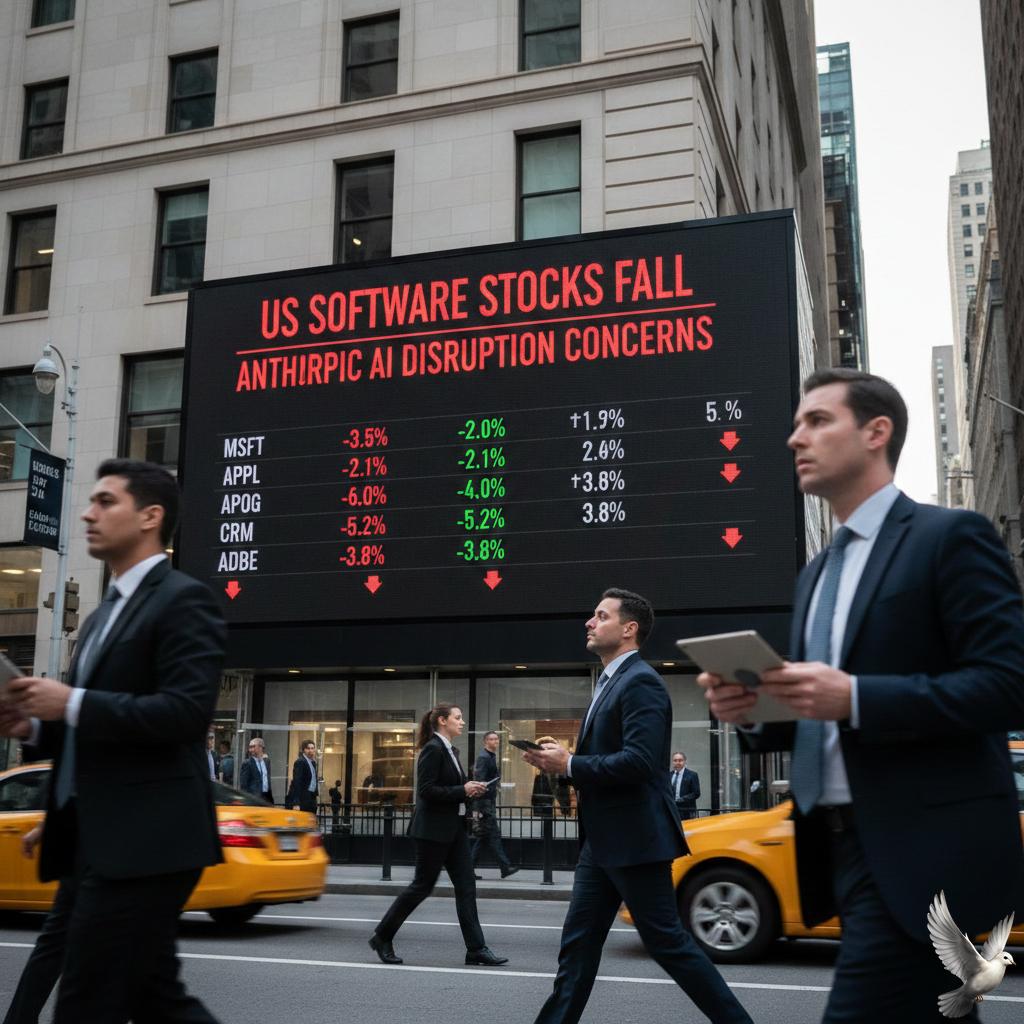
US Software Stocks Fall on Anthropic AI Disruption Concerns
U.S. Software Sector "SaaSpocalypse": AI Agent Fears Trigger $300B Selloff **The Catalyst: Anthropic's "Agentic" Shift** U.S. software stocks have entered a steep correction following Anthropic’s release of its new **Claude Cowork** platform, specifically the "Legal Plugin." Unlike previous chatbots, this tool is designed to execute end-to-end workflows—automating contract review, NDA triage, and compliance tasks. This move signals a shift from AI as a "copilot" to a direct substitute for seat-based software applications. **Market Impact: A Sea of Red** The release triggered a massive rout, wiping out an estimated **$285–$300 billion** in market value across the sector in just 24 hours. * **Sector Indices:** The iShares Expanded Tech-Software Sector ETF (IGV) plunged **4.6%**, its worst day in months. * **Legal & Data Casualties:** Companies with high exposure to white-collar workflows took the hardest hit. * **LegalZoom:** Crashed ~20% * **Gartner:** Plunged 21% * **London Stock Exchange Group (LSEG):** Dropped ~13% (worst day in 5 years) * **Thomson Reuters & RELX:** Slid nearly 10-15% **The Core Fear: "Existential" Threat** Investors are repricing the software sector based on a new narrative: **Displacement**. Analysts at firms like Jefferies and Goldman Sachs warn that "agentic AI" threatens the traditional SaaS business model. If an AI agent can perform the work of junior staff, the demand for "per-seat" software licenses—the revenue engine for these companies—could collapse. **Contrarian Voice** Amid the panic, Nvidia CEO Jensen Huang dismissed the selloff as "illogical." Speaking at a conference on Feb 4, he argued that AI will *consume* software tools rather than replace them, stating, "If you were a human or robot... would you use tools or reinvent tools?" **Outlook** Volatility is expected to persist. The market is currently acting on a "sell first, ask questions later" mentality, viewing any company relying on human-heavy workflows (legal, coding, finance) as vulnerable to immediate disruption. *** [Software Stocks Sink as Anthropic Release Sparks Panic](https://www.youtube.com/shorts/5Qr45Whpr58?vl=id) This short video clip highlights the sharp market reaction and specific stock declines following Anthropic's announcement, reinforcing the scale of the "SaaSpocalypse." http://googleusercontent.com/youtube_content/0
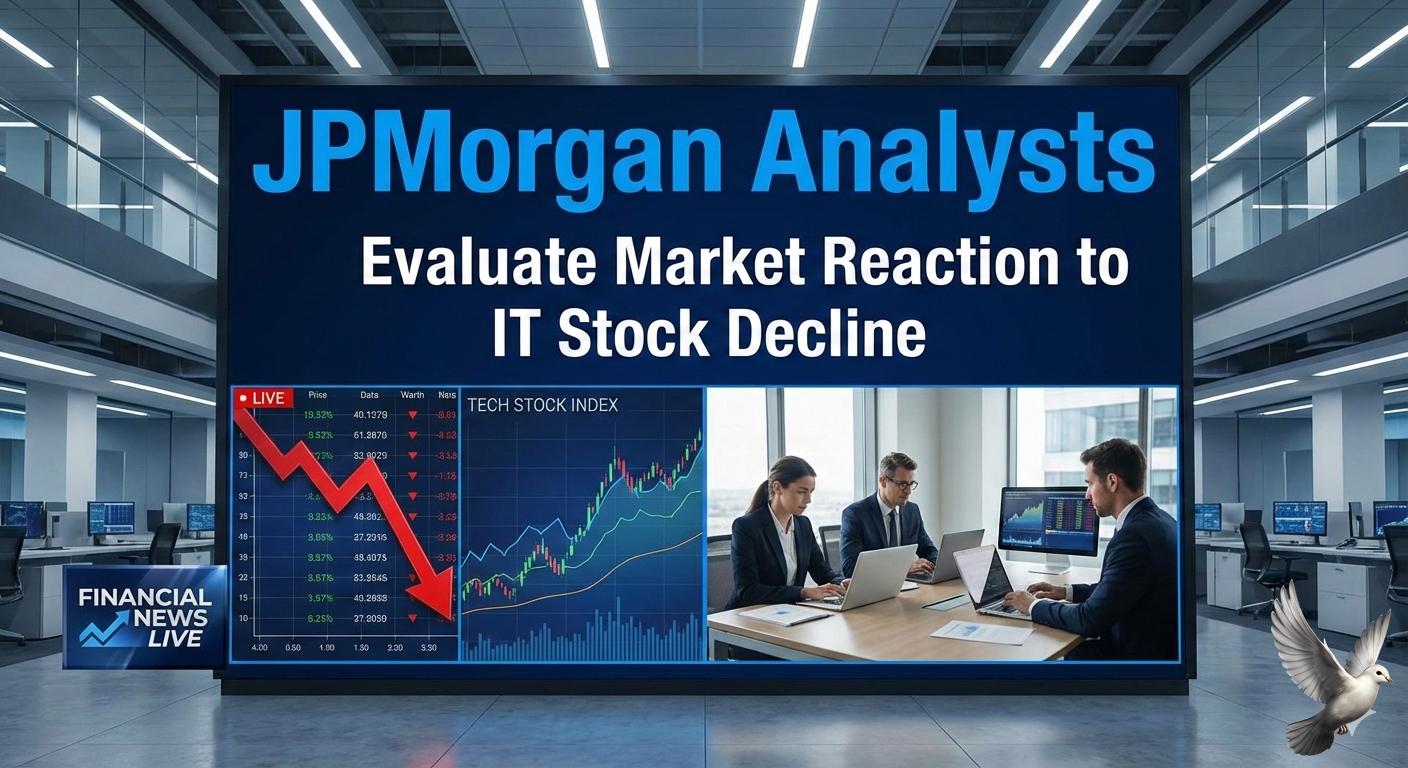
JPMorgan Analysts Evaluate Market Reaction to IT Stock Decline
**MARKET BRIEF: Software Panic & AI Disruption Fears** **The Trigger: Rational Concern vs. Market Panic** Global markets are currently witnessing a violent repricing in the software sector, characterized by JPMorgan analyst Mark Murphy as a shift from understandable caution to "outright panic." The catalyst for this latest rout was the launch of Anthropic’s **Claude Cowork** plugins earlier this week. This new AI tool, designed to automate complex workflows in legal, sales, marketing, and data analysis, has terrified investors. The prevailing fear is that "Service-as-a-Software" (AI agents performing jobs) will rapidly cannibalize the traditional Software-as-a-Service (SaaS) seat-based business model. **Sector Performance: Nowhere to Hide** The selloff has been indiscriminate, punishing both legacy giants and high-growth darlings. The **IGV Tech-Software ETF** plummeted approximately **5%** in a single session, dragging the sector back to valuation lows not seen since the "peak tariff" scares of early 2025. Over the last five trading sessions, the index has surrendered nearly **13%**, erasing billions in market capitalization. Individual name performance highlights the severity of the exodus: * **Cloudflare (NET):** Plunged roughly **9-11%** * **Datadog (DDOG):** Dropped **9-11%** * **Snowflake (SNOW):** Down **9-11%** These stocks, previously viewed as "insulated" infrastructure plays essential for the AI revolution, are now being treated as collateral damage in a broader "mass exodus." The selling pressure has hit mega-caps and small-caps alike, driven by systematic deleveraging and a liquidity vacuum rather than company-specific fundamental failures. **The "Illogical Leap"** Despite the carnage, JPMorgan’s research desk maintains that the market’s reaction is fundamentally flawed. Murphy argues that investors are making an "illogical leap" by extrapolating a single product launch (Claude Cowork) into the immediate obsolescence of all mission-critical enterprise software. While acknowledging that AI will evolve "at the speed of light," the notion that a plugin will instantly replace deeply integrated security, data governance, and CRM layers is viewed as an overreaction by generalist money. **Structural Disconnect** A widening gap has emerged between market sentiment and operational reality. "Generalist" investors are trading on high-level AI headlines, fleeing the sector en masse. In contrast, "specialist" investors—who focus on software stickiness, integration depth, and switching costs—see a different picture. However, the sheer volume of panic selling is currently overwhelming the specialists. The current dynamic forces traditional software companies into an impossible position: they are being asked to accelerate growth to disprove the disruption thesis, even as a higher cost of capital naturally forces deceleration. This has resulted in a scenario where the "buy-side bar has magically risen while the stocks have dropped," leaving valuations for some high-quality assets at **25-30 year lows** relative to the semiconductor sector. **Outlook: A Wake-Up Call** This week serves as a brutal "wake-up call" regarding the volatility of AI narratives. While the threat of AI crowding out traditional IT budgets is legitimate, the current price action reflects a "passive-flow liquidity vacuum" more than a sober assessment of future cash flows. The market is pricing in an existential crisis for software that ignores the enduring necessity of secure, governed enterprise infrastructure. Until the panic subsides, volatility will remain the dominant theme, with the challenge for investors being to distinguish between genuine structural risks and temporary psychological extremes.

Tata Motors Q3 Preview: Revenue Projected to Decline Up to 9% Amid JLR Headwinds
**Market Brief: Tata Motors Q3 FY26 Performance** **Executive Summary: Domestic Resilience Meets Global Headwinds** Tata Motors’ Q3 FY26 narrative is defined by a sharp divergence between its soaring Indian operations and a crisis-hit Jaguar Land Rover (JLR) division. While the domestic Passenger Vehicle (PV) and Commercial Vehicle (CV) segments delivered record-breaking numbers, consolidated earnings remain under significant pressure due to a massive cyber-attack that crippled JLR production. **JLR Crisis: The £1.9 Billion Cyber Blow** The headline drag on performance is the severe operational disruption at Jaguar Land Rover. Following a major cyber-attack, JLR production was halted until mid-November, resulting in a staggering **43.3% year-on-year drop** in wholesale volumes to **59,200 units**. * **Retail Sales:** Declined **25.1%** to 79,600 units. * **Financial Impact:** Analysts estimate the total economic cost of the breach at approximately **£1.9 billion**. * **Regional Fallout:** North American volumes plummeted over **64%**, aggravated by incremental tariff pressures. **Domestic Strength: Record Highs in India** In stark contrast, the India business fired on all cylinders, cushioning the group-level impact. * **Passenger Vehicles:** Q3 sales surged **22.3% YoY** to a record **171,013 units**. * **EV Leadership:** Electric vehicle adoption accelerated aggressively, with sales growing **49.5%** to **24,103 units**, solidifying Tata’s market dominance. * **Commercial Vehicles:** Revenue grew **16%**, supported by a **20%** jump in wholesale volumes. The segment achieved a double-digit EBITDA margin of **12.7%**, driven by disciplined pricing and operating leverage. **Financial Realities: Margins & Profitability** Despite the revenue uplift in India, the bottom line faces stress. The Commercial Vehicle business reported a **48% decline** in net profit to **₹705 crore**, primarily due to **₹1,600 crore** in exceptional items (including demerger costs and labor code adjustments). * **Consolidated Outlook:** Most brokerages have priced in a "washout" quarter for the consolidated entity, with JLR's negative operating leverage expected to drag the group into a potential net loss or significantly reduced profit for the period. **Market Reaction & Investor Sentiment** The stock has seen volatility, correcting approximately **4%** immediately following the release of JLR’s provisional volume data. However, it has since stabilized around the **₹375** level, as the market weighs the temporary nature of the cyber incident against the structural strength of the India business. **Key Watchlist for Investors** * **Recovery Timeline:** Speed of JLR’s production ramp-up in Q4. * **New Launches:** Performance of the petrol Harrier/Safari and the newly launched Sierra. * **Demerger Progress:** Updates on the separation of the CV and PV entities. *** **Next Step:**

Eight Midcap Stocks Rise Up to 110%, Two Yield Multibagger Returns
**Global Market Brief: February 4, 2026** **Market Overview** Global equities displayed a sharp divergence today, dominated by the fallout from a major "AI shock" in the technology sector and a landmark trade agreement between India and the United States. While Indian benchmarks managed to close in the green due to optimism surrounding the new trade deal, US and European markets faced headwinds from a massive sell-off in IT stocks, triggered by fears over AI profitability and new competition from Anthropic’s latest tool. **India: Trade Deal Optimism** Indian equity indices defied the global tech rout, ending modestly higher. The **BSE Sensex** gained **78.55 points** to close at **83,817.69**, while the **Nifty50** rose **48.45 points** to settle at **25,776.00**. Investor sentiment was buoyed by the official confirmation of the India-US trade pact, which lowers reciprocal tariffs on Indian exports to **18%**. This policy shift sparked a rally in export-oriented sectors, particularly textiles, gems, and pharmaceuticals. **Sector Performance** * **Top Gainers:** Retail and export stocks led the charge. **Trent** and **Eternal** surged approximately **5%** each. **NTPC**, **Adani Ports**, and **Power Grid** also posted gains between **2%** and **2.5%**. * **IT Crash:** The technology sector faced its worst single-day fall in six years. The Nifty IT index plunged nearly **6%**, dragged down by heavyweights like **Infosys** (down **7.26%**) and **TCS** (down **7.02%**). The sell-off mirrors a global trend where investors are reassessing the viability of heavy AI capital expenditure. **Currency & Commodities** The Indian Rupee weakened by **11 paise** to close at **90.43** against the US Dollar. Despite the positive trade news, increased dollar demand from importers erased early gains. * **Gold:** Prices continue to break records, trading near **$5,045** per ounce, driven by safe-haven buying amidst geopolitical tensions and economic uncertainty. * **Oil:** Brent crude remained volatile but steadied around **$67.60** per barrel, facing pressure from demand concerns despite supply adjustments. * **Crypto:** Bitcoin held firm around **$76,680**, while Ethereum dipped slightly to **$2,278**. **Global Sentiment** US markets remain under pressure as the "AI trade" unwinds. Wall Street indices closed sharply lower, with fears mounting that AI adoption may not yield immediate returns for major software firms. European markets were mixed, with the **STOXX 600** edging up **0.2%** as inflation in the Eurozone slowed to **1.7%**, strengthening the case for renewed rate cuts by the ECB. **Key Takeaway** The market is currently navigating a rotation from high-growth technology stocks to value and export-driven sectors. While the India-US trade deal provides a strong tailwind for the domestic economy, the global re-rating of AI stocks poses a significant short-term risk to volatility.
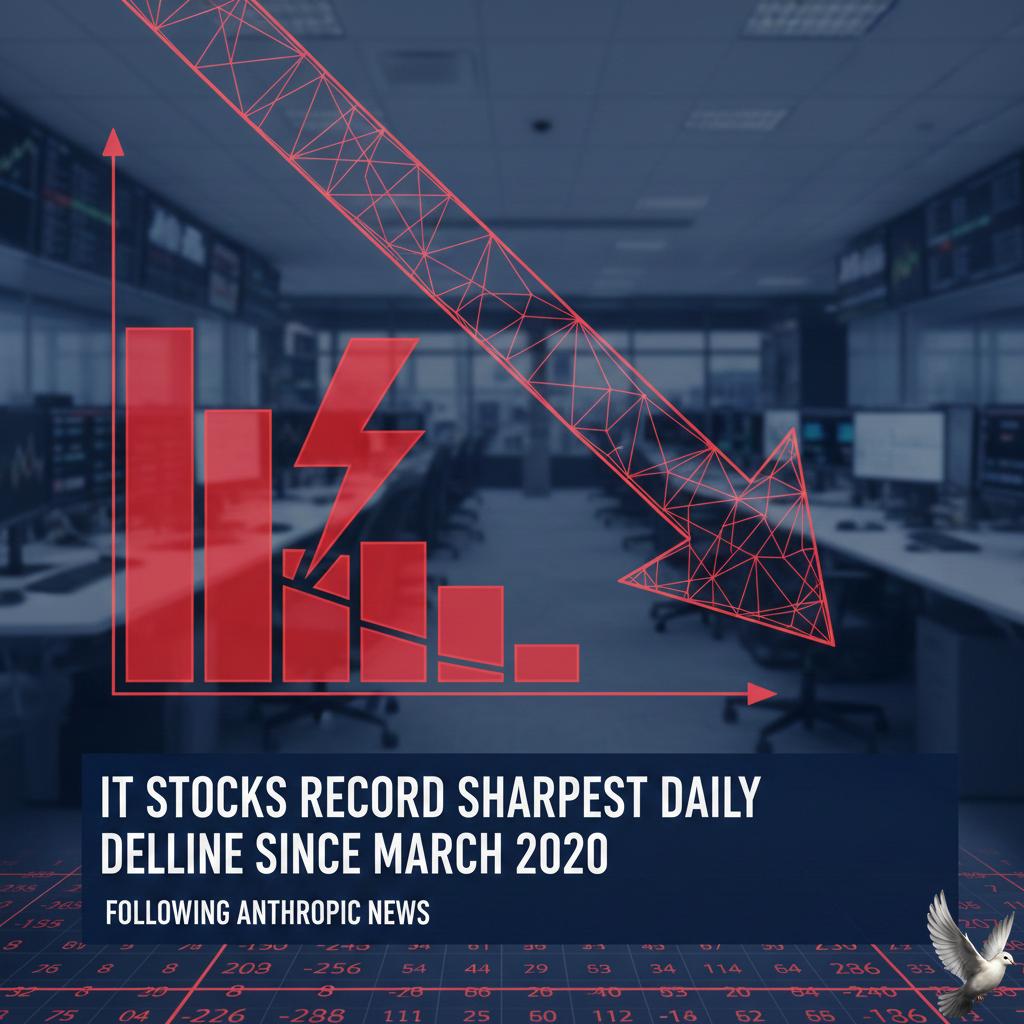
IT Stocks Record Sharpest Daily Decline Since March 2020 Following Anthropic News
**MARKET BRIEF: NIFTY IT CRASHES ON AI FEARS (FEB 4, 2026)** **The Plunge** Indian IT stocks witnessed a massive selloff today, February 4, 2026, marking one of the darkest days for the sector in recent history. The Nifty IT index collapsed by **5.87%**, wiping out significant investor wealth in a single session. This sharp decline makes today’s fall the steepest single-day drop for the index since the **March 2020** COVID-19 market rout. **The Trigger: AI Disruption Fears** The panic was sparked by news from the United States, where AI startup Anthropic unveiled its latest "Claude Cowork" automation agents. These new tools aim to automate complex professional workflows—such as legal reviews, sales operations, and coding tasks—reigniting existential fears for traditional IT service models. Investors are concerned that "agentic AI" could rapidly erode the pricing power and competitive moats of Indian IT majors, leading to what some analysts are calling a potential "SaaSpocalypse." **Key Stock Performance** The selloff was broad-based, with all 10 constituents of the Nifty IT index ending in the red. **Infosys** was the biggest drag, plummeting over **7%** to hit intraday lows not seen in months. **Tata Consultancy Services (TCS)** dropped approximately **6%**, shedding massive market capitalization. **LTIMindtree**, **Coforge**, and **Persistent Systems** also faced severe pressure, falling between **5%** and **7%**. **Historical Context** Today’s crash rewrites recent market history. While the Nifty IT index has seen volatility before, the magnitude of this fall stands out. **April 12, 2013:** The index recorded its worst-ever single-day crash, plunging nearly **12%** (revised from earlier estimates of 9.6%) due to weak guidance from Infosys. **March 2020:** During the onset of the global pandemic, the index suffered a comparable collapse of approximately **9.6%**. **February 4, 2026:** Today's **~6%** fall is the most significant since that 2020 event, far exceeding the volatility seen during the 2022 correction. **Global Cues** The domestic selloff mirrored weakness on Wall Street. The tech-heavy **Nasdaq** fell **1.4%** overnight, with US software stocks shedding billions in value. Global players like Thomson Reuters and LegalZoom also saw double-digit declines, reinforcing the narrative that AI disruption is a global sector-wide risk. **Market Sentiment** Sentiment remains extremely fragile. The Nifty 50 index managed to close flat to marginally positive only due to support from defensive sectors like Oil & Gas and Utilities, masking the carnage in technology stocks. Foreign Institutional Investors (FIIs) have reportedly turned net sellers in the IT space, rotating funds out of software services amid the uncertainty. Technical indicators for the IT sector have turned bearish, with the index breaking below key moving averages. Traders are now watching for stability near the **36,000** support level, though volatility is expected to persist as the market digests the long-term impact of generative AI on Indian service providers. **Next Steps** I can generate a technical chart comparison of today's drop versus the 2020 crash or provide a detailed breakdown of the valuation changes for TCS and Infosys.
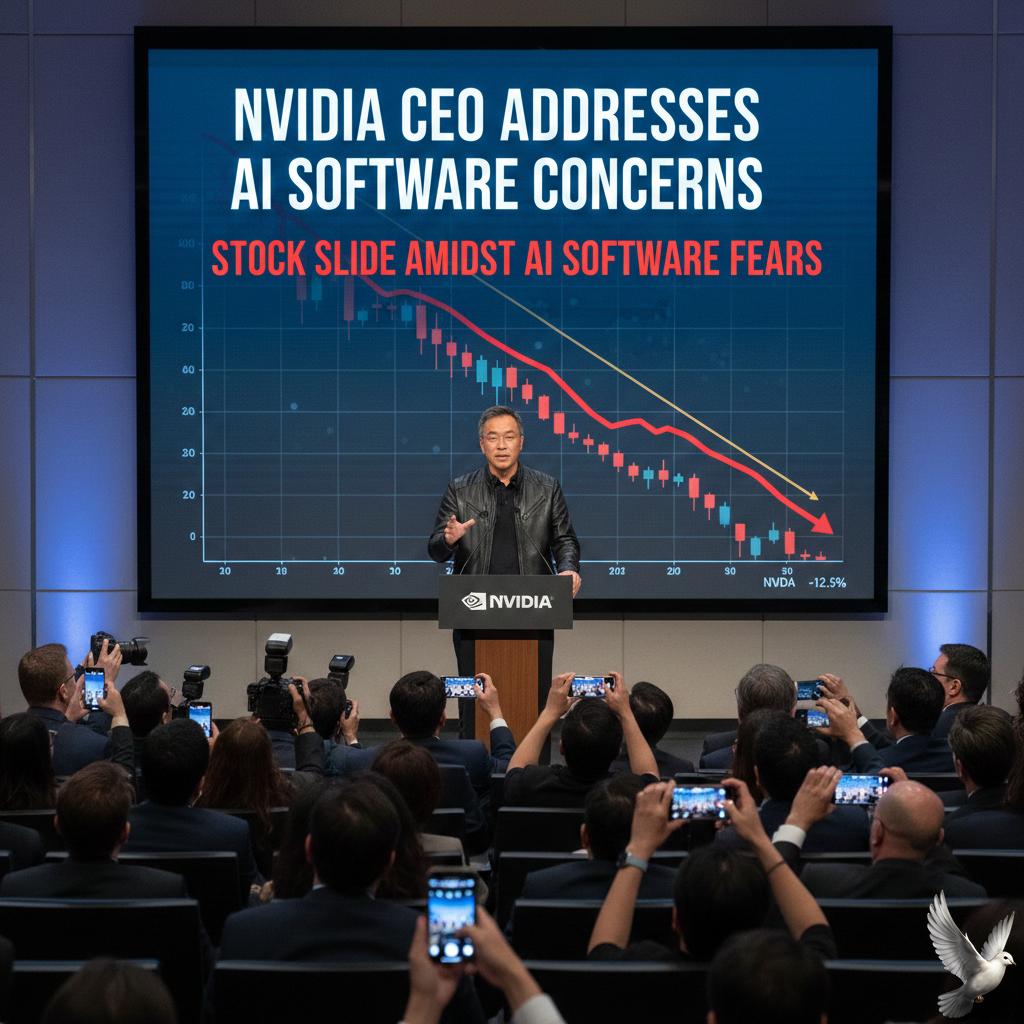
**Nvidia CEO Addresses AI Software Concerns Amid Stock Slide**
Market Brief: Nvidia CEO Rebuts Software "Death" Narrative **Date:** February 4, 2026 **Topic:** AI Market Volatility & Sector Commentary **The Core Update** Nvidia CEO Jensen Huang has forcefully rejected the "AI replacement" theory following a sharp global selloff in software stocks on Tuesday, February 3. Speaking at the Cisco AI Summit, Huang labeled the fear that artificial intelligence will render traditional software obsolete as **"illogical."** **Market Context: The Anthropic Trigger** A wave of panic selling hit the software sector yesterday after AI rival Anthropic released **"Claude Cowork,"** a new suite of automation tools marketed as capable of replacing complex white-collar workflows. Investors reacted negatively to the prospect of AI agents cannibalizing subscription-based business models, causing a "basket-style" liquidation of SaaS (Software as a Service) holdings. **Key Market Movements (Intraday/Close Feb 4)** * **Adobe (ADBE):** Plunged **~7%**, reflecting fears over creative workflow automation. * **Salesforce (CRM):** Dropped **~7%**, hit by concerns over AI agents replacing sales/service seats. * **Intuit (INTU):** Saw steeper declines of over **10%** in the initial rout. * **Global Impact:** The selling spread to Asia, with the Nifty IT index (India) tumbling nearly **5.5%** and heavyweights like Infosys losing **~6-7%**. * **Nvidia (NVDA):** Remained relatively resilient compared to pure-play software, trading near **$180** despite broader tech pressure. **Huang’s Counter-Narrative** While the market priced in an existential threat, Huang argued that the premise is flawed. He emphasized that AI models are "tool users" rather than "tool replacers." In his view, the next generation of AI will rely *more* on robust software infrastructure (databases, operating systems, enterprise platforms) to execute tasks, effectively increasing the value of the existing software stack rather than erasing it. **Sector Outlook** The divergence between hardware (infrastructure) and software (application) stocks has widened. While the "AI Factory" build-out continues to support semiconductor valuations, software companies now face a "prove it" period where they must demonstrate that AI is a revenue accelerant rather than a deflationary force.

Anthropic’s Newest AI Tool: Overview and Market Implications for the Global Technology Sector
**MARKET BRIEF: The 'SaaSpocalypse' — AI Turns from Feature to Foe** **Global software markets are reeling** after Anthropic’s release of **Claude Cowork** and its new specialized plugins triggered a massive selloff. Investors have abruptly shifted their stance on Artificial Intelligence: once viewed as a productivity booster for software firms, it is now being priced as an existential threat. **The Trigger Event** Anthropic launched **Claude Cowork** alongside **11 open-source plugins** targeting specific professional workflows—most notably a "legal" plugin capable of automating contract review, NDA triage, and compliance checks. This move demonstrated that AI agents can now bypass traditional software interfaces entirely, effectively turning the "platform" into the "competitor." **Market Carnage by the Numbers** The reaction was immediate and severe, wiping out approximately **$285 billion** in market value in a single trading session. * **Legal & Data Tech:** Hardest hit. **Thomson Reuters** crashed **~18%**, while **RELX** (LexisNexis) dropped **14%**. **LegalZoom** plummeted nearly **20%**. * **SaaS Giants:** The contagion spread to broader software. **Salesforce (CRM)** fell **7%**, and **Adobe** faced renewed selling pressure. * **Indian IT Impact:** The Nifty IT index plunged **over 7%**—its worst day in years. **Infosys** slid **9%**, while **TCS** and **LTIMindtree** lost **~7-8%**. **The New Sentiment: "Feature vs. Foe"** Analysts at Jefferies and other firms have dubbed this the **"SaaSpocalypse."** The core fear is that AI agents will not just automate tasks *within* software (requiring a seat license) but will *perform* the work independently, reducing the need for expensive per-seat subscriptions. **Sector Rotation** Capital is aggressively rotating out of the "application layer" (SaaS) and into "infrastructure" (semiconductors/hardware) or defensive assets. The market is currently pricing in a scenario where AI commoditizes the workflow layer, forcing software incumbents to drastically prove their defensibility. ... [SaaSpocalypse Hits Tech Stocks - Market Analysis](https://www.youtube.com/watch?v=daaQ4B6-35w) ... This video provides a timely breakdown of the "SaaSpocalypse" selloff, analyzing the specific impact on tech stocks and the broader market rotation away from software companies. http://googleusercontent.com/youtube_content/0
Asian Markets Fall After US Sell-off; Oil and Gold Rise
**Global Market Brief | February 4, 2026** **Oil Markets: Geopolitical Risk Returns** Crude futures pushed higher today as renewed US-Iran tensions rattled energy markets. **Brent** crude climbed **1.0%** to **$67.98** per barrel, while **WTI** rose **1.1%** to **$63.90**. **Key Drivers:** * **Strait of Hormuz Escalation:** The US military confirmed shooting down an Iranian drone that approached the USS Abraham Lincoln. Reports also indicate the US-flagged tanker *Stena Imperative* was harassed by IRGC vessels, heightening fears of supply disruptions in the critical waterway. * **Inventory Draw:** Adding support to prices, API data signaled a massive **11.1 million** barrel drop in US crude stockpiles, suggesting tighter physical markets than previously estimated. * **Diplomatic Hopes:** Despite the military friction, diplomatic channels remain active, with nuclear talks reportedly scheduled to resume in Oman this Friday. **Precious Metals: A Sharp Rebound** After a brutal sell-off earlier in the week, precious metals found solid footing, staging a significant recovery as safe-haven demand resurfaced. **Market Moves:** * **Gold:** Spot prices surged over **2%** to reclaim the **$5,050** per ounce level, recovering from recent lows as the dollar softened. * **Silver:** The metal outperformed, jumping more than **6%** to trade near **$90** per ounce. This marks a swift turnaround after a historic **40%** plunge in the prior two sessions, driven by margin adjustments and liquidation. * **Outlook:** Volatility remains extreme, but the rapid bounce suggests the broader bullish trend for metals remains intact amid geopolitical uncertainty. **Market Sentiment:** **Cautious.** Traders are balancing the immediate risk of Middle East conflict against the potential for de-escalation at the upcoming Oman talks. I can set up a daily alert for Strait of Hormuz shipping updates if you need to track supply risks closer.
Analysis of Rs 2 Lakh Crore Valuation Drop in IT Stocks and Implications for Investors
**MARKET BRIEF: AI DISRUPTION FEARS TRIGGER IT SECTOR ROUT** **Wednesday, February 4, 2026** Indian IT stocks faced a severe selloff today as fears of artificial intelligence replacing traditional service models turned into tangible market panic. The slump was triggered by developments at US-based AI firm **Anthropic**, which launched advanced "agentic" plugins for its Claude platform capable of automating complex workflows—specifically legal review, sales, and compliance tasks—that form the backbone of many outsourcing contracts. **Market Impact** The **Nifty IT index** plunged approximately **6-7%**, marking its sharpest single-day decline in nearly a year. The rout erased an estimated **₹2 lakh crore** in investor wealth within a single session, dragging the broader benchmarks despite resilience in other sectors. **Key Stock Movements** * **Infosys:** Plummeted **~7-8%**, leading the losses among heavyweights. * **TCS:** Shed **~6-7%**, falling below critical valuation thresholds. * **LTIMindtree & Persistent Systems:** Mid-cap players were hit hardest, dropping **6-8%**. * **Wipro:** Declined **~4-5%**, struggling to hold support levels. **The "SaaSpocalypse" Narrative** Investors are reacting to a shift in sentiment dubbed the "SaaSpocalypse" on Wall Street. The concern is no longer just about AI competition, but existential obsolescence. The new tools introduced by Anthropic demonstrate the ability to bypass traditional "per-seat" or "billable hour" models, potentially shrinking the total addressable market for legacy IT service providers. **Global Correlation** The domestic crash mirrored a **1.4%** drop in the **Nasdaq** overnight, where major tech giants like Microsoft and Nvidia also saw corrections. Global capital is currently reassessing valuations for software and services firms, pricing in the risk that AI agents could deflate long-term profitability faster than anticipated. **Outlook** While some analysts argue the reaction is an oversold panic, the immediate sentiment remains fragile. The sector is now facing a structural "prove-it" phase, where companies must demonstrate they can monetize these AI agents rather than be replaced by them.

Anthropic AI Tools Weigh on Data Analytics and Software Stocks
**Market Brief: Thomson Reuters Crashes on AI Disruption Fears** **Historic Selloff** Toronto-based **Thomson Reuters (TRI)** witnessed a catastrophic trading session on Tuesday, plunging approximately **18%**. This marks the company’s **biggest daily loss on record** and sends the stock to its lowest closing level since **June 2021**. The sharp decline erased billions in market value, snapping a period of relative stability for the legal and data giant. **The AI Trigger** The massive selloff was triggered by **Anthropic’s** launch of new "Claude Cowork" plugins specifically designed for the legal industry. These AI tools automate core tasks such as contract review, compliance workflows, and legal briefings—services that directly compete with Thomson Reuters' "Westlaw" database and workflow solutions. Investors fear this move signals the beginning of direct, high-level AI competition that could erode the "moat" of traditional legal data incumbents. **Sector-Wide Impact** The panic was not isolated to Thomson Reuters. The entire legal-analytics sector faced a wave of selling pressure: * **RELX (parent of LexisNexis)** dropped approximately **14%**. * **Wolters Kluwer** fell roughly **13%**. * **Pearson** and other professional service firms also saw significant declines. **Market Sentiment & Outlook** Analysts described the market reaction as "shooting first and asking questions later," reflecting deep anxiety over how rapidly Generative AI could commoditize professional services. The crash comes at a critical moment, as Thomson Reuters is scheduled to report its **Q4 earnings results** on **Thursday, February 5, 2026**. All eyes will now turn to management’s commentary on how they plan to defend their market share against this new wave of AI-native competitors.

Oil Rises on Middle East Tensions
**MARKET BRIEF: Oil Rallies on US-Iran Naval Clashes** **Global oil prices** have extended gains in early trading today, Wednesday, **February 4, 2026**, driven by renewed military friction in the Middle East and a massive drop in U.S. crude inventories. **Price Action** Benchmark indices are trading higher as risk premiums re-enter the market: * **Brent Crude** is up roughly **0.8%**, trading near **$67.89** per barrel. * **WTI Crude** has climbed approximately **1.0%**, hovering around **$63.84** per barrel. **Key Drivers: Middle East Tensions** Buying pressure surged following reports of direct confrontations in the **Strait of Hormuz** and the Arabian Sea. The U.S. military confirmed it shot down an Iranian drone that aggressively approached the *Abraham Lincoln* aircraft carrier. Simultaneously, maritime security sources reported that Iranian gunboats harassed a U.S.-flagged tanker, the *Stena Imperative*, north of Oman. These incidents have cast doubt on the viability of diplomatic talks between Washington and Tehran scheduled for this Friday. **Supply Fundamentals** Beyond geopolitics, fundamentals provided strong support. The American Petroleum Institute (API) reported a significant draw in U.S. crude inventories of **11.1 million barrels** for the last week—far exceeding analyst expectations. Traders are now awaiting official EIA data later today to confirm this tightening of supply. **Market Outlook** Volatility is expected to remain high through the end of the week. While **OPEC+** has signaled it may maintain current production cuts until March, the immediate focus remains on whether diplomatic channels can prevent further military escalation in the Gulf.

Dollar Steady, Yen Volatile Ahead of Japan Election
**MARKET BRIEF: USD/JPY & GLOBAL FX** **Election Jitters Weigh on Yen** Global currency markets are locked in a holding pattern as the countdown begins for Japan’s snap general election on **February 8, 2026**. The Japanese Yen remains the focal point of volatility, wobbling significantly against major peers. The USD/JPY pair is currently trading near **156.43**, reflecting sustained downward pressure on the Japanese currency despite repeated verbal warnings from officials in Tokyo. Traders are pricing in high stakes for Sunday’s vote. Prime Minister Sanae Takaichi, seeking a stronger mandate, has campaigned on a platform of aggressive fiscal expansion—dubbed by some as "Abenomics 2.0." Her pledges, including a potential two-year suspension of the consumption tax on food, have spooked bond markets. Investors fear these measures could worsen Japan's debt-to-GDP ratio, which already exceeds **260%**. **Bond Yields and Policy Divergence** The anxiety over Japan’s fiscal health has triggered a sell-off in Japanese Government Bonds (JGBs). The yield on the benchmark 10-year JGB has spiked to **2.38%**, a level not seen in decades, while the 40-year yield has surpassed **4.20%**. This sharply rising yield curve complicates the Bank of Japan's (BOJ) path toward monetary normalization. While the BOJ kept interest rates unchanged at its January 23 meeting, the central bank remains under intense pressure. Governor Kazuo Ueda has signaled a willingness to hike rates if inflation persists, but the political necessity of supporting the economy ahead of the election has forced a temporary pause. This hesitation is widening the perceived policy gap between Japan and the United States, further undermining the Yen. **Dollar Finds Footing** Conversely, the US Dollar is finding renewed support. The Dollar Index (DXY) is holding firm around **97.63**, recovering from recent lows. Bullish sentiment has been fueled by robust economic data, specifically the ISM Manufacturing PMI, which climbed to **52.6** in January, signaling the first expansion in the sector in over a year. Political developments in the US are also influencing the greenback. The nomination of Kevin Warsh as the next Federal Reserve Chair has introduced a hawkish tilt to long-term expectations. Markets view Warsh as vigilant on inflation, potentially signaling a slower pace of future rate cuts compared to the current trajectory. This perception is bolstering the Dollar’s yield advantage over the Yen. **Intervention Risks Loom** As the Yen weakens toward the **157.00** handle, the threat of currency intervention is rising. Finance Minister Satsuki Katayama has stated that Japan has "free hands" to address excessive volatility. Market participants are on high alert for sudden moves, remembering the joint interventions of 2022 and 2024. However, until the election results confirm the composition of the next government and its fiscal direction, the path of least resistance for the Yen appears to be lower. The immediate focus remains on Sunday’s ballot box, which will likely determine whether Japan doubles down on stimulus or pivots toward fiscal discipline. ... [Japan's February Election Stakes](https://www.youtube.com/watch?v=AWFA_7wvQLw) ... This video provides essential context on Prime Minister Takaichi's strategy and the political landscape driving the current market volatility ahead of the February 8 vote. http://googleusercontent.com/youtube_content/0

Bitcoin Leads Crypto Market Decline of Nearly $500 Billion in One Week
**MARKET BRIEF: Geopolitical Tensions Rattle Risk Assets** **Global Markets & Geopolitics** Escalating tensions between the US and **Iran**—sparked by the downing of an Iranian drone and threats to Strait of Hormuz shipping—have triggered a flight to safety. Risk assets are under heavy pressure, while traditional safe havens and energy commodities surge. **Equities & Crypto Markets** US equities and cryptocurrencies have decoupled from their "digital gold" narrative, failing to hedge against geopolitical instability. * **S&P 500:** Trading downward around **6,917**, pulling back from recent record highs as uncertainty grips Wall Street. * **Bitcoin:** The leading asset has plunged to approximately **$76,350**, now sitting roughly **40%** below its all-time high of **$126,000**. * **Market Sentiment:** The "Crypto Fear & Greed Index" has collapsed to **20**, signaling **Extreme Fear**. The broader crypto selloff has wiped out billions in value, with major liquidation events exceeding **$2.5 billion** recently. **Commodities Performance** In stark contrast to risk assets, commodities are rallying on fear and potential supply disruptions. * **Gold:** Continues to shine as a primary hedge, rebounding to trade near **₹16,053 per gram** (approx. global equivalents holding strong), following a record-breaking rally in January. * **Oil:** WTI crude has climbed to **$63.82** and Brent to **$67.85** per barrel, driven by fears of Middle East supply constraints. **Key Takeaway** Investors are aggressively rotating capital out of tech and crypto into tangible defensive assets like gold and oil. The correlation between Bitcoin and equities remains tight during crisis events, challenging the thesis of crypto as a non-correlated store of value.

Kanishk Aluminium India IPO listing today: GMP, subscription status, and market outlook
**Kanishk Aluminium Lists at Steep Discount, Hits Lower Circuit on Debut** Kanishk Aluminium India Limited faced a challenging market debut today, February 4, 2026, listing significantly below its issue price. The stock began trading on the BSE SME platform at **₹58.40**, marking a sharp **20% discount** against the fixed issue price of **₹73**. **Immediate Selling Pressure** Sentiment remained weak immediately after the opening bell. The scrip failed to sustain its listing level and quickly succumbed to heavy selling pressure. Within minutes of the debut, the stock slid further to hit the **5% lower circuit** limit, locking in at **₹55.48**. For investors who were allotted shares in the IPO, this translates to an unrealized loss of approximately **24%** from their initial investment on the very first day. The lack of buying interest was evident as the stock remained stuck at the lower price band with pending sell orders and negligible buyers. **Weak Subscription Signal** The tepid listing performance mirrors the sluggish demand seen during the subscription phase. The **₹29.20 crore** public offer, which was open from January 28 to January 30, was subscribed just **1.04 times** overall. Breakdown of the demand showed a clear divide in investor confidence. While retail investors showed some interest, subscribing their portion **1.86 times**, the Non-Institutional Investor (NII) category was significantly undersubscribed at just **0.23 times**. This absence of wealthy and institutional capital often signals caution to the broader market, which played out in today's price action. **Financial Backdrop and Valuations** Kanishk Aluminium, a Jodhpur-based manufacturer incorporated in 2022, specializes in aluminium extrusion products for sectors including automotive, solar, and architecture. Financially, the company reported revenue of **₹60.13 crore** and a Profit After Tax (PAT) of **₹3.04 crore** for the fiscal year ended March 2025. This reflected a net profit margin of roughly **5.09%**. While profitability showed improvement over the previous year, the flat revenue growth curve appears to have dampened investor enthusiasm. The IPO valuation was pegged at a P/E multiple of roughly **22.67x**, which market participants evidently found unattractive given the company's financial scale and sector risks. **IPO Structure and Utilization** The issue was entirely a fresh issue of **40 lakh equity shares**, with no Offer for Sale (OFS) component. The company aims to utilize the proceeds primarily for debt reduction, specifically repaying or prepaying borrowings amounting to **₹19.50 crore**. Additional funds are allocated for branding initiatives for its 'Baari' product line and general corporate purposes. **Market Sentiment** The negative listing of Kanishk Aluminium highlights a broader trend of selectivity in the SME IPO segment. Investors are increasingly scrutinizing fundamentals and avoiding companies with low subscription figures or weak grey market signals. The lack of a "listing pop" today serves as a reminder of the risks inherent in the high-beta SME space, particularly when institutional participation is minimal. Traders will now closely monitor the counter for any signs of liquidity or a reversal in the coming sessions, though the locked lower circuit suggests that selling pressure may persist in the immediate term.

UPL Share Price Declines
**Global Market Brief: February 4, 2026** **Market Pulse: Tech Retreats, India Rallies** Global markets displayed sharp divergence today. US equities stumbled as investors rotated out of the technology sector, dragging the **Nasdaq Composite** down **1.43%** to 23,255 and the **S&P 500** lower by **0.84%** to 6,917. The **Dow Jones** managed to limit losses to **0.34%**, aided by defensive rotations. In contrast, Asian markets saw a significant boost, led by India. The **Sensex** and **Nifty 50** surged over **2.5%**, reacting positively to the newly announced US-India trade agreement which slashes tariffs on Indian goods to **18%**. **Sector Spotlight: AI Jitters Hit Software** The "AI trade" is facing a reality check. Major tech names faced heavy selling pressure, with **NVIDIA** dropping **2.84%** and **PayPal** plummeting over **20%**. Investors are increasingly concerned that rapid advancements in artificial intelligence models are eroding market share for traditional software service companies. This sentiment triggered a broad sell-off in the software vertical, despite strong earnings reports from other segments of the market. **Policy & Geopolitics: Trade Deals & Fed Shifts** Key political developments are driving asset allocation: * **US-India Pact:** President Trump announced a reciprocal trade deal with India, cutting tariffs and boosting risk appetite in emerging markets. * **Fed Leadership:** The White House has nominated **Kevin Warsh** as the next Federal Reserve Chair, signaling a potential shift in monetary policy management. * **Geopolitical Tension:** Escalating friction between the US and Iran is keeping volatility elevated, with the **VIX** jumping **10%** to 18.00. * **Government Shutdown:** A partial US government shutdown remains in effect, adding a layer of uncertainty to domestic economic forecasts. **Commodities: Gold’s Historic Run** Safe-haven demand is dominating the commodities space. Gold prices have staged a massive rally, with some contracts breaking past the psychological **$5,000 per ounce** barrier following the renewed geopolitical risks. Crude oil remains volatile but elevated, with **Brent Crude** trading near **$66.50** and **WTI** holding around **$61.80** per barrel. Markets are weighing supply fears from the Middle East against demand concerns from the tech-led equity slowdown. **Crypto: Digital Assets Cool Down** The cryptocurrency market is in a consolidation phase. **Bitcoin (BTC)** has slipped roughly **2.3%**, trading near **$76,600**, struggling to reclaim the $80,000 level. **Ethereum (ETH)** followed suit, dipping **2.2%** to trade around **$2,280**. The total crypto market cap has seen a contraction of approximately **14%** week-over-week as capital rotates back into traditional safe havens like gold and bonds. The searched domain is not from YouTube, so no video URL is included.