Bullish News
Collection
Hyundai Motor India Reports Profit Growth Driven by SUV Demand
**Market Brief: Hyundai Motor India Q3 FY26 Performance** **Financial Highlights** Hyundai Motor India Limited (HMIL) delivered a steady performance for the quarter ended December 31, 2025. The company reported a standalone net profit increase of **6.3%** year-on-year, reaching **Rs 1,194.9 crore**. Consolidated net profit stood at **Rs 1,234.4 crore**, while revenue from operations rose **8%** to **Rs 17,973 crore**. EBITDA margins remained resilient at **11.2%**, supported by operational efficiencies despite rising input costs. **Operational Drivers** Growth was primarily fueled by the SUV segment, which now commands over **56%** of the company’s total portfolio. The **Hyundai Creta** reclaimed its position as India’s top-selling SUV, surpassing **200,000 units** in annual sales for CY2025. The new **Venue** also saw strong traction with nearly **80,000 bookings**. Rural markets contributed significantly, accounting for a record **24%** of total volumes, indicating deep market penetration beyond urban centers. Domestic wholesale volumes grew **5%** sequentially, signaling a recovery in dealer offtake. **Policy Impact: GST 2.0** The quarter benefited from the "GST 2.0" reforms implemented in September 2025. The restructuring of tax slabs—stabilizing rates at **18%** for small cars and **40%** for larger vehicles while removing complex cesses—has improved buyer sentiment. These tax cuts, combined with the festive season, provided a necessary tailwind for volume growth in both the compact and SUV segments. **Market Reaction & Outlook** Following the results, Hyundai Motor India's stock traded around **Rs 2,197** on the NSE. Management indicated that strong January 2026 sales figures suggest continued momentum. The strategic focus remains on "Quality of Growth," balancing volume expansion with profitability through an improved product mix.

Awfis Q3 Net Profit Up 43% To Rs 21 Crore
**Market Brief: Awfis Space Solutions Q3 FY26 Performance** **Financial Highlights** Awfis Space Solutions Ltd delivered a robust financial performance for the quarter ended December 31, 2025. Consolidated net profit surged **43%** year-on-year (YoY) to **Rs 21.65 crore**, driven by operational efficiencies and sustained demand for flexible workspaces. Revenue from operations climbed **20%** YoY to **Rs 382 crore**. The company’s core co-working segment remained a primary growth engine, recording a **32%** increase in revenue to **Rs 322 crore**. **Operational Efficiency** Profitability metrics showed significant improvement. Operating EBITDA rose **30%** YoY to **Rs 139 crore**, while EBITDA margins expanded by approximately **270 basis points** to **36.5%**. This margin expansion underscores the company's ability to scale effectively while managing costs. **Expansion & Market Presence** The company continued its aggressive expansion strategy, growing its footprint to **257 centers** across 18 cities. The total capacity now stands at approximately **177,000 seats**, with **8,000 seats** added during the quarter alone. The portfolio continues to attract high-value clients, particularly from the Global Capability Centres (GCCs) sector. **Stock Market Reaction** Following the results, shares of Awfis Space Solutions closed at **Rs 389.50**, capitalizing the company at roughly **Rs 2,759 crore**. Analysts note that the consistent double-digit growth in both top and bottom lines reflects strong industry tailwinds for the flex-space sector in India.

UPL Q3 Net Profit Declines 43% to Rs 490 Crore on High Base Effect
**UPL Ltd Q3 FY26: Market Brief** **Date:** February 2, 2026 **Financial Performance Overview** UPL Ltd reported a consolidated net profit of **Rs 490 crore** for the quarter ended December 31, 2025, marking a **43% decline** year-on-year. This drop is primarily attributed to a high base effect from the previous fiscal year, which included a significant one-time tax refund. Despite the headline profit dip, operational metrics signaled resilience: * **Revenue:** Rose by **12%** to **Rs 12,361 crore**, driven by higher volumes and favorable foreign exchange movements. * **EBITDA:** Surged approximately **18.5%** to **Rs 2,317 crore**, reflecting improved operational efficiency. * **Operational PAT:** Excluding exceptional items, operational profit actually grew significantly, showcasing underlying business strength. **Market Reaction & Stock Trend** Investors reacted positively to the operational beat and revenue growth. * **Stock Price:** Shares surged **5.2%** on Monday, closing at **Rs 699.95** on the NSE. * **Intraday High:** The stock hit a high of **Rs 706.90**, outperforming the broader agrochemical sector. **Key Operational Highlights** * **Debt Reduction:** The company successfully reduced net debt by **Rs 2,553 crore**, bringing the total down to **Rs 23,317 crore**. * **Segment Growth:** Robust performance was noted in the **Herbicides and Fungicides** segments. * **Geographic Performance:** Strong volume growth was recorded in **Europe** (up 21%) and the **'Rest of World'** region (up 32%). * **Seeds Business:** The Advanta seeds division delivered a solid **22% growth**. **Management Commentary** Group CEO Jai Shroff termed this a "record quarter" operationally, emphasizing that the results build on a strong foundation despite the statistical dip in reported net profit. The company maintains a focus on deleveraging and sustainable growth across its diversified portfolio.
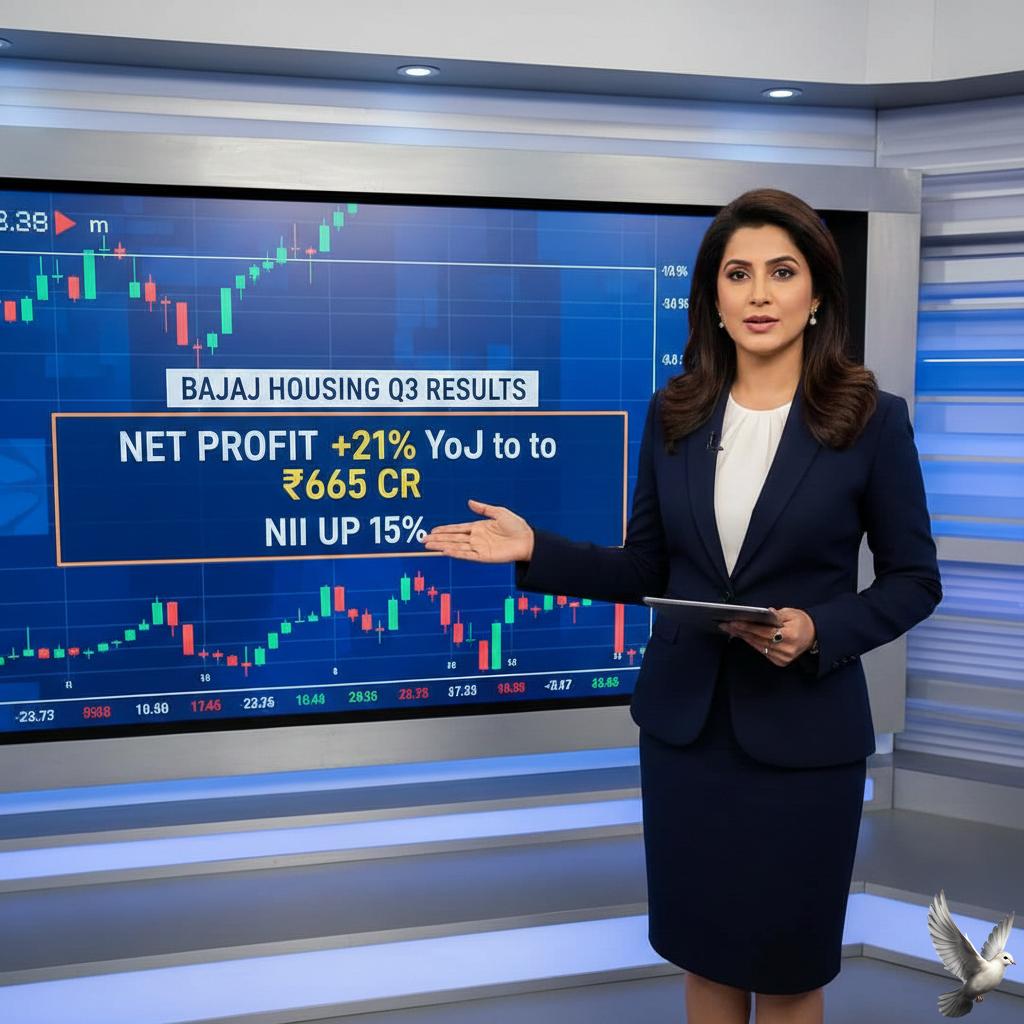
Bajaj Housing Q3 Results: Net Profit Rises 21% YoY to Rs 665 Crore, NII Up 15%
**Market Brief: Bajaj Housing Finance Q3 FY26 Performance** **Overview** Bajaj Housing Finance has delivered a robust set of numbers for the quarter ended December 31, 2025 (Q3 FY26), demonstrating strong growth momentum despite a challenging macro environment. The company reported a **21%** year-on-year (YoY) increase in net profit, supported by healthy loan disbursements and sustained momentum in Assets Under Management (AUM). While the bottom line was impacted by a one-time exceptional charge, core operating metrics remained resilient with improved asset quality and controlled operational costs. **Financial Highlights** The company’s Net Profit (Profit After Tax) climbed to **₹665 crore**, marking a **21%** rise compared to **₹548 crore** in the corresponding quarter of the previous fiscal year. This growth was driven principally by a strong expansion in the loan book and stable margins. * **Net Interest Income (NII):** The core income stream grew **19%** YoY to **₹963 crore**, up from **₹806 crore** in Q3 FY25. * **Total Revenue:** The company posted a revenue of **₹2,886 crore**, registering an **18%** growth. * **Net Total Income:** Rising **24%**, this metric stood at **₹1,153 crore**, reflecting the company’s ability to scale its income faster than its interest expenses. * **Profit Before Tax (PBT):** PBT grew **21%** YoY to **₹865 crore**. **Business Growth & AUM** Bajaj Housing Finance continues to aggressively expand its market footprint. Assets Under Management (AUM) surged **23%** YoY to cross the **₹1.33 lakh crore** milestone (up from **₹1.08 lakh crore** in Q3 FY25). Loan assets followed a similar trajectory, growing **23%** to stand at **₹1.17 lakh crore**. The sustained growth in AUM highlights the company's strong origination capabilities across its core segments—home loans and loans against property—despite competitive intensity in the housing finance sector. **Asset Quality & Provisions** The lender demonstrated commendable discipline in credit quality, reporting improvements in key asset quality ratios: * **Gross NPA (GNPA):** Improved to **0.27%** as of December 31, 2025, down from **0.29%** a year ago. * **Net NPA (NNPA):** declined to **0.11%** from **0.13%**, underscoring the high quality of the loan book. * **Provisioning:** The Provisioning Coverage Ratio (PCR) on Stage 3 assets stood at approximately **59%**. However, loan losses and provisions for the quarter increased to **₹56 crore** (versus **₹35 crore** in Q3 FY25), indicating a prudent approach to risk coverage. **Exceptional Item** The quarter’s profitability included the impact of a one-time exceptional item amounting to **₹13.14 crore**. This charge was attributed to an increase in gratuity liability necessitated by changes in the "New Labour Codes" issued by the Government of India in November 2025. Despite this charge, the company maintained a **20%+** profit growth trajectory. **Operational Efficiency** Cost discipline remained a key strength. The cost-to-income ratio (Operating Expenses to Net Total Income) improved to **19%** for the quarter, down from **20%** in the previous year, reflecting operating leverage kicking in as the AUM base expands. **Market Reaction & Stock Performance** Following the earnings announcement, the market reaction was muted. The stock closed the trading session slightly lower at **₹89.68**, down **0.06%**. * **Valuation Context:** The company maintains a strong capital adequacy ratio of **23.15%**, providing ample runway for future lending without immediate dilution risks. * **Analyst Sentiment:** Market observers are closely watching the net interest margin (NIM) trajectory and the impact of the new labor code regulations on long-term employee costs. **Summary** Bajaj Housing Finance’s Q3 FY26 scorecard reflects a "growth with quality" strategy. With AUM growing at **23%**, profit up **21%**, and asset quality at best-in-class levels (Net NPA **0.11%**), the company remains well-positioned to capitalize on the housing demand cycle, even as it navigates regulatory transitions and competitive pricing pressures.

Ather Energy Reports Narrowed Q3 Loss on Higher Sales
**Market Brief: Ather Energy Q3 FY26 Performance & Sector Update** **Date:** February 2, 2026 **Subject:** Financial Results Review and Competitive Landscape Analysis **Executive Summary** Ather Energy has reported a robust financial turnaround for the third quarter of Fiscal Year 2026 (ending December 2025). The company achieved its highest-ever quarterly revenue and significantly narrowed losses, driven by strong festive season demand and disciplined cost management. This performance consolidates Ather’s position as a top-three player in the Indian electric two-wheeler (E2W) market, amidst a major reshuffling of sector leadership. **Key Financial Highlights (Q3 FY26)** * **Revenue Surge:** Revenue from operations climbed to **₹995.7 crore**, marking a **53% year-on-year (YoY)** increase. This represents the company’s best quarterly topline performance to date. * **Loss Reduction:** Net loss narrowed sharply by **57%** to approximately **₹85 crore**, down from ₹198 crore in the same quarter last year. * **Profitability Metrics:** Adjusted Gross Margin (AGM) jumped **111% YoY** to **₹251.3 crore**. EBITDA margins improved significantly to **-3%**, approaching breakeven territory faster than projected. **Operational Performance** * **Sales Volume:** The company sold **67,851 units** during the quarter, a **50% YoY** growth. * **Market Share:** Ather now commands an **18.8%** share of the Indian E2W market. * **Regional Strength:** The brand continues to dominate South India with a **24.4%** market share and has doubled its penetration in central Indian markets to **17.4%**. * **Network Expansion:** The retail footprint expanded to **600 Experience Centres** nationwide, with 76 new outlets added in Q3 alone. **Competitive Landscape Update** The Indian E2W sector has witnessed a significant hierarchy shift as of early 2026: * **New Leadership:** Legacy players **TVS Motor Company** and **Bajaj Auto** have firmly secured the top two spots, leveraging their massive service networks and production scale. * **Ather’s Position:** Ather Energy retains a strong **3rd position**, distancing itself from smaller startups while closing the gap with legacy leaders. * **Ola Electric’s Decline:** Formerly the market leader, Ola Electric has slid to **5th place** (approx. 6% market share in Jan 2026), facing a 69% YoY volume drop due to service challenges and intensified competition. **Strategic Outlook** Ather is transitioning from a phase of hyper-growth to sustainable profitability. The company is actively expanding its manufacturing capabilities, with a third plant in Maharashtra expected to boost total annual capacity to over **1.4 million units**. With unit economics improving and losses shrinking, market sentiment suggests Ather is well-positioned to achieve operating breakeven in the coming quarters. *** **Next Step:** I can prepare a comparative valuation analysis of Ather Energy versus TVS Motor and Bajaj Auto to highlight relative stock performance and efficiency metrics.

Power Grid, Latent View Among Top 5 Market Movers on Monday
**Market Brief: Post-Budget Rebound** **Date:** February 2, 2026 Indian equity markets staged a robust recovery today, sharply reversing the losses from the **Budget-day sell-off**. Sentiment improved significantly as investors turned to value buying in blue-chip stocks, shrugging off concerns over the **STT hike** on derivatives announced yesterday. **Benchmark Performance** The **BSE Sensex** surged **944 points** (+1.17%) to close at **81,666**, while the **Nifty 50** climbed **263 points** (+1.06%) to reclaim the **25,000** mark, settling at **25,088**. The recovery was broad-based, though the **IT sector** remained under pressure. **Sectoral Movers** Gains were led by the **Auto** and **Metal** indices, which rose **2.1%** and **1.8%** respectively. Energy stocks also saw buying interest, aided by a decline in global crude oil prices. **Stocks in Focus** * **Power Grid Corporation:** Emerged as the top index gainer, rallying **7.6%**. The surge followed management’s decision to hike its **FY26 capex guidance** to **₹32,000 crore**. * **Latent View Analytics:** Witnessed high traction, jumping over **8%** with a significant spike in trading volumes, driven by strong Q3 earnings growth of **19% YoY**. * **Sundaram Finance:** Climbed nearly **6%** intraday after reporting robust **Q3 numbers**, with net profit rising **19%** to **₹541 crore**. **Key Takeaway** The sharp bounce-back indicates market resilience, with focus shifting rapidly from tax tweaks to corporate fundamentals and earnings visibility.

Promoters Reduce Stakes in 12 Stocks During December Quarter
**Market Brief: Promoters Trim Stakes Amidst Index Recovery** **Date:** February 2, 2026 **Market Snapshot** The Indian equity markets staged a robust recovery today, with the **Nifty 50** reclaiming the **25,000** mark to close near **25,080** (up ~1%), while the **Sensex** traded comfortably above **82,000**. Buying interest in capital goods and infrastructure, led by heavyweights like **Larsen & Toubro** (+2.7%) and **Asian Paints**, helped offset weakness in the IT and Healthcare sectors. **Promoter Trends: The December Shift** Recent data for the quarter ending **December 2025** highlights a cautious trend among corporate insiders. According to StockEdge, promoter shareholding declined in **12 Nifty 500 companies**. While the benchmark indices remain resilient, these stake reductions are critical indicators of insider sentiment. **Key Stake Reductions** Prominent names witnessed notable selling during Q3 FY26: * **Bharti Airtel:** Promoter holding slipped to **48.87%** (down from 50.27%), reflecting significant institutional absorption of equity. * **Bajaj Housing Finance:** Stake reduced to **92.44%** from **94.61%**, largely aligned with regulatory requirements to increase public float. * **OLA Electric Mobility:** Promoters trimmed their position to **57.41%** (previously 60.12%). * **Akzo Nobel India:** Holding dropped sharply to **30.59%** from **40.10%**. Other impacted counters include **Indian Overseas Bank**, **Bank of Maharashtra**, and **HFCL**, where promoters capitalized on valuations or adjusted holdings for compliance. **Strategic Implications** The trimming of stakes comes against the backdrop of the recently announced **Union Budget 2026**, which hiked the Securities Transaction Tax (STT) on Futures to **0.05%** and Options to **0.15%**. While some reductions—like those in PSU banks—may link to Minimum Public Shareholding (MPS) norms, discretionary sales in private entities like **Anant Raj** and **Choice International** suggest profit-booking after the recent bull run. **Investor Outlook** Despite the insider selling, domestic liquidity remains strong. The market has largely digested the STT hike, shifting focus back to earnings growth and capital expenditure themes. Investors are now closely watching if this promoter selling trend extends into the March 2026 quarter or if it was a one-time rebalancing act.

RBI Supports Rupee and Swaps Aid Liquidity Amid Bond Selloff
**Market Brief: Indian Rupee Stages Sharp Recovery Post-Budget** **Currency Performance** The Indian Rupee (INR) staged a significant recovery on Monday, logging its best single-day gain in recent weeks. The domestic unit appreciated by over **40 paise** to trade around **91.55** against the US Dollar, pulling back sharply from a record low of **92.00** touched in early trading. **Key Drivers** * **RBI Intervention:** Aggressive dollar sales by the Reserve Bank of India (RBI) were the primary catalyst, effectively defending the psychological **92.00** barrier. * **Budget Sentiment:** Market sentiment was buoyed by the Union Budget 2026-27, which projected a fiscal deficit of **4.3%** for FY27. This commitment to fiscal consolidation offset concerns regarding the higher-than-expected gross borrowing figure of **₹17.2 lakh crore**. **Market Context** While the currency market rallied, equities faced headwinds. The benchmark **BSE Sensex** remained under pressure, shedding over **1%** to trade near **81,186**, dampened by the announcement of a hike in the Securities Transaction Tax (STT) on derivatives. **Global & Regional Factors** * **Crude Oil:** Brent crude prices remained firm, trading up **1.3%** at **$69.30** per barrel, sustaining pressure on India's import bill. * **Dollar Index:** The greenback held steady near **96.16**, following the US Federal Reserve's decision to keep interest rates unchanged. **Outlook** The **92.00** mark remains a critical pivot. While the RBI's defense has stabilized the rupee temporarily, sustained global dollar strength and foreign portfolio outflows continue to pose downside risks in the near term.

Bajaj Finance Q3 Preview: NII and Profit Expected to Rise 20% YoY
Market Brief: Bajaj Finance Q3 FY26 Outlook **Earnings Expectations** Bajaj Finance is positioned for a steady operational quarter in Q3 FY26. Street estimates project **21%** year-on-year growth in Net Interest Income (NII) and approximately **20%** growth in Profit After Tax (PAT). Analysts anticipate these gains will be driven by robust loan expansion and stable margins, despite moderation in specific segments like MSME and mortgages. **Key Operational Metrics** Recent business updates indicate sustained momentum in asset accumulation. Assets Under Management (AUM) have swelled to approximately **₹4.86 lakh crore**, reflecting a **22%** annual increase. The lender continues to widen its reach, with its customer franchise expanding to over **115 million**. New loan bookings remained healthy, supporting the forecast for consistent top-line delivery. **Asset Quality & Margins** Credit costs are a focal point for investors, with expectations that they will ease to below **2%** (around **1.95%**) for the quarter. Gross Stage 3 assets are projected to remain stable at **1.2%**, with Net Stage 3 assets at **0.6%**, signaling manageable stress levels. Margins are likely to hold steady or improve marginally as borrowing costs moderate. **Market Reaction** Ahead of the earnings announcement scheduled for **February 3, 2026**, Bajaj Finance shares are trading near **₹902**, down approximately **2%** in recent sessions. The stock has seen a 52-week high of **₹1,102** and a low of **₹778**, with a current market capitalization of roughly **₹5.61 lakh crore**. Investor sentiment remains cautious but optimistic regarding the lender's ability to navigate slower growth in unsecured segments while capitalizing on strong consumer demand.

Gold Volatility Exceeds Bitcoin in Highest Price Swings Since 2008
**Market Brief: Historic Volatility Hits Precious Metals & Crypto** **Date:** February 2, 2026 **Gold** has entered a rare period of extreme turbulence, temporarily rivaling the instability typically associated with digital assets. In a historic market shock today, spot gold prices plummeted over **9%**, trading near **$4,403** per ounce. This marks the metal's steepest single-day decline since **1983**, driven by a liquidity crunch and forced selling. **Volatility Spike & Contagion** While **Bitcoin** also faced significant pressure—dropping to approximately **$76,000** following **$1.68 billion** in forced liquidations—gold’s volatility metrics have seen an unprecedented surge. The sudden correlation between the two assets stems from widespread margin calls; investors liquidated profitable gold positions to cover leveraging losses in crypto markets. **Economic Drivers** The sell-off was exacerbated by the nomination of **Kevin Warsh** as Federal Reserve Chair. viewed by markets as a "hawkish" signal. This triggered a sharp rally in the **US Dollar**, making dollar-denominated assets like gold more expensive globally. **Performance Outlook** Despite this immediate crash, gold has maintained a superior performance record over the trailing 12-month period. Having rallied nearly **65%** throughout 2025, it continues to outperform Bitcoin on an annual basis. While the "safe-haven" narrative is currently strained by this liquidity event, institutional sentiment largely views the metal's fundamental demand as intact compared to the speculative correction in the crypto sector. **Summary of Key Levels** * **Gold Spot:** ~$4,403 (Down >9% intraday) * **Bitcoin:** ~$76,000 (Testing 10-month lows) * **Key Trigger:** Fed Chair Nomination & Cross-asset Margin Calls

Sensex Adds 944 Points, Nifty Reclaims 25,000 Level in Post-Budget Market Recovery
**Indian Market Brief: Post-Budget Rebound** **Date: February 2, 2026** Indian equity markets staged a robust recovery on Monday, wiping out losses from the special Budget-day trading session. Investors shrugged off the steep hike in Securities Transaction Tax (STT) on derivatives announced in the Union Budget 2026, shifting focus to value buying and broader economic stability. **Benchmark Performance** The **BSE Sensex** surged **943.5 points** (+1.17%) to close at **81,666.46**, reclaiming the 81k mark. The **Nifty 50** followed suit, advancing **261 points** (+1.06%) to settle at **25,088.4**, comfortably crossing the psychological 25,000 level. **Key Drivers & Market Sentiment** * **Resilience Against Tax Hikes:** The rally defied the government's proposal to raise STT on Futures (from 0.02% to **0.05%**) and Options (from 0.1% to **0.15%**), a move intended to curb speculative trading. * **Broad-Based Recovery:** Buying interest was widespread, with **14 of 16** major sectoral indices logging gains. Small-cap and mid-cap indices rose **0.6%** and **1%** respectively, indicating returned risk appetite. * **Rupee Strength:** The Indian Rupee strengthened by **37 paise** to **91.56** against the US dollar, supported by retreating crude oil prices. **Top Movers** * **Gainers:** Heavyweights like **Reliance Industries**, **Larsen & Toubro**, and **Adani Ports** led the charge, with gains of up to **2.8%**. * **Laggards:** Consumption stocks faced pressure, with **Titan**, **ITC**, and **Hindustan Unilever** trading in the red. **Sectoral Highlights** * **Biopharma & Healthcare:** Continued momentum following the Budget's **₹10,000 crore** allocation for the Biopharma Shakti initiative. * **Data Centers & AI:** Tech stocks saw traction after tax holidays were proposed for foreign companies providing cloud services via Indian data centers. This session marks a swift turnaround from the sharp sell-off seen on Sunday, signaling that the market has largely priced in the new fiscal measures.

Power Grid Shares Gain 7% After Raising FY26 Capex Guidance to Rs 32,000 Crore
**MARKET BRIEF: POWER GRID CAPEX BOOST & Q3 EARNINGS** **Stock Surge & Market Reaction** Power Grid Corporation of India Limited (PGCIL) shares witnessed a sharp rally on Monday, February 2, 2026, trading with gains of over **4-7%** intraday. The stock price climbed above **₹260**, driven by renewed investor confidence in the company’s growth trajectory and raised capital expenditure targets. **Q3 FY26 Financial Highlights** The state-owned transmission utility delivered a robust performance for the quarter ended December 31, 2025: * **Net Profit:** Rose **8%** YoY to **₹4,185 crore**, reflecting operational efficiency. * **Revenue:** Jumped **~10%** YoY to **₹12,599 crore**, supported by higher asset capitalization and transmission income. * **Expenses:** Showed sequential moderation, aiding margin stability. **Guidance Upgrade: The Key Trigger** The primary catalyst for the rally was the management's decision to hike its execution guidance. * **Capex Target Raised:** The FY26 capital expenditure guidance has been increased to **₹32,000 crore**, up from earlier estimates. * **Execution Visibility:** The revision signals strong execution capabilities and a robust pipeline, particularly aligned with India's accelerated energy transition and infrastructure demand. **Dividend Announcement** Alongside the results, the Board declared a second interim dividend of **₹3.25** per equity share. The record date for the payout has been fixed as **February 9, 2026**. **Investor Outlook** Market sentiment remains positive as the raised capitalization targets alleviate concerns regarding growth saturation. With the power sector entering a high-investment phase for renewables and grid modernization, Power Grid’s aggressive capex push is viewed as a strategic pivot toward sustained long-term value creation.

Nithin Kamath: STT Hike May Impact Trading Volumes Without Curbing F&O Speculation
**Market Brief: STT Hikes & The Derivatives Dilemma** **Context** Following the Union Budget 2026 announcement, Zerodha CEO Nithin Kamath has issued a sharp critique of the continued increase in Securities Transaction Tax (STT) on equity derivatives. His comments come as the government proposes yet another steep hike, aiming to curb excessive retail speculation in the F&O segment. **The New Fiscal Reality** The latest Budget (Feb 2026) proposes raising STT rates significantly effective April 1, 2026: * **Futures:** Increased to **0.05%** (from 0.02%). * **Options Premium:** Increased to **0.15%** (from 0.1%). This marks the second major hike in two years, following the October 2024 revision. The cumulative impact has made trading costs exponentially higher for high-frequency traders and hedgers. **Revenue Paradox** Kamath highlights a critical disconnect between tax rates and actual revenue. Despite previous hikes intended to boost collections, government data reveals a shortfall. * **Projected STT Collection (FY26):** ₹78,000 crore. * **Actual Collection (Est.):** ~₹57,000 crore (approx. **25%** deficit). Kamath argues that the "Laffer curve" effect is setting in—higher taxes are shrinking the volume base, leading to lower-than-expected total revenue. **Impact on Market Structure** The "Death of Futures" is a primary concern. The tax structure now heavily disincentivizes futures trading, which is essential for price discovery and hedging. * **Volume Shift:** Traders are migrating further into low-premium options (buying "lottery tickets") where transaction costs are perceived as less burdensome relative to potential (but rare) outsized gains. * **Liquidity Drain:** Higher costs are forcing liquidity providers and arbitrageurs to widen spreads or exit, potentially increasing volatility during stress periods. **Regulatory vs. Fiscal Control** Critiquing the reliance on tax as a behavioral deterrent, Kamath suggests that fiscal penalties fail to address the root cause of speculation. Instead, he advocates for **product suitability norms**—strict regulatory frameworks that ensure only qualified investors with adequate capital and risk tolerance can access leveraged derivatives. **Market Outlook** Retail participation has already seen a **~20%** decline in turnover following SEBI’s earlier tightening measures (increased lot sizes and limited weekly expiries). With the new tax regime, industry experts anticipate a further consolidation of volumes, potentially making the market more expensive and less efficient for genuine hedgers.

Union Budget 2026: Focus on Capacity Building and Economic Growth
**Union Budget 2026: Market & Fiscal Brief** **Executive Summary** Finance Minister Nirmala Sitharaman presented the Union Budget 2026-27 yesterday, outlining a strategy focused on fiscal consolidation and infrastructure-led growth. The total budget size is pegged at **₹53.5 lakh crore**, with a clear intent to maintain macroeconomic stability while aggressively funding capital assets. **Fiscal Mathematics** * **Fiscal Deficit:** Targeted at **4.3%** of GDP for FY27, a marginal improvement from the **4.4%** revised estimate for FY26. * **Capital Expenditure:** Public capex raised to **₹12.2 lakh crore** (up from ₹11.2 lakh crore), signaling a continued push for asset creation. * **Total Receipts:** Non-debt receipts estimated at **₹36.5 lakh crore**, with net tax receipts projected at **₹28.7 lakh crore**. **Market Reaction & Taxation** Markets reacted sharply to the budget announcement. * **Indices:** The Sensex plunged over **1,800 points** (~2.2%) and Nifty fell nearly **600 points** on Budget day (Sunday session), primarily driven by a hike in Securities Transaction Tax (STT). * **STT Hike:** STT on Futures increased from 0.02% to **0.05%**; Options raised from 0.1% to **0.15%**. * **Income Tax:** No changes to existing tax slabs, though a new Income Tax Act will be implemented from April 1, 2026, aimed at simplification. * **Recovery:** Early trading today (Feb 2) shows a slight rebound as value buying emerges in blue-chip stocks. **Sector Allocations & Key Initiatives** * **Agriculture:** Allocation increased to **₹1.63 lakh crore**. Launch of "Bharat Vistar," a multilingual AI tool for farmers, and a focus on high-value crops like cashew and coconut. * **Defense & Security:** Home Ministry allocated **₹2.55 lakh crore** (9% increase). Defense retains a major share (11%) of total expenditure. * **Infrastructure:** **7 new high-speed rail corridors** proposed along with a dedicated Surat-Dankuni freight corridor. * **Biopharma:** New "Biopharma Shakti" scheme introduced with an outlay of **₹10,000 crore** to boost domestic biologics production. * **Technology:** Launch of ISM 2.0 to strengthen the semiconductor ecosystem and a tax holiday for global data centers. **Strategic Roadmap** The budget reinforces a "confident and fiscally disciplined" approach. By holding the deficit line at 4.3% while expanding the capex kitty to **₹12.2 lakh crore**, the government aims to crowd in private investment without overheating inflation. The focus remains on long-term resilience through digital capacity building and high-multiplier infrastructure spending.

Silver Plunges 41% and Gold Drops Over 25% in Three-Day Decline
**MARKET BRIEF: PRECIOUS METALS CORRECTION DEEPENS** **Market Action** Gold and silver prices have extended a violent correction following a historic speculative rally. The momentum-driven advance—which saw gold gain **65%** and silver **148%** in 2025—has reversed sharply due to aggressive profit-taking and liquidity events. **Current Pricing (Approximate)** * **Spot Gold:** Trading near **$4,680** per ounce, down significantly from the recent peak of **$5,600**. * **Spot Silver:** Hovering around **$79.60** per ounce, collapsing from highs of **$121**. * **MCX Gold:** Struggling near **₹1,45,000** per 10g. * **MCX Silver:** Trading around **₹2,50,000** per kg after testing lower circuits. **Key Drivers** * **Fed Leadership:** The US Dollar strengthened following reports of President Trump nominating **Kevin Warsh** as the next Federal Reserve Chair. His perceived hawkish stance on inflation and balance sheet reduction has dampened appetite for non-yielding assets. * **Margin Hikes:** Exchanges, including the CME, have raised margin requirements (Gold to **~8%**, Silver steeper) to curb excessive speculation, forcing leveraged traders to liquidate positions. * **Equity Contagion:** A tech-led selloff in US equities (driven by AI capex concerns) triggered a "dash for cash," exacerbating the slide in precious metals. * **Domestic Factors:** In India, prices dipped further post-**Union Budget 2026**, with no major duty relief to support immediate buying. **Analyst Sentiment** While short-term technical indicators signal "Strong Sell" with volatility remaining elevated, many analysts view this as a necessary consolidation within a structural bull market. Support is currently being tested at **$4,600** for gold and **$75** for silver. The consensus suggests waiting for stability rather than catching the falling knife, though the long-term case for real assets remains intact amidst global debt concerns. ***

Impact of STT Hike on Futures and Options Traders
**Union Budget 2026: Derivative Tax Hike Triggers Market Sell-Off** **Date:** February 2, 2026 The Union Budget 2026-27, presented on **February 1, 2026**, delivered a significant policy shift for India's capital markets with a sharp increase in the Securities Transaction Tax (STT) on derivative instruments. The announcement, intended to curb excessive speculative activity, led to an immediate negative reaction across benchmark indices and brokerage sectors during the special Sunday trading session. **Policy Update: STT Revisions** Finance Minister Nirmala Sitharaman announced a steeper tax structure for the Futures and Options (F&O) segment, effective from the next financial year. * **Futures:** STT raised to **0.05%** from the previous **0.02%**. * **Options:** STT on options premium increased to **0.15%** from **0.10%**. The revisions aim to moderate the "unchecked explosion" of retail participation in derivatives, which regulators have flagged as a systemic risk. The move effectively raises the breakeven point for traders, making high-frequency and scalping strategies significantly more expensive. **Market Reaction: Sharp Correction** Indian equity markets witnessed their worst Budget-day performance in six years. The benchmark indices erased early gains to close deep in the red, reflecting widespread risk-off sentiment. * **Sensex:** Plunged **1,547 points** (**-1.88%**) to close at **80,723**. * **Nifty 50:** Shed **495 points** (**-1.96%**) to end below the psychological 25,000 mark at **24,825**. * **Wealth Erosion:** Approximately **₹10 lakh crore** of investor wealth was wiped out in a single session. **Sector Impact: Brokerages and Exchanges Hit** Stocks of market intermediaries bore the brunt of the sell-off, as higher transaction costs are expected to dampen trading volumes—a key revenue driver for these firms. * **BSE Ltd:** Tanked **10.04%**. * **Angel One:** Slid **9.96%**. * **Groww (Billionbrains Garage Ventures):** Dropped approximately **8.7%**. **Outlook: Liquidity and Foreign Flows** The tax hike has renewed concerns regarding liquidity and foreign investor participation in India's derivatives market, one of the largest globally by volume. Analysts warn that the increased friction costs could temper Foreign Institutional Investor (FII) flows, particularly from high-frequency trading desks. While the government clarified that the intent is volume moderation rather than revenue maximization, the immediate market sentiment remains fragile. Participants are now assessing whether the higher costs will drive a structural shift from short-term speculative trading toward long-term delivery-based investing.

Biocon Biologics Highlights Role of Biopharma SHAKTI in India’s Biosimilar Sector
**MARKET BRIEF: India Biopharma & Budget 2026 Update** **Policy Spotlight: Biopharma SHAKTI** The Union Budget 2026-27 has unveiled the **₹10,000 crore** Biopharma SHAKTI programme, a decisive move to transition India from a generics powerhouse to a global leader in biologics and innovation. Allocated over the next **5 years**, this initiative targets the critical shift toward high-value biopharmaceuticals. The programme prioritizes three key pillars: * **Innovation Ecosystem:** Establishment of **3** new National Institutes of Pharmaceutical Education and Research (NIPERs) and upgrading **7** existing institutions to foster high-end research. * **Clinical Infrastructure:** Creation of a network of **1,000** accredited clinical trial sites to accelerate drug development and regulatory approvals. * **Manufacturing Scale:** Direct support for domestic production of complex biologics and biosimilars, reducing import dependence for cancer, diabetes, and autoimmune treatments. **Market Pulse & Key Data** The announcement comes as the Indian pharmaceutical market crosses significant milestones. * **Market Size:** Valued at approximately **$55 billion** in 2025, the sector is on track to reach **$120–130 billion** by 2030. * **Biosimilars Growth:** The domestic biosimilars segment is estimating a surge to **$12 billion** in 2025, growing at a CAGR of **22%**. * **Export Performance:** Pharmaceutical exports reached **$30.38 billion** (₹2.59 lakh crore) in FY25, with drug formulations and biologicals accounting for **75%** of shipments. * **CDMO Opportunity:** The Contract Development and Manufacturing Organization (CDMO) segment is projected to double to **$14 billion** by 2028. **Industry Implications** Market reaction has been swift and positive. Industry leaders view the SHAKTI programme as a validation of the "Volume to Value" strategy. The focus on non-communicable diseases aligns with shifting global healthcare demand, where patented drugs worth over **$270 billion** are losing exclusivity, opening a massive window for Indian biosimilars. The expanded clinical trial network addresses a long-standing bottleneck, potentially reducing approval timelines and attracting global R&D investments. With the government targeting a **$300 billion** bioeconomy by 2030, this policy provides the necessary capital and structural support to move up the value chain.

REITs Gain as Budget 2026 Proposes Recycling CPSE Real Estate Assets
**Market Brief: Budget 2026 & REIT Sector Update** **Date:** February 2, 2026 **Sector Focus:** Real Estate Investment Trusts (REITs) **Key Development** In the Union Budget 2026-27 presented yesterday, Finance Minister Nirmala Sitharaman proposed the creation of dedicated **Real Estate Investment Trusts (REITs)** for Central Public Sector Enterprises (CPSEs). The move aims to accelerate the monetization and "recycling" of significant land and real estate assets held by public sector entities, turning idle properties into income-generating financial instruments. **Market Reaction (Feb 1–2, 2026)** While the broader indices (Sensex and Nifty) faced downward pressure due to the hike in Securities Transaction Tax (STT) on F&O trades, the REIT sector emerged as a resilient outlier. * **Brookfield India Real Estate Trust:** Led the gains, surging approximately **2–3%** to trade near **₹360** levels. * **Embassy Office Parks REIT:** Showed positive momentum with gains around **1.3%**, trading near **₹436–439**. * **Nexus Select Trust:** Remained steady around **₹158**, benefiting from the positive sectoral sentiment despite broader market volatility. * **Mindspace Business Parks REIT:** Posted marginal gains, reflecting stability amidst the sell-off in other equities. **Strategic Impact** * **Asset Monetization:** The government intends to unlock value from vast CPSE land banks in prime urban locations, which were previously underutilized. * **Market Depth:** The entry of government-backed assets is expected to significantly expand the Indian REIT market, which currently has a gross asset value of over **₹2.3 trillion**. * **Investor Opportunity:** Retail investors will gain access to high-quality, government-anchored yield assets, offering a stable alternative to traditional fixed-income instruments. **Outlook** The announcement validates the REIT structure as a preferred vehicle for infrastructure financing. Analysts expect this to improve liquidity and attract long-term institutional capital into Indian real estate, decoupling the sector from short-term equity market volatility. **Next Step** I can generate a comparative performance chart of India's top listed REITs over the last 48 hours to visualize their divergence from the Nifty 50.

Defence Stocks Fall Despite 18% Capex Hike in Budget 2026
**Market Brief: Defence Sector Correction Post-Budget 2026** **Trend:** Defence stocks witnessed a sharp sell-off on Budget day (February 1, 2026), decoupling from the record budgetary allocation. The correction is attributed to a classic "sell on news" sentiment, stretched valuations, and the broader impact of the Securities Transaction Tax (STT) hike. **Budget 2026-27: The Key Figures** Despite the market reaction, the underlying allocations remain robust: * **Total Defence Budget:** Raised to **₹7.85 lakh crore**, up from ₹6.81 lakh crore in the previous fiscal. * **Capital Outlay (Modernisation):** Increased by approximately **18%** to **₹2.19 lakh crore**, aimed at acquiring new platforms and boosting indigenous production. * **Strategic Focus:** Emphasis on drone technology, anti-drone systems, and securing long-term procurement deals for the Navy and Air Force. **Why the Stocks Fell** While the capital injection was significant, it failed to surpass the "hyper-bullish" estimates already priced into the stocks. * **Profit Booking:** After a multi-year rally, investors utilized the event to book profits as the allocation was largely anticipated. * **STT Dampener:** A steep hike in STT on derivatives spooked broader sentiment, triggering a risk-off move in high-beta sectors like defence. * **F&O Options:** STT hiked to **0.15%** (from 0.1%). * **F&O Futures:** STT hiked to **0.05%** (from 0.02%). **Sector Watchlist** Key heavyweights saw corrections of **4–5%** intraday: * **Hindustan Aeronautics Ltd (HAL)** * **Bharat Electronics Ltd (BEL)** * **Mazagon Dock Shipbuilders** * **Bharat Dynamics Ltd (BDL)** * **Paras Defence** **Analysis:** The fundamentals remain intact with a strong order book pipeline, but the short-term trend indicates a cooling off in valuations as the market digests the higher tax on trading and the absence of "surprise" big-ticket announcements. I can set up a price alert for these defence majors to notify you when they stabilize near key support levels.

Budget Prioritizes Cautious Continuity Over Bold Reforms
**Union Budget 2026-27: Market Brief** **Core Analysis: Stability Over Reform** The Union Budget presented on **February 1, 2026**, is characterized as "unremarkable" by Economist Swaminathan Aiyar. The government prioritizes macroeconomic stability amid strong growth, eschewing bold structural overhauls for cautious continuity. While the administration avoided major legislative risks—such as the abolition of the fertiliser subsidy—it introduced numerous small-scale changes that may increase compliance complexity rather than simplification. **Fiscal & Capital Expenditure** * **Fiscal Deficit:** The target for FY27 is set at **4.3%** of GDP, a marginal consolidation from the revised estimate of **4.4%** in FY26. * **Capex Push:** Public capital expenditure sees a **9%** increase, rising to **₹12.2 lakh crore** from ₹11.2 lakh crore previously. * **Taxation:** A new Income Tax Act, 2025 will be effective from **April 1, 2026**. **Market Reaction: Volatility & STT Hike** Markets reacted negatively to the announcement, primarily driven by a hike in the Securities Transaction Tax (STT) on derivatives. * **Indices:** The Sensex fell **1,546 points** (-1.88%) to close at **80,722**, while the Nifty dropped roughly **2%** to settle at **24,825**. * **Derivatives Tax:** STT on Futures increased to **0.05%** and Options to **0.15%**, triggering a sell-off in brokerage and exchange-related stocks. **Sectoral Impact** Measures for specific sectors (MSMEs, biotechnology, rare earths) are viewed as politically necessary but economically modest. The approach involves minor tweaks across nearly 100 sub-sectors rather than a singular, transformative policy push. This strategy reflects a government confident in the existing **7%** growth trajectory, opting to avoid disruptive reforms in the current election cycle phase. [Reform, Rebuild, Rise: Swaminathan Aiyar on Union Budget](https://www.youtube.com/watch?v=mmDNDeYwyC0) This video features Economist Swaminathan Aiyar providing a detailed breakdown of the Union Budget 2026, expanding on his "unremarkable" verdict and analyzing the fiscal numbers mentioned above. http://googleusercontent.com/youtube_content/0